Question
What do you understand by 'parametric shift of a line'? How does a line shift when its:
  1. Slope decreases,
  2. Its intercept decreases?

Answer

Movement along a curve vs shift of a curve.

Let $\text{C}=\bar{\text{C}}+\text{bY}$ be the consumption function

Also Let $\bar{\text{C}}=5$ and b = 0.75

Thus, C = 5 + 0.75Y

Consider two situations:

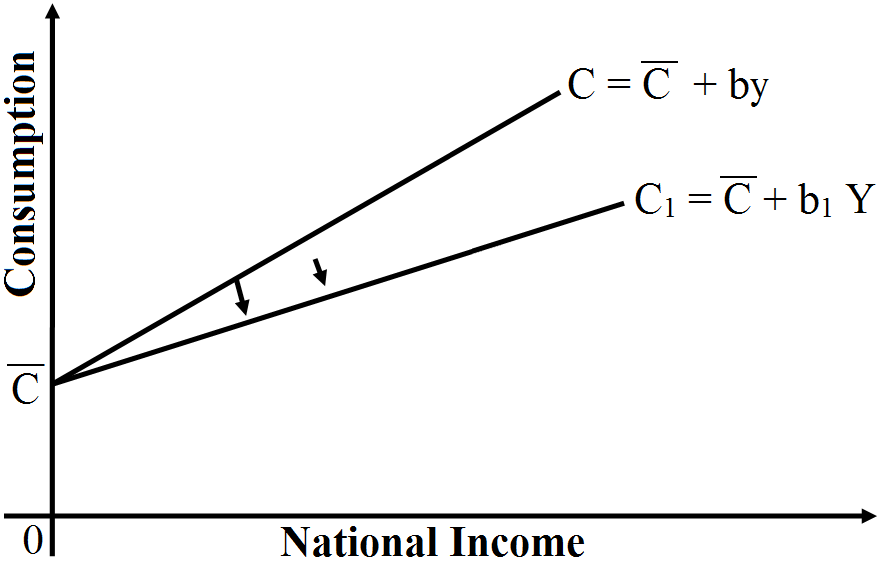
  1. When b decreases: b is the slope of the consumption curve. When b increases from 0.75 to 0.5, then consumption curve (which is a straight line) pivots downwards. This is called a parametric shift of a graph. It is shown in the given figure:

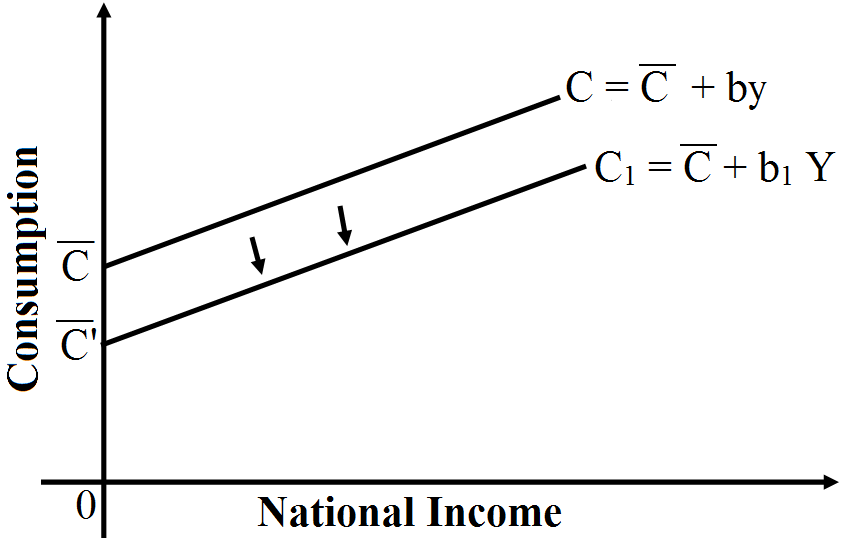
  1. When $\bar{\text{C}}$ decreases: It is the autonomous part of the consumption function. It graphically gives the intercept of the consumption curve. If decreases from 5 to 3, there will be parallel downward shift in the consumption curves. It is shown in the given figure:

Thus, when slope changes, there is parametric shift in the curve. When intercept changes, there is parallel shift in the curve.

Need a full question paper?

Generate a complete, print-ready paper with questions like this in minutes — across 16+ boards, with answer keys.

Start Generating Free

Similar questions

Explain how ‘bank rate’ is helpful in controlling credit creation?
A firm can sell more units of a good as it wants at a given price. Draw (a) TR curve (b) AR and MR curves of a firm. State the relationship between AR and MR curves in this case.

OR

Draw TR and MR curves of a firm which is free to sell any quantity of the good at a given price. Explain.

An economy is in equilibrium. Calculate the Marginal Propensity to Save from the following:
National Income = 1,000
Autonomous Consumption = 100
Investment = 120
The price elasticity of demand of a commodity is (-)1.5. When its price falls by ₹ 1 per unit its quantity demanded rises by 3 units. If the quantity demanded before the price change was 30 units, what was the price at this demand?
From the following data calculate net value added at factor cost:
S. No.
 
(₹in Lakhs)
(i)
Net factor income from abroad.
30
(ii)
Sales.
3,500
(iii)
Purchase of intermediate goods.
2,000
(iv)
Consumption of fixed capital.
500
(v)
Exports.
400
(vi)
Indirect taxes.
350
(vii)
Change in stock.
50
Which of the following is/are included in the revenue budget of the government? Give reasons for your answer.
  1. Tax revenue.
  2. Non-tax revenue.
  3. Loans received from foreign governments.
  4. Small savings.
  5. Interest payments.
From the following table, calculate average variable cost of each given level of output:
Output
Marginal Cost
1
80
2
70
3
72
4
78
Giving reasons, explain the treatment assigned to the following while estimating national income:
  1. Family members working free on the farm owned by the family.
  2. Payment of interest on borrowings by general government.
State the distinction between explicit cost and implicit cost. Give an example of each.
A consumer spends Rs. 1000 on a good priced at Rs. 8 per unit. When price rises by 25 percent, the consumer continues to spend Rs. 1000 on the good. Calculate price elasticity of demand by percentage method.