Question
What do you understand by shape selective catalysis? Why are zeolites good shape selective catalysts?

Answer

The catalytic reaction which depends upon the pore structure of the catalyst and the size of the reactant and product molecules is called shape selective catalysis. Zeolites are good shape selective catalysts because of their honey comb like structures.
  1. Zeolites are microporous aluminosilicates of the general formula $\text{M}\frac{\text{x}}{\text{n}}[(\text{AlO}_2)_\text{x}(\text{SiO}_2)_\text{y}]\text{m}\text{H}_2\text{O}$
  2. Zeolites have an enormous surface area which is largely on the inside of the solid. The zeolites can permit the entry and exit of molecules of a certain size into the active regions within the holes.
  3. They are used in petrochemical industries for cracking of hydrocarbons and isomerization.
  4. The reactions in zeolites depend upon the size of the cavities (cages) and pores (tunnels) present in them. The pore size in zeolites generally varies between 260 pm and 740 pm.
  5. Zeolite catalyst known as ZSM-5 converts alcohols to gasoline. The alcohol is dehydrated in the cavities and the hydrocarbons are formed.

Need a full question paper?

Generate a complete, print-ready paper with questions like this in minutes — across 16+ boards, with answer keys.
Start Generating Free

Similar questions


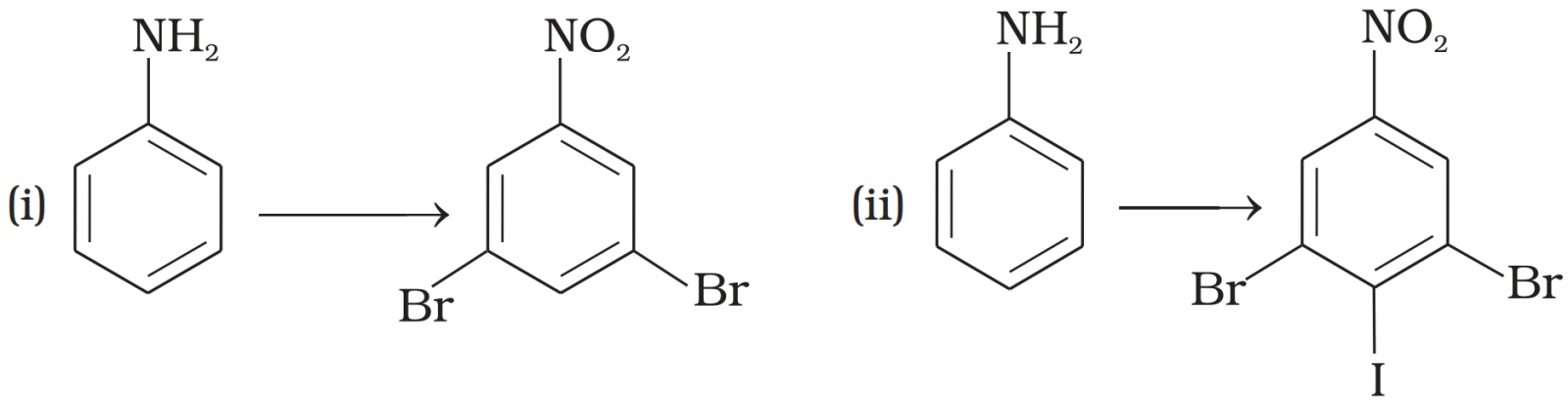
How will you carry out the following conversions?
Discuss aldol condensation in detail.
What are the classification of proteins on the basis of molecular shape?
  1. Account for the following:
i. Mn shows the highest oxidation state of +7 with oxygen but with fluorine it shows the highest oxidation state of +4 .
ii. $Cr ^{2+}$ is a strong reducing agent.
iii. $Cu ^{2+}$ salts are coloured while $Zn ^{2+}$ salts are white.
  1. Complete the following equations:
    1. $2\text{MnO}_{2} + 4\text{KOH} + \text{O}_{2} \xrightarrow{\Delta}$
    2. $\text{Cr}_{2}\text{O}^{2-}_{7}+ 14\text{H}^{+} + 6\text{I}^{-}\rightarrow.$
Assign reasons for the following:
i. The enthalpies of atomisation of transition elements are high.
ii. The transition metals and many of their compounds act as good catalyst.
iii. From element to element the actinoid contraction is greater than the lanthanoid contraction.
iv. The $E ^0$ value for the $Mn ^{3+} / Mn ^{2+}$ couple is much more positive than that for $Cr ^{3+} / Cr ^{2+}$.
v. Scandium $(Z=21)$ does not exhibit variable oxidation states and yet it is regarded as a transition element.
The rate constant for the first order decomposition of $H_2O_2$​​​​​​​ is given by the following equation:
log $k = 14.34 – 1.25 \times 10^4K/T$
Calculate $E_a​​​​​​​$​​​​​​​ for this reaction and at what temperature will its half-period be $256$ minutes?
(i). Write the structures of main products when benzene diazonium chloride $\left( C _6 H _5 N_2^{+} Cl ^{-}\right)$ reacts with the following reagents.
a. $HBF _4 / \Delta$
b. $Cu / HBr$
(ii). Write the structures of A, B and C in the following reactions:
a. $C _6 H _5 NO _2 \xrightarrow{ Sn / HCl } A \xrightarrow[\Delta]{ NaNO _2+ HCl } B \xrightarrow{273 K} H$
b. $CH _3 Cl \xrightarrow{ KCN } A \xrightarrow{ LiAlH _4} B \xrightarrow[273 K]{\stackrel{273 K}{ HNO }{ }_2} C$
Explain valence bond theory for coordination compounds.
Define the following modes of expressing the concentration of a solution. Which of these modes are independent of temperature and why?
  1. w/w (mass percentage)
  2. V/V (volume percentage)
  3. w/V (mass by volume percentage)
  4. ppm. (parts per million)
  5. x (mole fraction)
  6. M (Molarity)
  7. m (Molality)

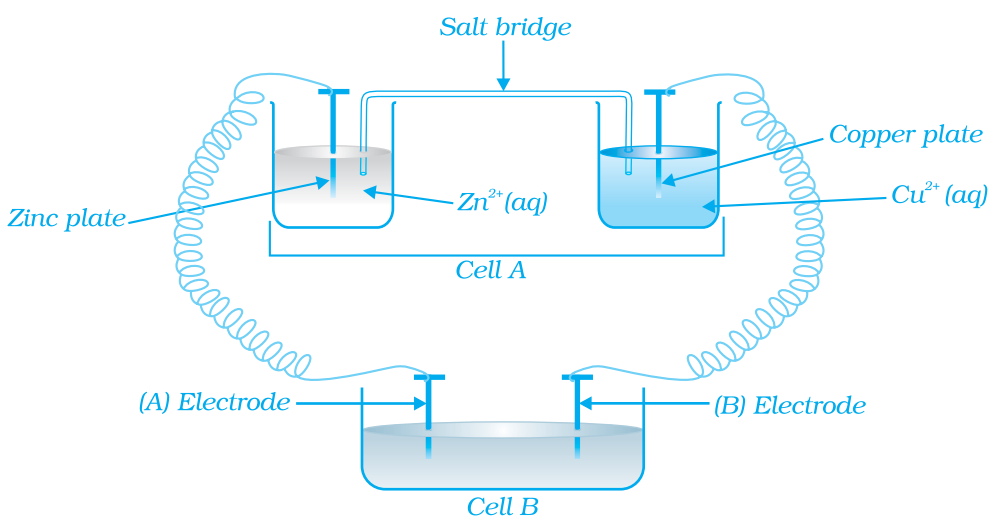
Consider the and answer the following questions.

i. Cell 'A' has $E_{\text {Cell }}=2 \mathrm{~V}$ and Cell 'B' has $E_{\text {Cell }}=1.1 \mathrm{~V}$ which of the two cells ' $A$ ' or ' $B$ ' will act as an electrolytic cell. Which electrode reactions will occur in this cell?
ii. If cell 'A' has $E_{C e l l}=0.5 \mathrm{~V}$ and cell 'B' has $E_{C e l l}=1.1 \mathrm{~V}$ then what will be the reactions at anode and cathode?