Question
What happens to the demand of a good when consumer's income changes? Explain.
Answer

The quantity of a good that the consumer demands can increase or decrease with the rise or fall in income depending on the nature of the good.
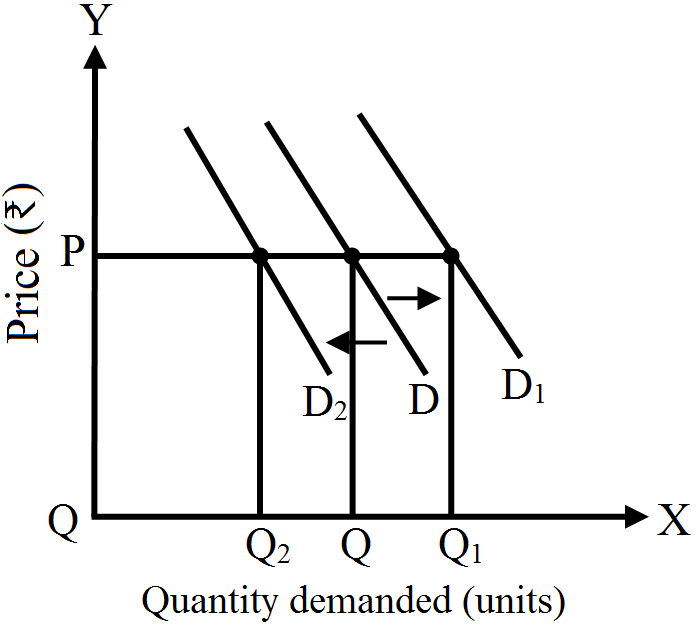
  1. Normal Goods: These are the goods for which the demand is directly related to consumer's income. Other things remaining constant, demand for these goods increases in response to increase in consumer's income and vice-versa, e.g. full cream milk, pulses, grains, etc. The given figure illustrates the income effect in case of normal goods. When income increases, the demand curve $D$ shifts to right to $D_1$​​​​​​​ and when income decreases, the demand curve D shifts to left to $D_2.$
  1. Inferior Goods: These are the goods for which the demand is inversely related to consumer's income. Other things remaining constant, demand for these goods decreases in response to increase in income and vice-versa, e.g. coarse cereals, toned milk, etc.


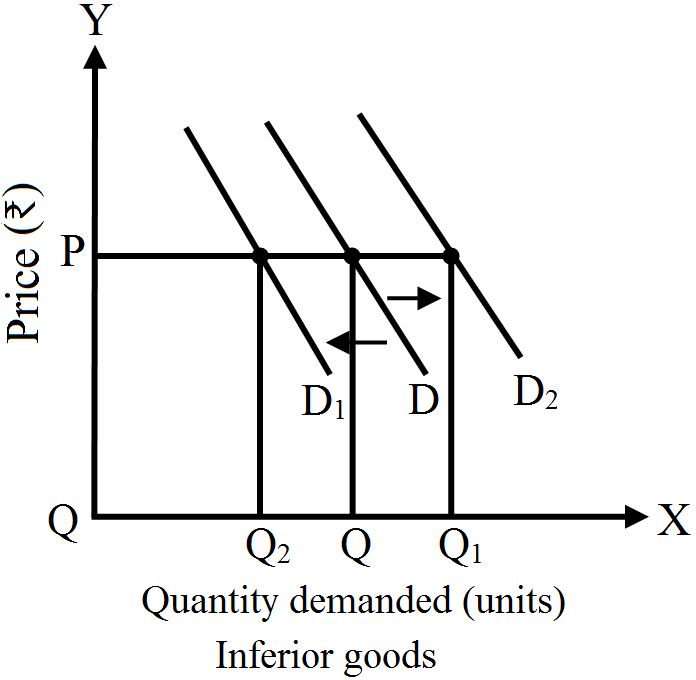
The given figure Quantity demanded (units) illustrates the Inferior goods income effect in case of inferior goods. When income increases, the demand curve $D$ shifts to left to $D_1​​​​​​​$ and when income decreases, the demand curve $D$ shifts to right to $D_2$​​​​​​​. In case of normal goods, income effect is positive while in case of inferior goods, income effect is negative.

Need a full question paper?

Generate a complete, print-ready paper with questions like this in minutes — across 16+ boards, with answer keys.

Start Generating Free

Similar questions

Explain the conditions of consumer’s equilibrium under indifference curve approach.
Total fixed cost is 90, complete the following table:
Output
1
2
3
MC
10
20
15
AVC (₹)
-
-
-
What change in total revenue will result in:
  1. A Decrease in marginal revenue.
  2. An increase in marginal revenue?
  1. What is a budget line? What does the point on it indicate in terms of prices?
  2. A consumer consumes only two 2 pieces of goods X and Y. Her money income is 24 and the prices of pieces of goods X and Y are 24 and 2 respectively.
Answer the following questions:
  1. Can the consumer afford a bundle 4X and 5Y? Explain.
  2. What will be the MRS. when the consumer is in equilibrium? Explain.
Explain with the help of a diagram, the effect of a decrease in the supply of a commodity on its equilibrium price and quantity.
OR
Explain the chain of effects of decrease in supply of a good on its price, supply and demand. Use diagram.
A seller sells 3 diamond rings of ₹ 15000 each. If a seller sells his 4th diamond ring, his MR becomes ₹ 13500. Calculate the price at which the seller sells his fourth ring.
Total revenue is 400 when the price of the commodity is 2 per unit. When price rises to 3 per unit, the quantity supplied is 300 units. Calculate the price elasticity of supply.
Differentiate between decrease in supply and contraction in supply (decrease in quantity supplied).
Show that AR curve and demand curve are the same.
Due to $10$ percent rise in the price of a commodity, its quantity supplied rises from $400$ units to $450$ units. Calculate its price elasticity of supply.