Question
What is a Bank Reconciliation Statement? Explain any four points regarding need and importance of preparing a Bank Reconciliation Statement.

Answer

Bank Reconciliation Statement is a statement prepared by the account holder on a particular date to reconcile the bank balance as per Cash Book with the balance as per Bank Statement or Bank Pass Book showing entries because of which differences between the two balances exist.
By Patil- "Bank reconciliation statement is a statement prepared mainly to reconcile the difference between the Bank Balance shown by the Cash Book and Bank Pass Book.''
Need and Importance of Bank Reconciliation Statement
It is essential to prepare a bank reconciliation statement due to the following reasons:
  1. A bank reconciliation statement locates the errors or omissions that may have been committed either on the part of the customer or the bank. The errors so detected can be rectified accordingly.
  2. By preparing a bank reconciliation statement, the customer becomes sure of the correctness of the bank balance shown by the cash book. It helps him in making further transactions with the bank. For example, suppose the cash book shows a bank balance of ₹ 20,000, whereas the balance shown by the pass book is ₹ 15,000. By reconciling the two, it is disclosed that cheques for ₹ 5,000 were deposited into the bank but have not been collected so far (or some of these have been dishonoured). In such a case, further cheques will be issued by assuming the bank balance of ₹ 15,000 only.
  3. A reconciliation statement facilitates the preparation of a revised cash book. For example, the entries relating to bank charges, interest allowed or charged by the bank, direct payment by the bank on our behalf etc. will be recorded in the pass book but for which there is no entry in the cash book. Such entries will now be recorded in the cash book as well.
  4. Periodic preparation of this statement reduces the chances of embezzlement by the staff of the firm or even that of the bank. For example, if a cashier merely makes an entry in the cash book but does not deposit the cash and cheques into the bank, it will be disclosed by preparing a bank reconciliation statement.
  5. A reconciliation statement helps in revealing the unnecessary delay in the collection of cheques by the bank.
  6. It also helps in keeping a track of cheques which have been sent to the bank for collection.

Need a full question paper?

Generate a complete, print-ready paper with questions like this in minutes — across 16+ boards, with answer keys.

Start Generating Free

Similar questions

Show the effect of the following transactions and also prepare a Balance Sheet:
  1. Started business with cash ₹ 60,000.
  2. Rent received ₹ 2,000.
  3. Accrued interest ₹ 500.
  4. Commission received in advance ₹ 1,000.
  5. Amount withdrawn ₹ 5,000.
[Hint: Capital = Opening Capital ₹ 60,000 + Rent Received ₹ 2,000 + Accrued Interest ₹ 500 - Drawings ₹ 5,000 = ₹ 57,500.]
What is a journal? Give a specimen of journal showing at least five entries.
A Book-keeper finds that the totals of his trial balance disagree by ₹ 2,800. He temporarily debits a Suspense Account with this amount and closes the books. On an examination of the books, the following errors are discovered:-
  1. The total of Purchase Return Book ₹ 710 was posted Twice.
  2. Goods costing ₹ 800 were distributed as free samples but no entry was passed in the books.
  3. Purchase of Machinery for ₹ 5,600 on credit was recorded in Purchase Book as ₹ 6,500.
  4. Cash Sales to Ram Lal for ₹ 1,200 were recorded in Cash Book as well as in Sales Book and were posted from both.
  5. Closing Stock has been overvalued by ₹ 1,500.
  6. Sales Return Book was untotalled, though personal accounts were posted ₹ 1,580.
  7. No entries have been made in the Cash Book for the Insurance Premium directly paid by bank ₹ 700 and interest charged on overdraft ₹ 320.
  8. A sum of ₹ 200 for Drawings on the Credit Side of Cash Book was not posted to the Drawings account.
Pass entries to rectify the above errors. Close the Suspense Account already opened.
Journalise the following:
2017
 
March 4
Purchased building for ₹ 1,50,000 and incurred expenses of ₹ 10,000 on its purchase.
March 10
Satish who owed us ₹ 20,000 is declared insolvent and 60 paise per ₹ is received from his estate.
March 15
Paid ₹ 500 for repairing the office furniture.
March 18
Proprietor withdrew for his personal use cash ₹ 5,000 and goods worth ₹ 2,000.
March 20
Purchased the following items for business: Iron Safe ₹ 15,000; Filing Cabinet ₹ 5,000; Computer ₹ 12,000; Postage ₹ 200 and Stationery ₹ 150
March 28
Paid electricity charges ₹ 1,600.
March 31
Charge depreciation on Machinery @ 10% for one year (Machinery ₹ 75,000).
March 31
Outstanding wages at the end of the year ₹ 6,000.
On 1st September 2011, Gopal Ltd. purchased a plant for ₹ 10,20,000. On 1st July 2012 another plant was purchased for ₹ 6,00,000. The firm writes off depreciation @ 10% p.a. on original cost and its accounts are closed every year on 31st March. On 1st October 2014, a part of the second plant purchased on 1st July 2012 for ₹ 1,80,000 was sold for ₹ 1,10,000. On 1st December 2014, another plant was purchased for ₹ 3,00,000.
Prepare Plant Account, Provision for Depreciation Account and Plant Disposal Account.
Prepare Accounting Equation from the following:
 
 
i.
Sandeep started business with Cash
1,00,000
ii.
Purchased furniture for cash
5,000
iii.
Purchased goods for cash
20,000
iv.
Purchased goods on credit
36,000
v.
Paid for rent
700
vi.
Goods costing ₹ 40,000 sold at a profit of 20% for cash
 
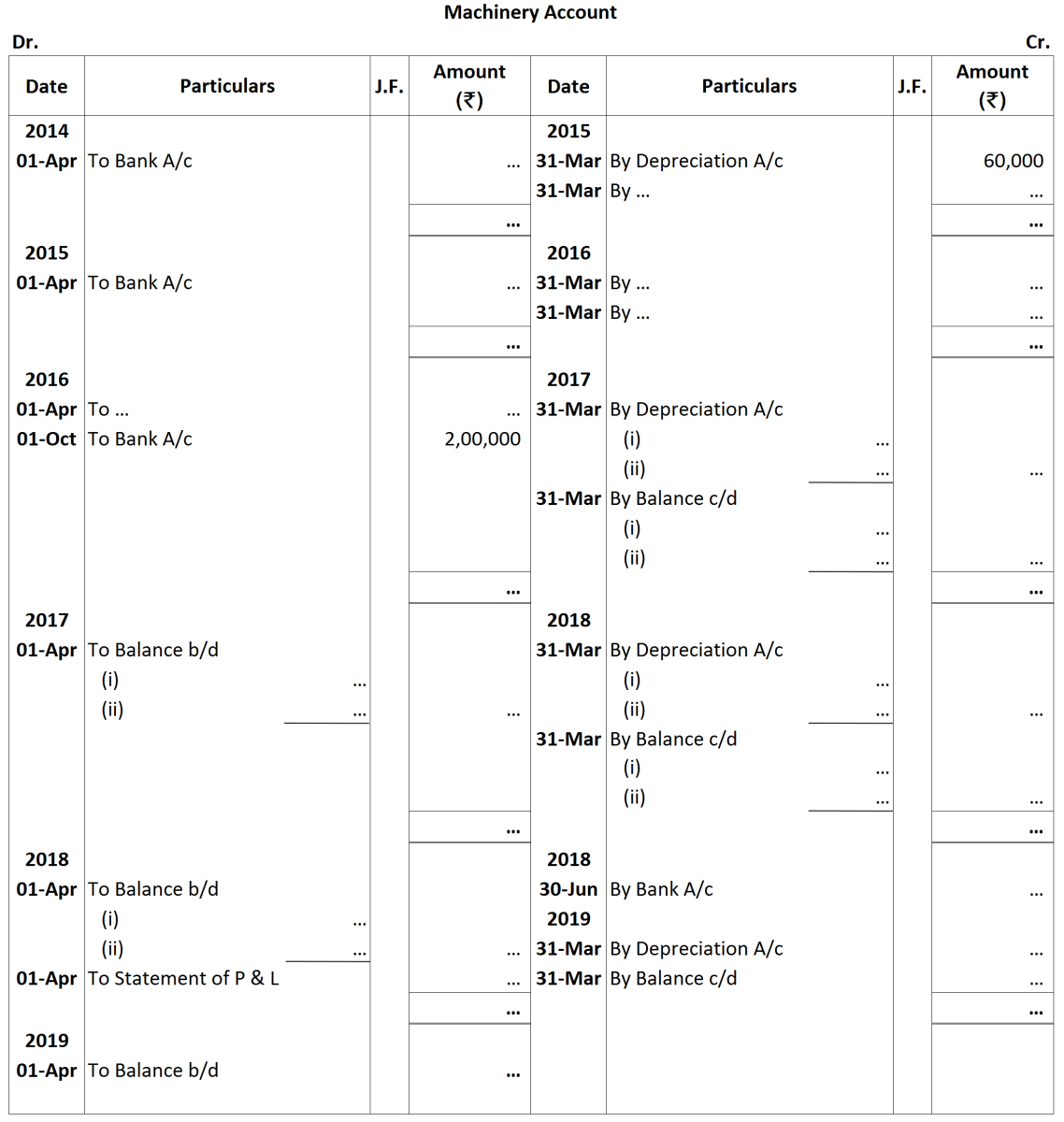
Fill up the missing information in the Machinery Account below. You are informed that the Machine purchased on $1^{\text {st }}$ October,$ 2016$ was sold on $1^{\text {st }}$ April, $2018$ for ₹ $2,30,000$. The depreciation is provided at the rate of $10 \%$ p.a. on diminishing blance method by the company.
A owed B ₹ 400. A accepted a Bill of Exchange at 3 months for this amount which B discounted for ₹ 380.
Give the necessary Journal entries in the books of A and B if this bill is:
  1. Dishonoured on the due date.
  2. Met at maturity.
  3. Retired under rebate at 6% p.a. 2 months before its maturity.
Following accounts are being maintained in the books of Shri Ashok. Classify them into Personal, Real and Nominal Accounts:
i Land and Building ii Excise Duty
iii Creditors iv Capital
v Motor Vehicles vi Goodwill
vii Investments viii Salary
ix Debtors x Bad Debts
xi Depreciation xii Wages
xiii Repairs xiv Ramesh, a debtor
xv Interest Received xvi Bank Overdraft
xvii Purchase Returns xviii Drawings
xix Freight xx Return Inwards.
Explain the meaning of any three of the following terms:
Conservatism.