Questions

6 Marks Question

🎯

Test yourself on this topic

21 questions · timed · auto-graded

Question 16 Marks
The bank statement of Mr. James Flint showed an overdraft to the tune of ₹ 60,400 as on 31-12-2014. Cash Book showed a debit balance of ₹ 2,00,120 as on the same date. The following further facts are available:
 
 
(a)
Cheque issued to Tax Consultants was not cashed till 31-12-2014.
12,000
(b)
Cheque issued to Management Consultancy Services was cashed on 14-1-2015.
20,000
(c)
Cheque received from M/s General Studies and deposited into the bank was credited in the account on 3-1-2015.
2,20,000
(d)
Dividend warrant deposited on 29-12-2014 was not credited by the bank till 31-12-2014.
74,400
(e)
Bank charge not adjusted in books of Mr. Flint till 31-12-2014
680
(f)
Interest credited by the bank and not adjusted in the books till 31-12-2014
2,560
Prepare a Bank Reconciliation Statement of Mr. James Flint as on 31-12-2014.
View full question & answer
Question 26 Marks
On 31st January, 2017 the Pass Book of Shri M.L. Gupta shows a debit balance of ₹ 41,000. Prepare a bank reconciliation statement from the following particulars:-
  1. Cheques amounting to ₹ 15,600 were drawn on 27th January, 2017. Out of which cheques for ₹ 11,000 were encashed up to 31-1-2017.
  2. A wrong debit of ₹ 800 has been given by the bank in the Pass Book.
  3. A cheque for ₹ 200 was credited in the Pass Book but was not recorded in the Cash Book.
  4. Cheques amounting to ₹ 21,000 were deposited for collection. But out of these, cheques for ₹ 7,400 have been credited in the Pass Book on 5th February, 2017.
  5. A cheque for ₹ 1,000 was returned dishonoured by the bank and was debited in the Pass Book only.
  6. Interest on overdraft and bank charges amounting to ₹ 100 were not entered in the Cash Book.
  7. A cheque of ₹ 500 debited in the Cash Book omitted to be banked.
View full question & answer
Question 36 Marks
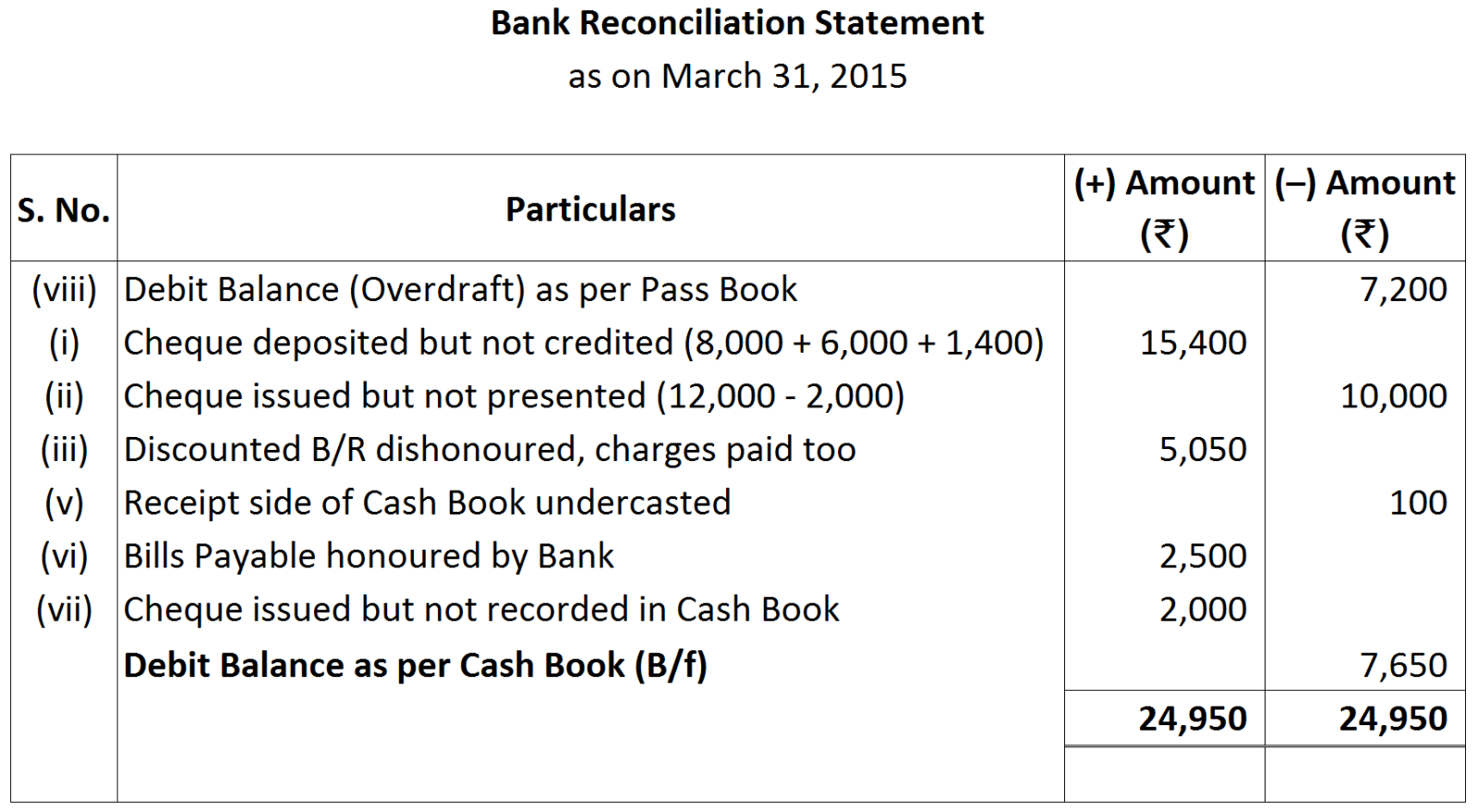
Prepare a Bank Reconciliation Statement from the following particulars as on 31st March 2015:
  1. Cheques were deposited into bank on 25th March for ₹ 20,000. Out of these cheques for ₹ 8,000 were cleared on 4th April, cheques for ₹ 6,000 on 6th April and one cheque for ₹ 1,400 was dishonoured on 7th April.
  2. Cheques amounting to ₹ 12,000 were issued in March, out of which cheques for ₹ 2,000 were encashed upto 31st March.
  3. A bill for ₹ 5,000 (discounted with the bank in January) dishonoured on 30th March 2015 and noting charges paid by bank ₹ 50. No information regarding the dishonour was received from the bank in March 2015.
  4. Cheque issued to a creditor for ₹ 2,000 was through mistake entered in the cash column of the Cash Book. The same has not been presented for payment till today.
  5. Receipt side of the Cash Book (bank column) was undercast by ₹ 100.
  6. Bank has paid a bill payable amounting to ₹ 2,500 but it has not been entered in the Cash Book.
  7. A cheque for ₹ 2,000 issued to Mr. X was omitted to be recorded in Cash Book.
  8. Dr. balance as per Pass Book was ₹ 7,200.
Answer

Note:
Transaction no. (iv) will have no effect on the bank balance as the issued cheque was recorded in the cash column and was not presented for payment till the date of preparation of Bank Reconciliation Statement.
View full question & answer
Question 46 Marks
On 30th June, 2014, the bank column of Mohan Kapoor's Cash Book showed a debit balance of ₹ 12,000. On checking the Cash Book with bank statement you find that:-
  1. Cheques paid into Bank ₹ 8,000, but out of these only cheques of ₹ 6,500 were cleared and credited by the Bankers upto 30th June.
  2. Cheques of ₹ 9,200 were issued but out of these only cheques of ₹ 7,000 were presented for payment upto 30th June.
  3. The receipt column of the Cash Book has been undercast by ₹ 200.
  4. The Pass Book shows a credit of ₹ 330 as interest on investments collected by bankers and debit of ₹ 60 for bank charges.
  5. On 29th June a Customer deposited ₹ 3,000 direct in the bank account but it was entered only in the Pass Book.
Prepare a Bank Reconciliation Statement.
View full question & answer
Question 56 Marks
On 30th June 2014, the Cash Book of a trader shows a bank overdraft of ₹ 2,500. Following informations are available:-
  1. Cheques amounting to ₹ 14,600 had been paid to the bank, but of these only ₹ 12,200 were credited in the Pass Book, up to 30th June, 2014.
  2. He had also issued cheques amounting to ₹ 10,000, out of which only ₹ 3,600 had been presented for payment.
  3. A cheque of ₹ 500 which he had debited to the bank account was not sent to bank for collection by mistake.
  4. There is a debit in the Pass Book of ₹ 10 for Bank Charges and ₹ 50 for interest.
  5. A customer directly paid into his bank ₹ 1,000, but it was not shown in the Cash Book.
  6. Bank has paid insurance premium of ₹ 400 according to his instructions, but this is not recorded in the Cash Book.
Prepare a Bank Reconciliation Statement.
View full question & answer
Question 66 Marks
Prepare a Bank Reconciliation Statement on 31 December, 2014 from the following particulars:
  1. A's overdraft as per Pass Book ₹ 20,000 as at 31st Dec.
  2. On 30th December, cheques had been issued for ₹ 80,000, of which cheques worth ₹ 15,000 only had been encashed up to 31st December.
  3. Cheques amounting to ₹ 6,500 had been paid into the bank for collection but of these only ₹ 2,500 had been credited in the Pass Book.
  4. The bank has charged ₹ 700 as interest on overdraft and the intimation of which has been received on 2nd January 2015.
  5. The Bank Pass Book shows credit for ₹ 2,000 representing ₹ 1,400 paid by debtor of A direct into the bank and ₹ 600 collected direct by bank in respect of interest on A,s investment. A had no knowledge of these items.
  6. A cheque for ₹ 3,600 has been debited in bank column of Cash Book by A, but it was not sent to bank at all.
View full question & answer
Question 76 Marks
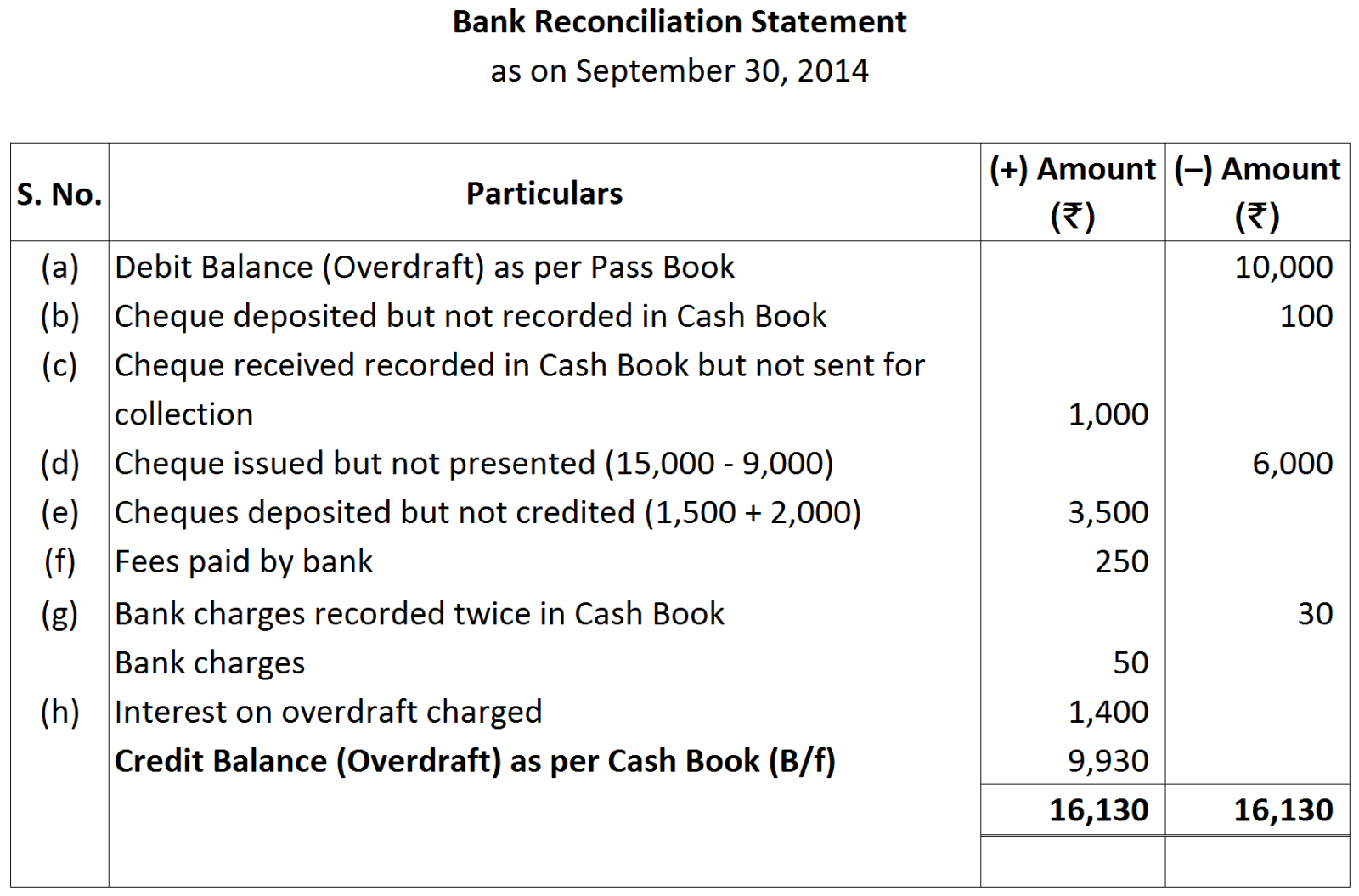
From the following particulars, prepare a Bank Reconciliation Statement of Alpha Electronic Motor. Private Ltd. as on 30th September, 2014:
  1. Overdraft on 30th September 2014 as per Pass Book ₹ 10,000.
  2. Cheque deposited in the bank but not recorded in Cash Book ₹ 100.
  3. Cheque received and recorded in the Cash Book but not sent to bank for collection ₹ 1,000.
  4. Several cheques were drawn in the last week of September, totalling ₹ 15,000; of these cheques totalling only ₹ 9,000 were cashed before 30th September.
  5. Similarly, several cheques, totaling ₹ 9,000 were sent for collection; of these cheques of the value of ₹ 1,500 were credited on 5th October and ₹ 2,000 on 7th October, balance being credited before 30th September.
  6. Fees of ₹ 250 was paid directly by the bank but was not recorded in the Cash Book.
  7. In the Cash Book, a bank charge of ₹ 30 was recorded twice while another bank charge of ₹ 50 was not recorded at all.
  8. Interest of ₹ 1,400 was charged by the bank but was not recorded in the Cash Book.
Answer
Solution is as follows:
View full question & answer
Question 86 Marks
From the following particulars make out the Bank Reconciliation Statement as on 31st December 2016.
  1. Pass book showed a credit balance of ₹ 15,000 on 31st December 2016.
  2. Cheques of ₹ 17,500 were issued but cheques of ₹ 12,000 only presented for payment till 31st December.
  3. Cheques of ₹ 10,000 were sent to the bank for Collection. Out of which cheques of ₹ 2,000 were credited in the month of January 2017.
  4. Bank paid ₹ 300 as per standing instructions but no record made in the cash book.
  5. Bank charged interest on overdraft ₹ 800 and it was entered twice in pass book by bank.
  6. ₹ 40 as bank charges not recorded in the cash book.
  7. Bank receives ₹ 200 as interest on debentures, but no information being sent to the customer.
View full question & answer
Question 96 Marks
What is a Bank Reconciliation Statement? Explain any four points regarding need and importance of preparing a Bank Reconciliation Statement.
Answer
Bank Reconciliation Statement is a statement prepared by the account holder on a particular date to reconcile the bank balance as per Cash Book with the balance as per Bank Statement or Bank Pass Book showing entries because of which differences between the two balances exist.
By Patil- "Bank reconciliation statement is a statement prepared mainly to reconcile the difference between the Bank Balance shown by the Cash Book and Bank Pass Book.''
Need and Importance of Bank Reconciliation Statement
It is essential to prepare a bank reconciliation statement due to the following reasons:
  1. A bank reconciliation statement locates the errors or omissions that may have been committed either on the part of the customer or the bank. The errors so detected can be rectified accordingly.
  2. By preparing a bank reconciliation statement, the customer becomes sure of the correctness of the bank balance shown by the cash book. It helps him in making further transactions with the bank. For example, suppose the cash book shows a bank balance of ₹ 20,000, whereas the balance shown by the pass book is ₹ 15,000. By reconciling the two, it is disclosed that cheques for ₹ 5,000 were deposited into the bank but have not been collected so far (or some of these have been dishonoured). In such a case, further cheques will be issued by assuming the bank balance of ₹ 15,000 only.
  3. A reconciliation statement facilitates the preparation of a revised cash book. For example, the entries relating to bank charges, interest allowed or charged by the bank, direct payment by the bank on our behalf etc. will be recorded in the pass book but for which there is no entry in the cash book. Such entries will now be recorded in the cash book as well.
  4. Periodic preparation of this statement reduces the chances of embezzlement by the staff of the firm or even that of the bank. For example, if a cashier merely makes an entry in the cash book but does not deposit the cash and cheques into the bank, it will be disclosed by preparing a bank reconciliation statement.
  5. A reconciliation statement helps in revealing the unnecessary delay in the collection of cheques by the bank.
  6. It also helps in keeping a track of cheques which have been sent to the bank for collection.
View full question & answer
Question 106 Marks
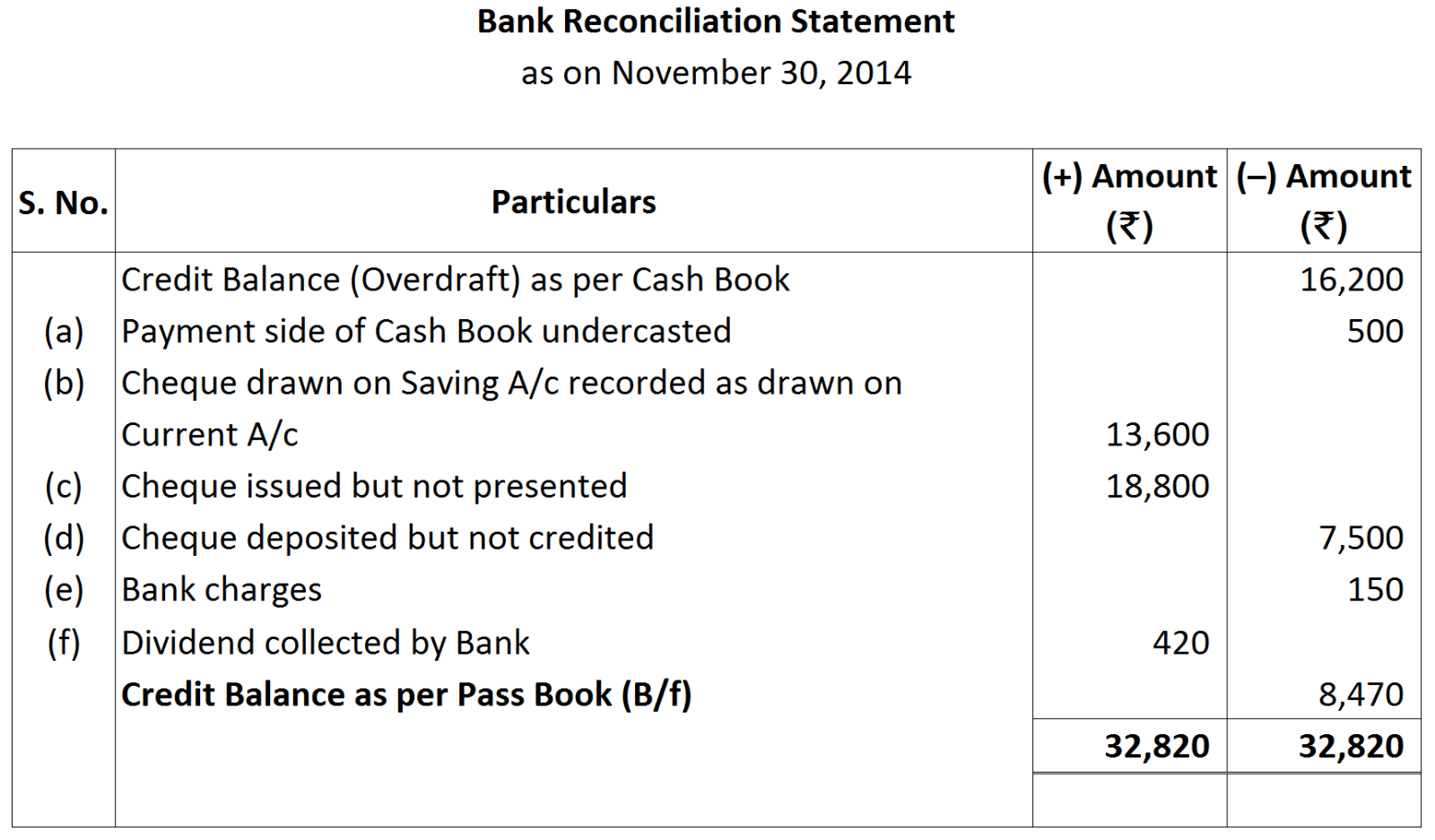
On Checking Ram's Cash Book with the bank statement of his overdraft current account for the month of November 2014, you find the following:
  1. Cash Book showed an overdraft of ₹ 16,200.
  2. The payment side of the Cash Book had been undercast by ₹ 500.
  3. A cheque for ₹ 13,600 drawn on his saving deposit account has been wrongly recorded as drawn on current account in the Cash Book.
  4. Cheques amounting to ₹ 18,800 drawn and entered in the Cash Book had not been presented.
  5. Cheques amounting to ₹ 7,500 sent to the bank for collection though entered in the Cash Book, had not been credited by the bank.
  6. Bank charge of ₹ 150 as per bank statement of account had not been taken in the Cash Book.
  7. Dividend of the amount of ₹ 420 had been paid direct to the bank and not entered in the Cash Book.
You are requested to arrive at the balance as it would appear in the bank statement as on 30th November 2014.
Answer
Solution is as follows.
View full question & answer
Question 116 Marks
Prepare a Bank Reconciliation Statement as on 31st Dec., 2012 from the following transactions:
  1. Bank overdraft as per Pass Book ₹ 22,000 as on 31st Dec.
  2. On 28th Dec., cheques had been issued for ₹ 50,000 of which cheques worth ₹ 6,000 only had been encashed upto 31st Dec.
  3. Cheques amounted to ₹ 4,500 had been paid into the bank for collection but out of these only ₹ 1,000 had been credited in the Pass Book.
  4. The bank has charged ₹ 1,500 as interest on overdraft and the intimation of which has not been received as yet.
  5. Bank has collected ₹ 1,600 directly in respect of interest on investment.
  6. A cheque of ₹ 1,200 has been debited in bank column of Cash Book, but it was not sent to bank at all.
View full question & answer
Question 126 Marks
On 30th June 2014, the bank balance as per Sanjay Yadav's Cash Book was ₹ 1,500. On comparing with the Pass Book the following information was received:-
  1. Cheques amounting to ₹ 7,290 were issued on 28th June, of which one cheque of ₹ 1,300 was presented in the bank for payment on 4th July.
  2. Cheques deposited into bank for ₹ 10,000, but of these cheques for ₹ 4,000 were cleared and credited in July.
  3. Interest and Dividend on investments ₹ 580 collected by bank and credited to his account but he did not have any information for this.
  4. Life Insurance Premium ₹ 750 paid by bank according to his standing orders.
  5. Bank Charges ₹ 25 not recorded in the Cash Book.
Prepare a Bank Reconciliation Statement.
View full question & answer
Question 136 Marks
On 30th June, 2016, the pass book of Nataraj showed a bank overdraft of ₹ 46,000. The following additional information is available. You are required to prepare a bank reconciliation statement as on the above mentioned date:
  1. Out of total cheques issued, cheques for ₹ 22,000 have not been presented for payment so far.
  2. Cheques paid into bank for collection, but not yet cleared total ₹ 31,000.
  3. Bank has charged ₹ 2,300 as interest on overdraft; it does not appear in cash book.
  4. A customer has directly deposited ₹ 8,300 with bank in Nataraj's account for which there is no entry in cash book.
  5. Dividend on shares collected by bank and credited in the pass book amounts to ₹ 2,000 for which no intimation has been given to Nataraj so far.
  6. A bill for ₹ 10,000 discounted with the bank was dishonoured on maturity. Bank has debited Nataraj with ₹ 10,100 including ₹ 100 for noting charges, the transaction has not yet been recorded in cash book.
View full question & answer
Question 146 Marks
While comparing the cash book of Mayank with the bank pass book on 30th September, 2016 you find the following:
  1. The bank pass book showed a debit balance of ₹ 15,000.
  2. Bank paid insurance premium ₹ 2,000, but it was recorded as ₹ 200 only in cash book.
  3. Cheques issued in favour of suppliers in September, 2016 amounted to ₹ 55,000, but cheques for ₹ 50,000 only were presented for payment upto 30th September, 2016.
  4. Direct deposit of ₹ 10,000 in Mayank's bank account by a customer on 25th September, 2016 had not been recorded in the cash book.
  5. Dividend collected by bank, but not recorded in cash book ₹ 1,000.
  6. Bank charged ₹ 300 for its services, but they were yet to be recorded in cash book.
  7. Cheques amounting to ₹ 78,000 were deposited with bank in the last week of September, 2016 but cheques for ₹ 51,000 only had been cleared before 1st October, 2016.
Prepare the bank reconciliation statement ascertaining bank balance/overdraft as per cash book.
View full question & answer
Question 156 Marks
Following information has been given by Rajendra. Prepare a Bank Reconciliation Statement as on 31st Dec. 2016, showing balance as per cash book:
  1. Debit balance shown by the pass book ₹ 17,800.
  2. Cheques of ₹ 21,600 were issued in the last week of December, but of these ₹14,800 only were presented for payment.
  3. Cheques of ₹ 10,750 were deposited in bank, out of them a cheque of ₹ 4,200 was credited in the first week of January, 2017.
  4. A cheque of ₹ 1,200 was debited in the cash book but was not deposited in bank.
  5. Insurance premium paid by bank ₹ 1,450.
  6. A bill of exchange for ₹ 6,200 which was discounted with bank, returned dishonoured but no entry was made in the cash book.
  7. Bank charges and interest charged by bank are ₹ 350.
View full question & answer
Question 166 Marks
On comparing the Cash Book with Pass Book of Naman it is found that on March 31, 2017, bank balance of ₹ 40,960 showed by the Cash Book differs from the bank balance with regard to the following:
  1. Bank charges ₹ 100 on March, 31 2017, are not entered in the Cash Book.
  2. On March 21, 2017, a debtor paid ₹ 2,000 into the company's bank in settlement of his account, but no entry was made in the Cash Book of the company in respect of this.
  3. Cheques totalling ₹ 12,980 were issued by the company and duly recorded in the Cash Book before March 31, 2017, but had not been presented at the bank for payment until after that date.
  4. A bill for ₹ 6,900 discounted with the bank is entered in the Cash Book without recording the discount charge of ₹ 800.
  5. ₹ 3,520 is entered in the Cash Book as paid into bank on March 31st 2017, but not credited by the bank until the following day.
  6. No entry has been made in the Cash Book to record the dishonour on March 15, 2017 of a cheque for ₹ 650 received from Bhanu.
Prepare a reconciliation Statement as on March 31, 2017.
View full question & answer
Question 176 Marks
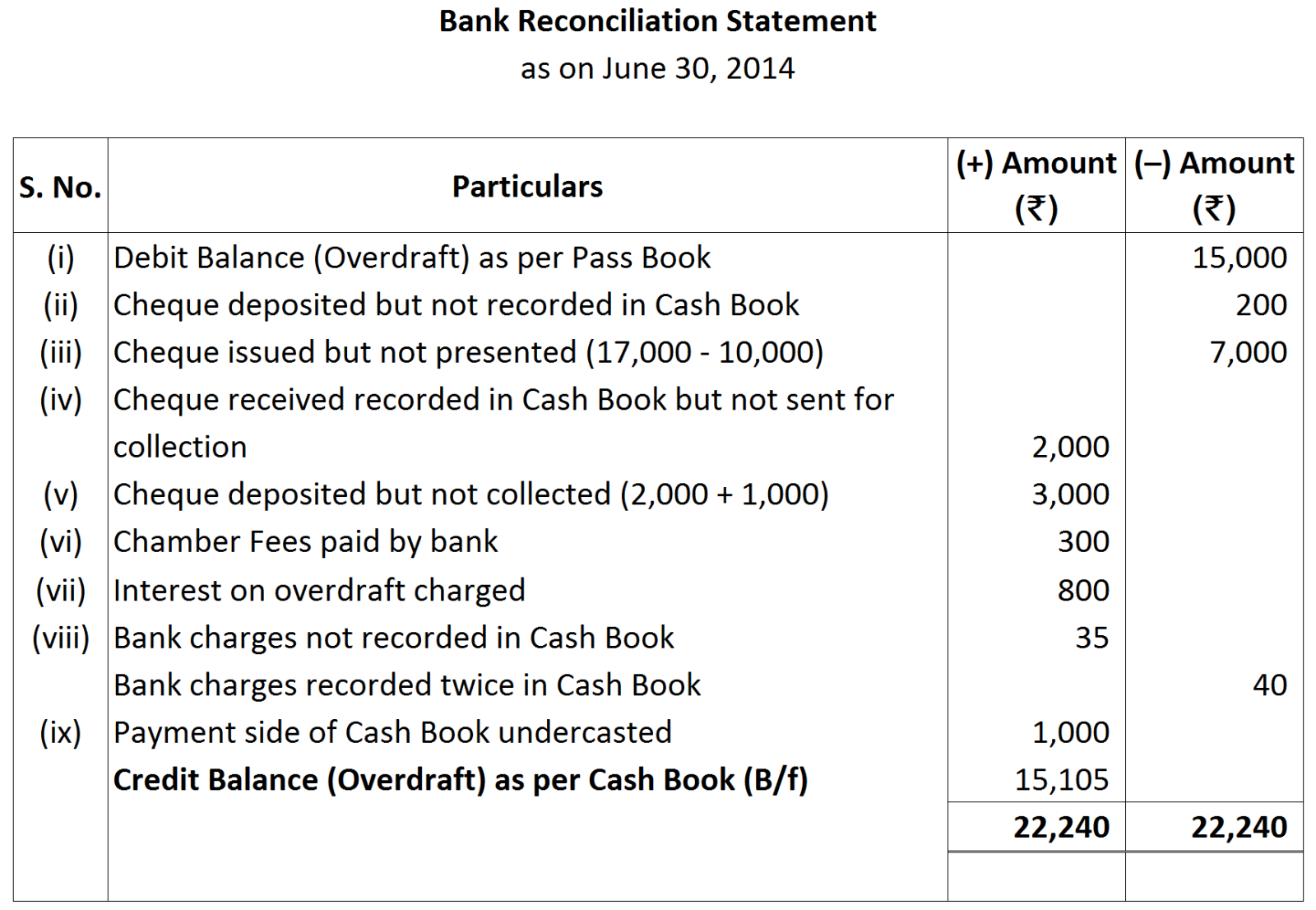
Prepare bank reconciliation statement of Dinesh on 30th June 2014 with following particulars:
  1. Pass Book showed an overdraft of ₹ 15,000 on 30th June 2014.
  2. A cheque of ₹ 200 was deposited in bank but not recorded in Cash Book.
  3. Cheques of ₹ 17,000 were issued but cheques worth only ₹ 10,000 were presented for payment up to 30th June 2014.
  4. Cheques of ₹ 2,000 were received and recorded in Cash Book but not sent to bank.
  5. Cheques of ₹ 10,000 were sent to bank for collection; out of these cheques of ₹ 2,000 and of ₹ 1,000 were credited respectively on 8th July and 10th July and the remaining cheques were credited before 30th June 2014.
  6. Bank paid ₹ 300 fee of Chamber of Commerce on behalf of Dinesh, which was not recorded in Cash Book.
  7. Bank charged interest on overdraft ₹ 800 which was not recorded in Cash Book.
  8. ₹ 40 for bank charges were recorded two times in Cash Book and bank expenses of ₹ 35 were not at all recorded in Cash Book.
  9. Total of credit side of bank column of Cash Book was undercast by ₹ 1,000 by mistake.
Answer
Solution is as follows.
View full question & answer
Question 186 Marks
Prepare a Bank Reconciliation Statement as on 31st March 2015 from the following informations:
 
 
(a)
Cash Book Balance (Overdraft)
12,500
(b)
Cheques deposited but not recorded in Cash Book
2,000
(c)
Cheque received but not sent to Bank
1,500
(d)
Credit side of the Bank Column has been overcast
60
(e)
Bank charges entered in Pass Book twice
75
(f)
Bills Receivable directly collected by the Bank
4,000
(g)
Deposited cheques returned dishonoured by Bank
1,700
(h)
Electricity Bill paid by Bank as per instruction
800
(i)
Cheques issued but not presented for payment
5,400
(j)
Cheques deposited but not cleared
3,200
View full question & answer
Question 196 Marks
On 31st March, 2019 the bank column of the Cash Book of Mr. Rajesh showed a debit balance of ₹ 5,200. On examining the Pass Book you find that:
  1. Cheques of ₹ 20,000 were sent to bank for collection; Out of these cheques of ₹ 4,000 and of ₹ 5,000 were credited respectively on 5th April and 6th April respectively and the remaining cheques were credited before 31st March.
  2. A cheque for ₹ 7,500 received from a customer although entered in the bank column of the Cash Book, was omitted to be paid into the bank.
  3. Cheques drawn for ₹ 25,000 were not presented for payment.
  4. Credit side of the bank column of the Cash Book was overcast by ₹ 100.
  5. A B/P for ₹ 3,600 has been paid by the bank, but not yet recorded in the Cash Book.
  6. No entry has been made in the Cash Book to record the dishonour on 28th March 2019, of a cheque for ₹ 5,400 received from a customer.
  7. A cheque for ₹ 2,500 issued to a creditor was wrongly entered in the cash column of the Cash Book.
  8. In the Cash Book, bank charges of ₹ 200 were entered twice while another bank charge of ₹ 500 was not recorded at all.
You are required to show the necessary corrections in the Cash Book and to prepare a statement reconciling the amended cash balance with that shown in bank Pass Book.
View full question & answer
Question 206 Marks
The Cash Book of a merchant showed an overdraft balance of ₹ 15,700 on 31st December 2018. On comparing it with the Pass Book, the following differences were noted:
  1. Cheques amounting to ₹ 12,250 were deposited into the bank, out of which cheques for ₹ 8,200 have been credited in the Pass Book on 2nd January, 2019.
  2. Cheques were issued amounting to ₹ 8,300 of which cheques for ₹ 2,000 have been cashed upto 31st Dec.
  3. A cheque of ₹ 4,250 issued to a creditor, has been entered in the Cash Book as ₹ 4,520.
  4. Bank charges of ₹ 180 on 30th November 2018 and ₹ 240 on 30th December 2018 have not been entered in the Cash Book.
  5. A B/R for ₹ 6,000 discounted with the bank is entered in the Cash Book without recording the discount charges of ₹ 300.
  6. A cheque for ₹ 2,000 deposited into the bank appear in the Pass Book, but not recorded in the Cash Book.
  7. A cheque for ₹ 3,700 deposited into the bank appear in the Pass Book, was recorded in the cash column of the Cash book.
You are required:
  1. To make appropriate adjustments in the cash book, bringing down the correct balance.
  2. To prepare a bank reconciliation statement with the adjusted balance.
View full question & answer
Question 216 Marks
On 31st March, 2019 the Cash Book of Gopal disclosed a balance of ₹ 12,580. On checking entries in the Cash Book with the bank statement, it was ascertained that:
  1. Cheques amounting to ₹ 18,000 were drawn on 25th March, of which cheques of ₹ 4,800 were cashed before 31st March.
  2. Cheques for ₹ 18,000 were sent for collection out of which cheques for ₹ 8,200 were credit by bank after 31st March.
  3. An amount of ₹ 5,000 paid directly into the merchant's account by a customer was not entered in the Cash Book.
  4. On 31st March, cash was deposited into the bank ₹ 12,720 but the cashier debited the bank account with ₹ 12,270 by mistake.
  5. Dividend collected by bank on our behalf ₹ 570 does not appear in the Cash Book.
  6. ₹ 300 is entered in the bank statement as bank charges. This was recorded as ₹ 200 in the cash book.
You are required:
  1. To prepare the Amended Cash Book.
  2. Then prepare a Bank Reconciliation Statement.
View full question & answer
6 Marks Question - Account STD 11 Commerce Questions - Vidyadip