Question
What is a capacitive and an inductive AC circuit? Explain.

Answer

Amplitude of electric current in an $L - C - R$ AC series circuit (Amplitude means maximum current)
$i_m=\frac{u_m}{\sqrt{ R ^2+\left( X _{ C }- X _{ L }\right)^2}}$
Phase difference between voltage and current
$\phi=\tan ^{-1}\left(\frac{ X _{ C }- X _{ L }}{ R }\right)$
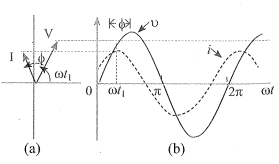
→Case-I : If $X _{ C }> X _{ L }$ phase difference $\phi$ is positive. and the circuit is predominatly capacitive. Consequently, the current in the circuit leads the source voltage.
→Case-II : If $X _{ C }< X _{ L }, \phi$ is negative and the circuit is predominantly inductive. Consequently, the current in the circuit lags the source voltage.
Image
Figure shows the phasor diagram and variation of $v$ and $i$ with $\omega t$ for the case $X _{ C }> X _{ L }$.

Need a full question paper?

Generate a complete, print-ready paper with questions like this in minutes — across 16+ boards, with answer keys.
Start Generating Free

Similar questions

Describe schematically the equipotential surfaces corresponding to:
  1. a constant electric field in the z-direction.
  2. a field that uniformly increases in magnitude but remains in a constant (say, z) direction.
  3. a single positive charge at the origin, and.
  4. a uniform grid consisting of long equally spaced parallel charged wires in a plane.
An electron, an alpha particle and a proton have the same kinetic energy. Which one of these particles has (i) the shortest and (ii) the largest, de Broglie wavelength?
  1. Find the first excitation potential of $He^+$ ion.
  2. Find the ionization potential of $Li^{++}$ion.
In a Young's double slit experiment $\lambda=500\text{nm},$ d = 1.0mm and D = 1.0m. Find the minimum distance from the central maximum for which the intensity is half of the maximum intensity.
The mean speed of the molecules of a hydrogen sample equals the mean speed of the molecules of a helium sample. Calculate the ratio of the temperature of the hydrogen sample to the temperature of the helium sample.
A point charge is placed at the centre of a closed Gaussian spherical surface of radius r. Electric flux passing through the surface is $\Phi$ How is the electric flux $\Phi$ through the surface affected when the following changes are made in turn:
  1. The spherical surface is replaced by a cylindrical surface of the same radius?
  2. The point charge is replaced by an electric dipole?
Justify your answer in each case.
The radii of curvature of the faces of a double convex lens are 10 cm and 15 cm. If focal length of the lens is 12 cm, find the refractive index of the material of the lens.
How the radii of different stable orbits are related to principal quantum number?
A uniform electric field of $10NC^{-1}$ exists in the vertically downward direction. Find the increase in the electric potential as one goes up through a height of 50cm.
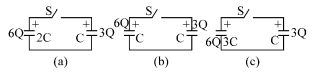
Three circuits, each consisting of a switch ' S ' and two capacitors, are initially charged as shown in the figure. In which circuit, when the switch is closed, the charge on the given capacitor will (i) increase, (ii) decrease and (iii) remain unchanged? Give reason.
Image