Question
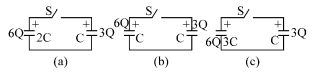
Three circuits, each consisting of a switch ' S ' and two capacitors, are initially charged as shown in the figure. In which circuit, when the switch is closed, the charge on the given capacitor will (i) increase, (ii) decrease and (iii) remain unchanged? Give reason.
Image

Answer

According to the law of conservation of charge, Let $q _1$ and $q _2$, are two charges which are on the left and right side of the capacitor.
$ \left(q_1+q_2\right)_{\text {Beforè }}=\left(q_1^{\prime}+q_2^{\prime}\right)_{\text {After }} $
(a) For the first circuit
$ 6 Q+3 Q=2 CV+CV $
Common potential difference, $V =\frac{9 Q }{3 C }=\frac{3 Q }{ C }$
Value of charge on the left capacitor after closing the switch S .
$q_1^{\prime}=2 CV =2 C \times \frac{3 Q }{ C }$
$q_1^{\prime}=6 Q$
Therefore, the value of charge on the left capacitor remains unchanged.
(b) For the second circuit
$ 6 Q+3 Q=C V+C V $
Common potential difference, $V =\frac{9 Q }{2 C }$
After closing the switch (S) value of the capacitor on the left capacitor
$ \begin{aligned} q_1^{\prime} & =CV \\ & =C \times \frac{9 Q}{2 C}=4.5 Q \end{aligned} $
Therefore, the value of charge on the left capacitor in circuit (b) will decrease.
(c) For the third circuit
$ 6 Q+3 Q=3 C V+C V $
Common potential difference,
$ V=\frac{9 Q}{4 C} $
Value of charge on the left capacitor
$q_1^{\prime}=3 C \times \frac{9 Q }{4 C }=\frac{27 QC }{4 C }$
$q^{\prime}{ }_1=6.75 Q$
Therefore, in circuit (c) the value of the left capacitor will increase.

Need a full question paper?

Generate a complete, print-ready paper with questions like this in minutes — across 16+ boards, with answer keys.

Start Generating Free