Question
What is a capacitive and an inductive AC circuit? Explain.

Answer

Amplitude of electric current in an $L - C - R$ AC series circuit (Amplitude means maximum current)
$i_m=\frac{u_m}{\sqrt{ R ^2+\left( X _{ C }- X _{ L }\right)^2}}$
Phase difference between voltage and current
$\phi=\tan ^{-1}\left(\frac{ X _{ C }- X _{ L }}{ R }\right)$
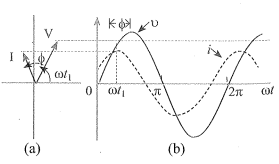
→Case-I : If $X _{ C }> X _{ L }$ phase difference $\phi$ is positive. and the circuit is predominatly capacitive. Consequently, the current in the circuit leads the source voltage.
→Case-II : If $X _{ C }< X _{ L }, \phi$ is negative and the circuit is predominantly inductive. Consequently, the current in the circuit lags the source voltage.
Image
Figure shows the phasor diagram and variation of $v$ and $i$ with $\omega t$ for the case $X _{ C }> X _{ L }$.

Need a full question paper?

Generate a complete, print-ready paper with questions like this in minutes — across 16+ boards, with answer keys.
Start Generating Free

Similar questions

Why do we prefer a potentiometer to measure the emf of a cell rather than a voltmeter?
Show that the interior of a conductor can have no excess charge in the static situation.
Under what condition, force on moving charged particle in a magnetic field will be (i) maximum (ii) minimum?
Describe schematically the equipotential surfaces corresponding to:
  1. a constant electric field in the z-direction.
  2. a field that uniformly increases in magnitude but remains in a constant (say, z) direction.
  3. a single positive charge at the origin, and.
  4. a uniform grid consisting of long equally spaced parallel charged wires in a plane.
The minimum deviations suffered by red, yellow and violet beams passing through an equilateral transparent prism are 38.4°, 38.7° and 39.2° respectively. Calculate the dispersive power of the medium.
If we put a cardboard (say 20cm × 20cm) between a light source and our eyes, we can't see the light. But when we put the same cardboard between a sound source and our ear, we hear the sound almost clearly. Explain.
A molecule of a substance has a permanent electric dipole moment of magnitude $10^{-29} C m$. A mole of this substance is polarised (at low temperature) by applying a strong electrostatic field of magnitude $10^6 V m ^{-1}$. The direction of the field is suddenly changed by an angle of $60^{\circ}$. Estimate the heat released by the substance in aligning its dipoles along the new direction of the field. For simplicity, assume $100 \%$ polarisation of the sample.
Draw a plot of potential energy of a pair of nucleons as a function of their separation. Write two important conclusions which you can draw regarding the nature of nuclear forces.
The wavelength of light in a medium is $\lambda=\frac{\lambda_0}{\mu},$ where $\lambda$ is the wavelength in vacuum. A beam of red light $(\lambda_0=720\text{nm})$ enters into water. The wavelength in water is $\lambda=\frac{\lambda_0}{\mu}=540\text{nm}.$ To a person under water does this light appear green?
Power P is to be delivered to a device via transmission cables having resistance RC. If V is the voltage across R and I the current through it, find the power wasted and how can it be reduced.