Questions

2 Marks Questions

Take a timed test

20 questions · self-marked practice — reveal the answer and mark yourself.

Question 12 Marks
Derive the equation of instantaneous power and average power for a purely capacitive? circuit.
Answer
Voltage of AC source $v=v_m \sin \omega t$
Current in a circuit containing only capacitors is
$i=i_m \sin \left(\omega t+\frac{\pi}{2}\right)$
Where,
$i_m=\frac{v_m}{ X _{ C }}=\frac{v_m}{\frac{1}{\omega C }}$ Amplitude of electric current
The instantaneous power supplied to the capacitor is,
$\begin{aligned}
p & =v i \\
\therefore p & =v_m i_m \sin \omega t \sin \left(\omega t+\frac{\pi}{2}\right) \\
\therefore p & =v_m i_m \sin \omega t \cos \omega t \\
\therefore \quad p & =\frac{v_m i_m}{2}(2 \sin \omega t \cos \omega t)
\end{aligned}$
But, $2 \sin \omega t \cos \omega t=\sin 2 \omega t$
$\therefore p=\frac{v_m i_m}{2} \sin 2 \omega t$
Average power (during one complete cycle)
$\begin{array}{l} 
P =\bar{p}=\left\langle\frac{v_m i_m}{2} \sin 2 \omega t\right\rangle \\
\therefore P =\frac{v_m i_m}{2}<\sin 2 \omega t> \\
\text { But },<\sin 2 \omega t>=0 \\
\therefore P =0
\end{array}$
Thus, average power supplied to a capacitor during one complete cycle is zero.
View full question & answer
Question 22 Marks
Draw the phasor diagram and graph of voltage and current versus $\omega t$  for a purely capacitive circuit and explain it.
Answer

Image
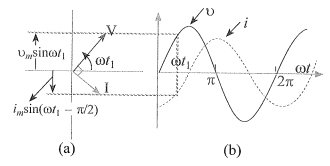
Here, the voltage applied to the capacitor is $v=v_m \sin \omega t$ And the current flowing throught the circuit is $i=i_m \sin \left(\omega t+\frac{\pi}{2}\right)$
A comparison of both the equations shows thit the current is $\frac{\pi}{2} rad$ ahead of voltage.
Fig. shows the phasor diagram at an instanl time $t_1$. Here, the current phasor $\vec{I}$ is $\frac{\pi}{2}$ ahead of the voltage phasor $\vec{V}$ as they rotate countle clockwise.
View full question & answer
Question 32 Marks
Draw and explain the phasor diagram and the graph of $v$ and $i$ versus $\omega$t, for an AC circuit having pure inductor.
Answer
Voltage of the AC source, $v=v_{ m } \sin \omega t$
For an AC circuit which is purely inductive, electric current, $i=i_m \sin \left(\omega t-\frac{\pi}{2}\right)$.
Comparison of above two equations shows that current lags behind the voltage by $\frac{\pi}{2} rad$ (or one fourth of a time period $\frac{T}{4}=\frac{\frac{\pi}{2}}{\omega}$ )

Image
The fig. shows the voltage and the current phasors for some time $t_1$. Current phasor $\vec{I}$ is lagging behind voltage phasor $\overrightarrow{ V }$ by $\frac{\pi}{2}$ radian.
When rotated with angular frequency $\omega$ counter clockwise, they generate the voltage and current given by equations
$v=v_{ m } \sin \omega t$ and $i=i_m \sin \left(\omega t-\frac{\pi}{2}\right)$,
respectively as shown in the figure.
View full question & answer
Question 42 Marks
Derive/obtain the instantaneous power and average power for an AC circuit having purely inductive component.
Answer
Voltage of the AC source,
$v=v_{ m } \sin \omega t$
Electric current in the circuit having only inductor,
$i=i_m \sin \left(\omega t-\frac{\pi}{2}\right)$
Where, $i_m=\frac{v_m}{\omega L }$ Amplitude of electric current
The instantaneous power supplied to the inductor is.
$\begin{aligned}
\quad p & =v i \\
\therefore \quad p & =v_m i_m \sin \omega t \sin \left(\omega t-\frac{\pi}{2}\right) \\
\therefore \quad p & =-v_m i_m \sin \omega t \cos \omega t \\
\therefore \quad p & =-\frac{v_m i_m}{2}(2 \sin \omega t \cos \omega t)
\end{aligned}$
But $2 \sin \omega t \cos \omega t=\sin 2 \omega t$
$\therefore p=-\frac{v_m i_m}{2} \sin 2 \omega t$
The average power over a complete cycle is
$\begin{array}{l} 
P =\bar{p}=\left\langle-\frac{v_m i_m}{2} \sin 2 \omega t\right\rangle \\
P =-\frac{i_m U_m}{2}<\sin 2 \omega t> \\
\text { But }<\sin 2 \omega t>=0 \\
\therefore P =0
\end{array}$
Thus, the average power supplied to an inductor over one complete cycle is zero.
View full question & answer
Question 52 Marks
Explain resonance for $L-C-R$ series $A C$ circuit. Obtain the equation of resonance frequency and explain resonance curve.
Answer
Electric current for LCR series AC circuit,
$i=i_m \sin (\omega t+\phi)$
Where, $i_m=\frac{v_m}{ Z }=\frac{U_m}{\sqrt{ R ^2+\left( X _{ C }- X _{ L }\right)^2}}$
$X_C=\frac{1}{\omega C } \text { and } X _{ L }=\omega L$
From this equation, it can be said that when the value of $\omega$ is varied, the current also changes. Then at a particular frequency $\omega=\omega_0, X _{ C }=$ $X_L$.
Then the impendence becomes miniumum.
$\left(Z=\sqrt{R^2+\left(X_C-X_L\right)^2}=R\right)$
This frequency is called resonant frequency.
Here, $X _{ C }= X _{ L }$
$\begin{array}{l}
\therefore \frac{1}{\omega_0 C }=\omega_0 L \\
\therefore \omega_0^2=\frac{1}{ LC } \\
\therefore \omega_0=\frac{1}{\sqrt{ LC }}
\end{array}$
At resonant freq. the current amplitude is maximum.
$\therefore \quad i_m^{\max }=\frac{\nu_m}{ R }(\because Z=R)$
The phenomenon of maximum current is called series resonance
Image
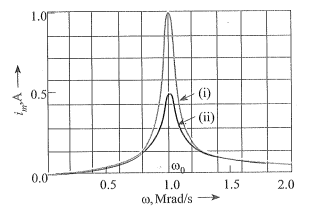
Figure shows the variation of $i_m$ with $\omega$ in an RLC series circuit with $L =1.00 mH , C =1.00 nF$ for two values of R : (i) $R =100 \Omega$ and (ii) $R =200 \Omega$ for the source applied $v_m=100 V$
$\omega_0$ for this case is :
$\omega_0=\frac{1}{\sqrt{ LC }}=1.00 \times 10^6 rad / s \text { (substituting values) }$
We can see that current amplitude becomes maximum at the resonance frequencey.
Since, $i_m^{\max }=\frac{U_m}{ R }$ at resonance, the current amplitude for case (i) is twice to that for case (ii).
View full question & answer
Question 62 Marks
Explain the representation of AC current and voltage by rotating vectors. (phasors).
Answer
→In an AC circuit in order to show the phase relationship between voltage and current the notion of phasor is used.
→A phasor is a vector, which is used to represent periodically changing quantities in the form of vectors.
→For example to draw a phasor representing voltage $V =v_m \sin \omega t$, draw a vector of magnitude equal to $v_m$ and in the direction making an angle $\omega t$ with the horizontal axis.
→As time increases, value of $\omega t$ goes on increasing and the phasor (vector) rotates in anticlockwise direction accordingly. And its instantaneous value also keeps changing.
Image
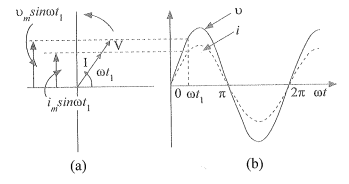
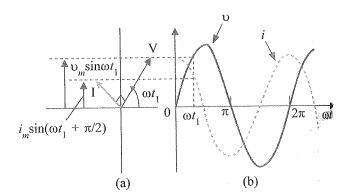
→The voltage and current phasor shown in the fig. rotates about the origin with angular speed $\omega$. The vertical components of $\vec{V}$ and $\vec{I}$ represent the sinusoidally varying quantities $v$ and $i$.The magnitudes of phasors $\vec{V}$ and $\vec{I}$ represent the amplitudes (/peak values $v_m$ and $i_m$ ) of these oscillating quantities.
Image
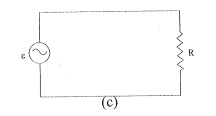
→Fig. (a) shows the voltage and current phasors and their relationship at time $t_1$ for the case of an AC source connected to a resistor. (fig. c)
→The projection of voltage and current phasors on vertical axis, i.e. $v_m \sin \omega t_1$, and $i_m \sin \omega t_1$ respectively represent the value of voltage and current at that instant.
→As shown in fig. (a), phasors $\vec{V}$ and $\vec{I}$ for the case of a resistor are in the same direction.
This means that phase angle(/phase difference) between the voltage and current is zero.
View full question & answer
Question 72 Marks
How is transformer used in large scale transmission and distribution of electrical energy (power) over long distances ? Explain.
Answer
Large scale transmission and distribution of electrical energy over long distances is done using transformers.
The voltage $O / P$ of the generator is stepped up (So that current is reduced and consequently, $I ^2 R$ loss is cut down.)
It is then transmitted over long distances to an area sub-station near the consumers.
There the voltage is stepped down.
It is further stepped down at distributing substations and utility poles before a power supply of 240 V reaches our homes.
View full question & answer
Question 82 Marks
Mention the disadvantages of phasor method of analysing AC circuits.
Answer
Following are the disadvantages of phasor method :
(i) The phasor diagram say nothing about the initial condition.
(ii) One can take any arbitrary value of $t$ (say, $t_1$ as taken in this chapter) and draw different phasors which show the relative angle between different phasors.
The solution so obtained is called the steadystate solution. This is not a general solution.
(iii) Additionally, there is another type of solution as well, which is called transient solution which exists even for $v =0$.
After a sufficiently long time, the effects of the transient solution die out and the behaviour of the circuit is described by the steady-state solution.
View full question & answer
Question 92 Marks
What is rms value (root mean square)?
Derive the equation of rms values of voltage and current?
Answer
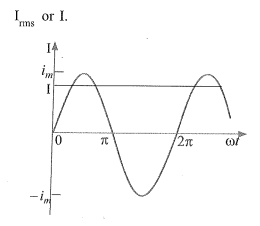
To express AC power in the same form as DC power ( $\left.P=I^2 R\right)$, a special value of current is defined and used. It is called root mean square (rms) current or effective current and is denoted by
Image
RMS value is definded as follows:
$\begin{aligned}
I _{ rms }= I & =\sqrt{i^2} \\
& =\sqrt{\frac{1}{2} i_m^2} \\
& =\frac{i_m}{\sqrt{2}} \\
& =0.707 \cdot i_m
\end{aligned}$
In terms of I , the average power,
$\begin{array}{l} 
P =\bar{p}=\frac{1}{2} i_m^2 R \\
\therefore P=I^2 R=I^2{ }_{\text {rms }} R \\
\end{array}$
Similarly, rms voltage (or effective voltage) can be defined as follows :
$V _{ rms }= V =\frac{v_m}{\sqrt{2}}=0.707 v_m$
But, as per ohm's law,
$\begin{aligned}
& v _m=i_m R \\
\therefore \quad & \frac{v_m}{\sqrt{2}}=\frac{i_m}{\sqrt{2}} \cdot R \\
\therefore \quad V _{ rms } & = I _{ rms } \cdot R \\
& \text { OR } \\
V & = IR
\end{aligned}$
Average power (in terms of voltage) :
$P = I ^2 R \quad OR \quad P = I _{\text {mms }}^2 R$
But taking $I =\frac{ V }{ R }$
$\therefore P =\frac{ V ^2}{ R } \text {. }$
View full question & answer
Question 102 Marks
Obtain the equations of instantaneous power and average power for an AC circuit containing only resistor.
Answer

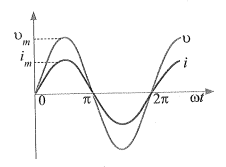
Image
→Voltage applied to the AC circuit $v=v_{ m } \sin \omega t$
→Current passing through the circuit containing only resistor,
$i=i_m \sin \omega t$
Where, $i_m=\frac{v_m}{R}$
$i_m=$ Current amplitude (/amplitude of current)
→Necessary graphs of voltage and current are shown in the figure.
→Values of both, applied voltage and current vary sinusoidally and have corresponding positive and negative values during each cycle.
→Thus, the sum of the instantaneous current values over one complete cycle is zero and the average current is zero.
→The fact that the average current is zero, does not mean that the average power consumed is zero and that there is no dissipation of electrical energy.
→As we know, joule heating is given by $i^2 R t$ and depends on $i^2$. Which is always positive (whether $i$ is positive or negative), So, the dissipated power is not zero.
→The instantaneous power dissipated in the resistor is,
$\begin{array}{l}
\therefore p=i^2 R \\
\therefore p=i_m^2 R \sin ^2 \omega t
\end{array}$
→The average value of $p$ over a cycle is
$\begin{array}{l}
\bar{p}= \\
\therefore \quad \bar{p}=i_m^2 R <\sin ^2 \omega t> \\
→<\sin ^2 \omega t>=\left\langle\frac{1-\cos 2 \omega t}{2}\right\rangle \\
=\left\langle\frac{1}{2}\right\rangle-\left\langle\frac{\cos 2 \omega t}{2}\right\rangle
\end{array}$
But $\quad\left\langle\frac{1}{2}\right\rangle=\frac{1}{2}$
and $\left\langle\frac{\cos 2 \omega t}{2}\right\rangle=0$
$\therefore \quad<\sin ^2 \omega t>=\frac{1}{2}$
→From equation (1),
$< P >=\bar{p}=\frac{i_m^2 R }{2}$
→There is maximum power dissipation in an AC circuit containing only resistive component.
View full question & answer
Question 112 Marks
Derive/obtain the equation of current in case of AC voltage applied to a resistor and also draw the graph showing the phase difference between voltage and current.
Answer
Image
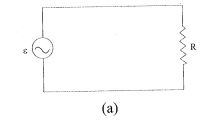
As shown in fig., an AC source is connected with a (pure) resistor.
Voltage of the AC source, $v=v_m \sin \omega t \ldots$ (1) Where, $v_m$ is the amplitude of the oscillating potential difference and $\omega$ is the angular frequency.
To find the value of current through the resistor, we apply Kirchhoff's loop rule $\sum \varepsilon(t)=0$, to the closed loop shown in fig.,
$\begin{array}{l}
\therefore \quad v_m \sin \omega t=i R \\
\therefore \quad i=\frac{v_m}{ R } \sin \omega t \text { (Here, } R \text { is constant) } \\
\therefore \quad i=i_m \sin \omega t
\end{array}$
Image
Where, $i_m=\frac{v_m}{R}$ Amplitude of electric current
Equation (3) is Ohm's law which works equally well for both AC and DC voltages.
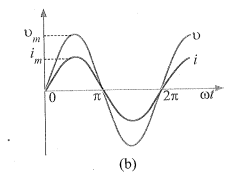
From eq. (1) and (2), it can be said that voltage and current both are in phase with each other.
[Which means both V and $i$ reach zero, minimum and maximum values at the same time.]
View full question & answer
Question 122 Marks
What is AC current and DC current? Why is AC voltage preferred compared to DC voltage in practice?
Answer
→AC current : The current that varies like a sine or cosine function with time is called AC current.
→DC current : The current that remains constant with time is called DC current.
AC voltage is preferred more than DC voltage in practice, because...
(1) Using transformers, the value of AC voltage can be changed easily.
(2) Electrical energy can be transmitted economically (and easily) over long distances.
View full question & answer
Question 132 Marks
Explain the energy losses in a transformer.
Answer
(1) The flux leakage : There is always some flux leakage. i.e. not all the flux due to primary passes through the secondary. (due to poor design of the core or the air gaps in the core).
→Sol. : It can be reduced by winding the primary & secondary coils one over the other.
(2) Resistance of the windings : The wire used for the windings has some resistance and so, energy is lost due to heat produced in the wire ( $I^2 R$ ).
→Sol. : This can be minimized by using thick wire in high current, low voltage windings.
(3) Eddy currents : The alternating magnetic flux induces eddy currents in the iron core and causes heating.
→Sol. : The effect can be reduced by housing a laminated core.
(4) Hysterisis : The magnetisation of the core is repeatedly reversed by the alternating magnetic field. The resulting expenditure of energy in the core appears as heat.
→Sol. : Can be reduced by using a magnetic material which has low hysterisis loss.
View full question & answer
Question 142 Marks
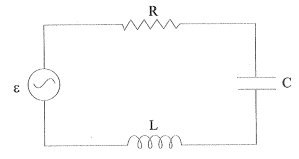
Draw the series L-C-R AC circuit and obtain the relationship between voltage and current for this circuit. (Derive the necessary equations.)
Answer

Image
Figure shows a series LCR circuit connected to an AC source ' $\varepsilon$ '.
Voltage of the source is $v=v_m \sin \omega t$.
Suppose, $q$ is the charge on the capacitor and $i$ is the current at time $t$.
From Kirchhoff's loop rule for the given closed circuit,
$\begin{aligned}
L \frac{d i}{d t}+i R +\frac{q}{ C }=v \\
\therefore \quad L \frac{d i}{d t}+i R +\frac{q}{ C }=v_m \sin \omega t
\end{aligned}$
which shows the relation between voltage and current for the LCR series AC circuit.
View full question & answer
Question 152 Marks
What is natural frequency of a system ? What is resonance? - Explain using a simple example.
###
What is resonance ? Explain using an appropriate example.
Answer
→Natural Frequency : "When a system capable of oscillating is given some initial displacement from its equilibrium position and left free, it begins to oscillate. Thus the oscillations performed by the system in the absence of any type of resistive forces are known as natural (free) oscillations."
If such a system is driven by an energy source at a frequency that is near the natural frequency, the amplitude of the oscillations is found to be large. This phenomenon is known as resonance.
→Example : A familiar example of this phenomenon is a child on a swing. The swing has a natural frequency for swinging back and forth like a pendulum. If the child pulls on the rope at regular intervals and the frequency of the pulls is almost the same as frequency of swinging, the amplitude of the swinging will be large.
View full question & answer
Question 162 Marks
What is a capacitive and an inductive AC circuit? Explain.
Answer
Amplitude of electric current in an $L - C - R$ AC series circuit (Amplitude means maximum current)
$i_m=\frac{u_m}{\sqrt{ R ^2+\left( X _{ C }- X _{ L }\right)^2}}$
Phase difference between voltage and current
$\phi=\tan ^{-1}\left(\frac{ X _{ C }- X _{ L }}{ R }\right)$
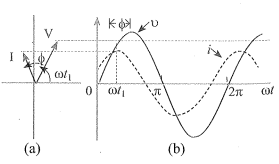
→Case-I : If $X _{ C }> X _{ L }$ phase difference $\phi$ is positive. and the circuit is predominatly capacitive. Consequently, the current in the circuit leads the source voltage.
→Case-II : If $X _{ C }< X _{ L }, \phi$ is negative and the circuit is predominantly inductive. Consequently, the current in the circuit lags the source voltage.
Image
Figure shows the phasor diagram and variation of $v$ and $i$ with $\omega t$ for the case $X _{ C }> X _{ L }$.
View full question & answer
Question 172 Marks
Derive the equation of average power for $L - C - R$ series AC circuit.
Answer
Voltage in the $L - C - R$ series AC circuit. $v=v_m \sin \omega t$ and the current driven in the circuit,
$i=i_m \sin (\omega t+\phi)$
Where, $i_m=\frac{v_m}{ Z }$ and $\phi=\tan ^{-1}\left(\frac{ X _{ C }- X _{ L }}{ R }\right)$
Therefore, the instantaneous power $p$ supplied by the source is,
$\begin{array}{l}
p=v i \\
p=\left( U _m \sin \omega t\right) \times\left[i_m \sin (\omega t+\phi)\right] \\
\therefore p=\frac{\nu_m i_m}{2}[\cos \phi-\cos (2 \omega t+\phi)] \\
\left(\sin \alpha \sin \beta=\frac{1}{2}\{\cos (\alpha-\beta)-\cos (\alpha+\beta)\}\right) \\
\end{array}$
Average of the two terms in the RHS of above equation gives the average power over one cycle.
The second term is time-dependent whose average over one time period is zero ( $\because$ The positive half cycle of the cosine cancels the negtive half.)
Therefore, Average power,
$P =\bar{p}=\frac{v_m i_m}{2} \cos \phi(\because<\cos (2 \omega t+\phi)>=0)$
$\begin{array}{l}
\therefore P =\frac{U_m}{\sqrt{2}} \frac{i_m}{\sqrt{2}} \cos \phi \\
\therefore P = VI \cos \phi
\end{array}$
This equation can also be written as,
$\therefore \quad P = I ^2 Z \cos \phi$
So, the average power dissipated depends not only on the voltage and current but also on the cosine of the phase angle $\phi$ between them.
The quantity $\cos \phi$ is called the power factor.
View full question & answer
Question 182 Marks
What is a transformer? Write down its working principle and construction.
Answer
The device using which alternating voltage can be changed from one to another of greater or smaller value, is called a transformer.
• Principle :
Electro magnetic induction (Mutual induction)
• Construction :
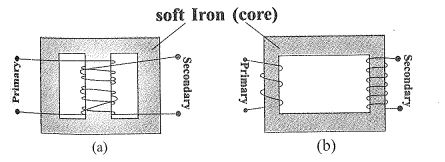
A transformer consists of two sets of coils, insulated from each other. They are wound on a soft iron core, either on top of the other as in fig. (a) or on separate limbs of the core as shown in (b).
Image
One of the coils is called the primary coil and the other is called the secondary coil.
Number of turns in the coils are $N _{ P }$ and $N _{ S }$ respectively.
Often, the primary coil is the input coil and the secondary coil is the output coil of the transformer.
When an alternating voltage is increased using a transformer, it is called step up transformer, and if the voltage is decreased, the transformer is known as step down transformer.

View full question & answer
Question 192 Marks
Write applications of the resonance phenomenon in the $L - C - R$ series circuit.
Answer
Resonant circuits have a variety of applications:
In the tuning mechanism of a radio or a TV set, the antenna acccepts (/receives) signals from so many braodcasting stations.
The signals picked up in the antenna act as a source in the tuning circuit of the radio (or TV), so the circuit can be driven by at many frequencies.
But to hear one particular radio station, we tune the radio. (or TV)
In tuning, we vary the capacitance of a capacitor in the tuning circuit such that the resonant frequency of the circuit becomes nearly equal to the frequency of the radio signal received.
When this happens, the amplitude of the current with the frequency of the signal of the particulat radio station in the circuit is maximum. And $s_0$ we can listen to that radio/TV station properly,
View full question & answer
Question 202 Marks
In RL and RC series AC circuits the resonance phenomenon isn't possible. Why?
Answer
Resonance phenomenon is exhibited by a circuit only if both L and C are present in the circuit, Only then do the voltages across $L$ and $C$ cancel each other (both being out of phase) and the current amplitude is $\frac{v_m}{R}$, the total source voltage appearing across $R$.
This means that we cannot have resonance in RL or RC circuit.
View full question & answer