Question
What is a chemical equation. How is it represented. Differentiate between a 'word equation' and a 'molecular equation' with a suitable example.

Answer

“Chemical equation is a short form $–$ representing the result of a chemical change.”
OR
“Is the representation of a chemical change.”
Word equation tells which substances react $($take part$)$ in chemical reaction and which substances are produced where as molecular equation symbols and molecular formulas are used for both reactants and products.
Example :
When zinc reacts with dilute sulphuric acid, both being reactants, products produced are zinc sulphate and hydrogen gas, which are shown as below :
Word equation :
Zinc $+$ Sulphuric acid $\rightarrow$ Zinc sulphate $+$ Hydrogen
Molecular equation :
$\underset{\text { Zinc }}{ Zn }+\underset{\text { [Sulphuric acid] }}{ H _2 SO _4 \text { (dil.) }} \longrightarrow \underset{\text { [Zinc sulphate] }}{ ZnSO _4}+\underset{\text { [Hydrogen] }}{ H _2[ g ]}$

Need a full question paper?

Generate a complete, print-ready paper with questions like this in minutes — across 16+ boards, with answer keys.
Start Generating Free

Similar questions

Starting from carbon dioxide how would you obtain $(a)$ A weak acid $(b)$ A fertilizer $(c)$ A highly poisonous gas $(d)$ Black particles of carbon. $[$Give balanced equations for the same$]$
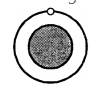
The diagram represents an isotope of hydrogen $[H],$ Answer the following:
Image
At. no.$ = 1$
Mass no. $= 1$
$1.$ Are isotopes atoms of the same element or different elements.
$2.$ Do isotopes have the same atomic number or the same mass number.
$3.$ If an isotope of $‘H’$ has mass no.$ = 2$, how many electrons does it have.
$4.$ If an isotope of ‘$H’$ has mass no. $= 3$, how many neutrons does it have.
$5.$ Which sub$-$atomic particles in the $3$ isotopes of $‘H’ $ are the same.
State the valencies of the following metallic elements $–$
$(a)$ Potassium
$(b)$ Sodium
$(c)$ Calcium
$(d)$ Magnesium
$(e)$ Zinc
$(f)$ Aluminium
$(g)$ Chromium
write each symbol with the valency
Elements are broadly classified into metals $\&$ non$-$metals. State six general differences in physical properties of metals $\&$ non$-$metals. State two metals & two non-metals which contradict with the general physical properties $–$ giving y between metalloids $\&$ noble gases.
Explain the term ‘mixture’. Differentiate between homogenous $\&$ heterogenous mixtures. State why brass is considered as a homogenous mixture while a mixture of iron $\&$ sulphur – heterogenous. Give an example of two liquids which form $–$
$(a)$ homogenous
$(b)$ heterogenous $–$ mixtures.
Give two examples each of the following oxides $–$
$(a)$ Acidic oxides
$(b)$ Basic oxides
$(c)$ Amphoteric oxides
$(d)$ Neutral
oxides. State which of the following oxides Le. $(a)$ to $(d)$
$(i)$ React with water to give a base
$(ii)$ React with a base to give salt $\&$ water
$(iii)$ React with acids $\&$ bases to give salt $\&$ water.
What are isotopes? How does the existence of isotopes contradict Dalton’s atomic theory?
Differentiate between: A balanced and an unbalanced chemical equation.
Define water of crystallization. Give two examples with formulae.
Explain with diagrams the process used to $-$ separate the following substances from the given mixtures.
$(a)$ Ammonium chloride from a mixture of $-$ ammonium chloride $\&$  potassium chloride.
$(b)$ Iron from a mixture of $-$ iron $\&$ copper
$(c)$ Sulphur from a mixture of $-$ sulphur $\&$ copper.
$(d)$ Potassium nitrate from a mixture of $-$ potassium nitrate $\&$ potassium chlorate.
$(e)$ Lead carbonate [insoluble] from a mixture of $-$ lead carbonate $\&$ water.
$(f)$ Lead nitrate [soluble] from a mixture of $-$ lead nitrate $\&$ water Le. lead nitrate solution.
$(g)$ Carbon tetrachloride from a mixture of $-$ carbon tetrachloride $[$heavier component$]\  \&$ water.
$(h)$ Benzene from a mixture of $-$ benezene $\left[\right. b.p. \left.80^{\circ} C \right]$ toluene $\left[ b . p . \ 110^{\circ} CJ\right.]$.
$(i)$ Different dyes $-$ in their liquid constituent ink.