Question
What is a filter circuit? Explain its functioning.

Answer

The rectified voltage is in the form of pulses of the shape of half sinusoilds. Though, it is unidirectional it does not have a steady value.
To get steady dc output from pulsating voltage, the filter circuit is used. Filter circuits consist of only capacitor, only inductor or a combination of both. Since these additional circuits appear to filter out the ac ripple and give a pure dc voltage, so they are called filters.
• Functioning of a Filter Circuit :
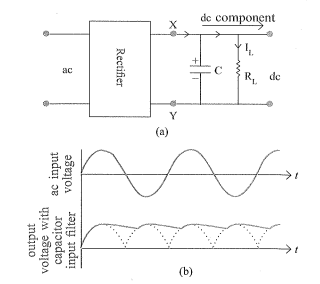
When the voltage across the capacitor is rising, it gets charged. If there is no external load, it remains charged to peak voltage of the rectified output.
When there is a load, it gets discharged through the load and the voltage across it begins to fall. In the next half cycle of rectified output it again gets charged to the peak value.
As shown in the fig., the rate of fall of the voltage across capacitor depends on the inverse product of capacitor C and the effective resistance $R_L$ used in the circuit and is called the time constant. To make the time constant large, value of C should be large. So capacitor input filters use large capacitors.
The output voltage obtained by using capacitor input filter is nearer to the peak voltage of the rectified voltage.
This type of filter is most widely used in power supplies.
Image

Need a full question paper?

Generate a complete, print-ready paper with questions like this in minutes — across 16+ boards, with answer keys.
Start Generating Free

Similar questions

A vertical rod is hit at one end. What kind of wave propagates in the rod if:
  1. The hit is made vertically.
  2. The hit is made horizontally?
Elemental semiconductor and compound semiconductors. Explain with examples.
Prove that $\varepsilon_0 \mu_0=\frac{1}{c^2}\left(\right.$ or $\left.c=\frac{1}{\sqrt{\varepsilon_0 \mu_0}}\right)$. ###
Derive the relation between the permittivity of free space $\left(\varepsilon_0\right)$, the permeability of free space $\left(\mu_0\right)$ and the speed of light $(c)$.
Derive the formula of magnetic field for a current carrying infinite wire using Ampere's circuital law and discuss its interesting cases.
The force on a charged particle due to electric and magnetic fields is given by $\overrightarrow{\text{F}}=\text{q}\overrightarrow{\text{E}}+\text{q}\overrightarrow{\text{v}}\times\overrightarrow{\text{B}}.$ Suppose $\overrightarrow{\text{E}}$ is along the X-axis and $\overrightarrow{\text{B}}$ along the Y-axis. In what direction and with what minimum speed v should a positively charged particle be sent so that the net force on it is zero?
What is the importance of radial magnetic field in a moving coil galvanometer?
The plates of a parallel-plate capacitor are made of circular discs of radii 5.0cm each. If the separation between the plates is 1.0mm, what is the capacitance?
An electric dipole of length I cm, which placed with its axis making an angle of $60^{\circ}$with uniform electric field, experiences a torque of $6\sqrt{3}$ Nm. Calculate the potential energy of the dipole if it has charge $\pm$ 2 nC.
A plate of thickness t made of a material of refractive index $\mu$ is placed in front of one of the slits in a double slit experiment.
  1. Find the change in the optical path due to introduction of the plate.
  2. What should be the minimum thickness t which will make the intensity at the centre of the fringe pattern zero? Wavelength of the light used is $\lambda$. Neglect any absorption of light in the plate.
Name the semiconductor device that can be used to regulate an unregulated dc power supply. With the help of I-V characteristics of this device, explain its working principle.