Question
What is a filter circuit? Explain its functioning.

Answer

The rectified voltage is in the form of pulses of the shape of half sinusoilds. Though, it is unidirectional it does not have a steady value.
To get steady dc output from pulsating voltage, the filter circuit is used. Filter circuits consist of only capacitor, only inductor or a combination of both. Since these additional circuits appear to filter out the ac ripple and give a pure dc voltage, so they are called filters.
• Functioning of a Filter Circuit :
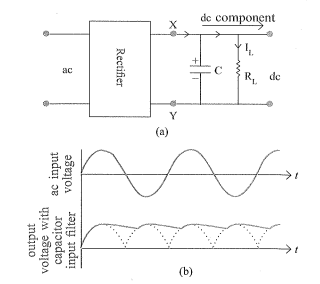
When the voltage across the capacitor is rising, it gets charged. If there is no external load, it remains charged to peak voltage of the rectified output.
When there is a load, it gets discharged through the load and the voltage across it begins to fall. In the next half cycle of rectified output it again gets charged to the peak value.
As shown in the fig., the rate of fall of the voltage across capacitor depends on the inverse product of capacitor C and the effective resistance $R_L$ used in the circuit and is called the time constant. To make the time constant large, value of C should be large. So capacitor input filters use large capacitors.
The output voltage obtained by using capacitor input filter is nearer to the peak voltage of the rectified voltage.
This type of filter is most widely used in power supplies.
Image

Need a full question paper?

Generate a complete, print-ready paper with questions like this in minutes — across 16+ boards, with answer keys.
Start Generating Free

Similar questions

A spy jumps from an airplane with his parachute. The spy accelerates downward for some time when the parachute opens. The acceleration is suddenly checked and the spy slowly falls on the ground. Explain the action of parachute in checking the acceleration.
A point source is placed at a depth h below the surface of water (refractive index = μ).
  1. Show that light escapes through a circular area on the water surface with its centre directly above the point source.
  2. Find the angle subtended by a radius of the area on the source.
Give an explanation about electric field lines and explain how they can be drawn.
Write the expression for the resistivity of the conductor and explain each term of the expression.
$A$ radioactive nucleus ‘$A’$ undergoes a series of decays according to the following scheme: $\text{A} - \xrightarrow{a}\text{A}_{1} \xrightarrow{\beta}\text{A}_{2}\xrightarrow{\alpha}\text{A}_{3}\xrightarrow{\gamma}\text{A}_{4}$
The mass number and atomic number of $A$ are $180$ and $72$ respectively. What are these numbers for $A_4$ ?
Explain that in day to day life we can't get coherent sources using two sodium lamps.
Obtain the equivalent focal length of combination of thin lenses placed in cantact.
$\left(\frac{1}{f}=\frac{1}{f_1}+\frac{1}{f_2}\right)$
Which of the following can act as a source of electromagnetic waves:
  1. A charge moving with a constant velocity.
  2. A charge moving in a circular orbit.
  3. A charge at rest.
Give reason.
Find the average magnitude of linear momentum of a helium molecule in a sample of helium gas at $0^\circ C.$ Mass of a helium molecule $= 6.64 \times 10^{-27}kg$ nd Boltzmann constant $= 1.38 \times 10^{-23}JK^{-1}.$
A test charge q is made to move in the electric field of a point charge Q along two different closed paths Fig. First path has sections along and perpendicular to lines of electric field. Second path is a rectangular loop of the same area as the first loop. How does the work done compare in the two cases?