Question
What is a functional group? Give examples of four different functional groups.

Answer

For the definition of functional group and example,
Functional Group Family Representation
$-\text{OH}$ Alcohols $\text{R}-\text{O}-\text{H}$
$\ \ \ \ \text{O}\\\ \ \ \ ||\\-\text{C}-\text{H}$ Aldehydes $\ \ \ \ \ \ \ \ \text{O}\\\ \ \ \ \ \ \ \ ||\\\text{R}-\text{C}-\text{H}$
$\ \ \ \ \text{O}\\\ \ \ \ ||\\-\text{C}-$ Ketones $\ \ \ \ \ \ \ \ \text{O}\\\ \ \ \ \ \ \ \ ||\\\text{R}-\text{C}-\text{R}$
$\ \ \ \ \text{O}\\\ \ \ \ ||\\-\text{C}-\text{OH}$ Carboxylic acids $\ \ \ \ \ \ \ \ \text{O}\\\ \ \ \ \ \ \ \ ||\\\text{R}-\text{C}-\text{OH}$
$-\text{N}-\text{H}\\\ \ \ \ |\\\ \ \ \text{H}$ Amines $\text{R}-\text{NH}_2$
$-\text{O}-$ Ethers $\text{R}-\text{O}-\text{R}$
$-\text{X}\ (\text{halogen})$ Haloalkanes $\text{R}-\text{X}$
$-\text{NO}_2$ Nitroalkanes $\text{R}-\text{NO}_2$

Need a full question paper?

Generate a complete, print-ready paper with questions like this in minutes — across 16+ boards, with answer keys.
Start Generating Free

Similar questions

A compound $X$ is formed by the reaction of a carboxylic acid $C _2 H _4 O _2$ and an alcohol in presence of a few drops of $H _2 SO _4$. The alcohol on oxidation with alkaline $KMnO _4$ followed by acidification gives the same carboxylic acid as used in this reaction. Give the names and structures of:
a. Carboxylic acid.
b. Alcohol.
c. The compound X . Also, write the reaction.
An organic compound A on heating with concentrated $H _2 SO _4$ forms a compound B which on addition of one mole of hydrogen in presence of Ni forms a compound C . One mole of compound C on combustion forms two moles of $CO _2$ and 3 moles of $H _2 O$. Identify the compounds $A , B$ and C and write the chemical equations of the reactions involved.
X, Y, and Z are three animals. The animal X can fly but animal Y can only run on ground or walls. The forelimbs of animals X and Y have the same basic design but they are used for different purposes such as flying and running respectively. The animal Z became extinct an long time ago. The study of fossils of Z tells us that it had some features like those of X and some like those of Y. In fact, Z is said to form a connecting link in the evolutionary chain of X and Y.
  1. What could the animals X, Y and Z be?
  2. What name is given to the forelimbs like those of X and Y which have the same basic design but different functions?
  3. Name one feature in which Z resembled X.
  4. Name one feature in which Z resembled Y.
  5. Which is the correct evolutionary chain involving X, Y and Z : X → Z → Y or Y → Z → X?
A carbon compound ‘P' on heating with excess cont. $H2SO_4$ forms another carbon compound ‘Q' which on addition of hydrogen in the presence of nickel catalyst forms a saturated carbon compound ‘R'. One molecule of ‘R' on combustion forms two molecules of carbon dioxide and three molecules of water. Identify P, Q and R and write chemical equations for the reactions involved.
Define magnetic field lines. Describe an activity to draw a magnetic field line outside a bar magnet from one pole to another pole.
i. List three points of difference between nervous and hormonal mechanisms for control and coordination in animals.
ii. How are auxins related with the bending of plant shoot towards unidirectional light? Explain.
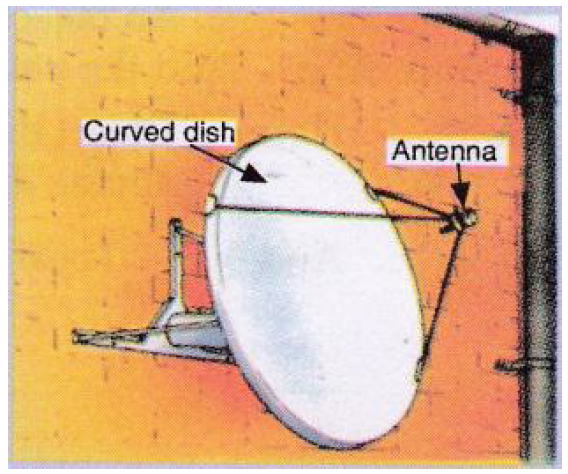
The diagram shows a dish antenna which is used to receive television signals from a satellite. The antenna (signal detector) is fixed in front of the curved dish.
  1. What is the purpose of the dish?
  2. Should it be concave or convex?
  3. Where should the antenna be positioned to receive the strongest possible signals?
  4. Explain what change you would expect in the signals if a larger dish was used.
a) A doctor has advised Sameer to reduce sugar intake in his diet and do regular exercise after checking his blood test reports. Which disease do you think Sameer is suffering from? Name the hormone responsible for this disease and the organ producing the hormone.
b) Which hormone is present in the areas of rapid cell division in a plant and which hormone inhibits the growth?
A student focussed the image of a candle flame on a white screen using a convex lens. He noted down the position of the candle screen and the lens as under,
Position of candle = 12.0cm
Position of convex lens = 50.0cm
Position of the screen = 88.0cm
  1. What is the focal length of the convex lens?
  2. Where will the image be formed if he shifts the candle towards the lens at a position of 31.0cm?
  3. What will be the nature of the image formed if he further shifts the candle towards the lens?
  4. Draw a ray diagram to show the formation of the image in case (iii) as said above.
When a person puts food in his mouth, then teeth cut it into small pieces, chew and grind it. The glands A in the mouth secrete a substance B which is mixed with the food by tongue. The substance B contains an enzyme C which starts the digestion of food in the mouth. The slightly digested food from the mouth goes down a tube D. The special type of movements E in the walls of tube D push the food into stomach for further digestion. The stomach wall secretes gastric juice containing three substance F, G and H. One of the functions of F is to kill bacteria which may enter the stomach with food. The substance G protects the inside layer of stomach from the damaging effect of substance F whereas substance H is and enzyme for digestion. The partially digested food then enters into small intestine for further digestion.
  1. What is Gland A, Substance B and Enzyme C?
  2. Name the tube D.
  3. What is the movement E known as?
  4. What are F, G and H?