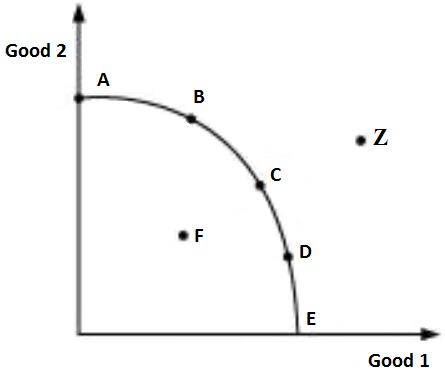
Question
What is a production possibility frontier?
Generate a complete, print-ready paper with questions like this in minutes — across 16+ boards, with answer keys.
OR
Using indifference curve approach, explain the conditions of consumer's equilibrium.OR
Why is the consumer in equilibrium when he buys only that combination of the two goods that is shown at the point of tangency of the budget line with an indifference curve? Explain.OR
What are the conditions of consumer's equilibrium under the indifference curve approach? What changes will take place if the conditions are not fulfilled to reach equilibrium?OR
State and explain the conditions of consumer's equilibrium in indifference curve analysis.OR
Explain consumer equilibrium using the concept of budget line and indifference map or Interior Optimum Consumer Equilibrium.OR
A consumer consumes only two of goods. For the consumer to be in equilibrium why must Marginal Rate of Substitution between the two goods must be equal to the ratio of prices of these two goods? Is it enough to ensure equilibrium?OR
A consumer consumes only two goods. Explain the conditions that need to be satisfied for the consumer to be in equilibrium under indifference curve analysis.OR
Show diagrammatically the conditions for consumer's equilibrium, in Hicksian analysis of demand.OR
Explain the conditions of consumer's equilibrium under indifference curve approach.| S. No. | | (₹ in lakhs) |
| (i) | Sales by firm A. | 300 |
| (ii) | Purchases from firm B by firm A. | 120 |
| (iii) | Purchases from firm A by firm B. | 180 |
| (iv) | Sales by firm B. | 600 |
| (v) | Closing stock of firm A. | 60 |
| (vi) | Closing stock of firm B. | 105 |
| (vii) | Opening stock of firm A. | 75 |
| (viii) | Opening stock of firm B. | 135 |
| (ix) | Indirect taxes by both firms. | 90 |
| Price per unit(Rs.) | Output(units) | Total cost(Rs.) |
| 8 | 1 | 6 |
| 7 | 2 | 11 |
| 6 | 3 | 15 |
| 5 | 4 | 18 |
| 4 | 5 | 23 |