Question
  1. What is a trophic level in an ecosystem? What is ‘standing crop’ with reference to it?
  2. Explain the role of the ‘first trophic level’ in an ecosystem.
  3. How is the detritus food chain connected with the grazing food chain in a natural ecosystem?

Answer

  1. Tropic level: Organisms occupy a place in the natural surroundings or in a community according to their feeding relationship with other organisms. Based on the source of their nutrition or food, organisms occupy a specific place in the food chain and this is known as trophic level.

Each trophic level has a certain mass of living material at a particular time and this is called as Standing crop. It is measured as the mass of living organisms (biomass) or the number in a unit area.

  1. First trophic level is formed by producers.

This is the basic unit.

These organisms can live without feeding on any another level.

The only thing that these organisms need to survive is sunlight and water which they can turn into energy themselves.

All other trophic levels depend on this level for energy.

  1. GFC is Grazing Food Chain: It is depicted as below:

Producers → Primary consumers → Secondary consumers

DFC is Detritus Food Chain: It begins with dead organic matter. It is made up of decomposers which are heterotrophic organisms like fungi, bacteria etc.

GFC is the major conduct for energy flow. DFC may be connected with GFC at some levels: Some of the organisms of DFC are prey to the GFC animals.

$\text{Producers}\xrightarrow[]{\downarrow\ \text{Decomposers}}\ \text{Primary consumers}\xrightarrow[]{\downarrow\ \text{Decomposers}}\ \text{Secondary consumers.}$

These natural inter connection of food chains forms food web.
Need a full question paper?

Generate a complete, print-ready paper with questions like this in minutes — across 16+ boards, with answer keys.

Start Generating Free

Similar questions

How do you express the meaning of words like race, breed, cultivars or variety?
How is the placenta connected to the embryo?
Describe the roles of pituitary and ovarian hormones during the menstrual cycle in a human female.

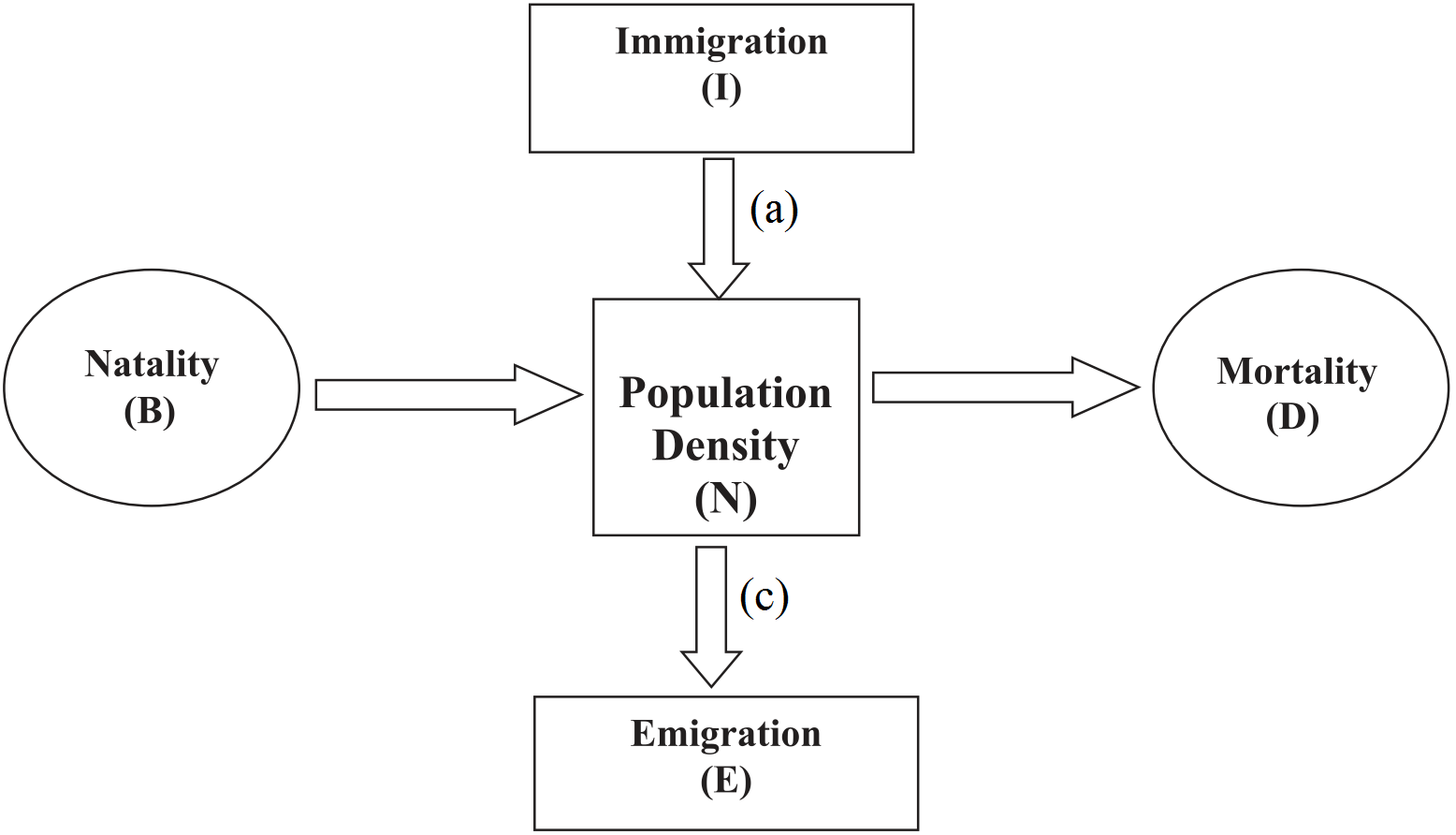
  1. Which of the above represents the increase or decrease of population?
  2. If N is the population density at time t, then what would be its density at time (t + 1)? Give the formula.
  3. In a barn there were 30 rats. 5 more rats enter the barn and 6 out of the total rats were eaten by the cats. If 8 rats were born during the time period under consideration and 7 rats left the barn, find out the resultant population at time (t + 1).
  4. If a new habitat is just being colonized, out of the four factors affecting the population growth, which factor contributes the most?
Explain insertional inactivation.
If a desired gene is identified in an organism for some experiments, explain the process of the following:
i. Cutting this desired gene at specific location.
ii. Synthesis of multiple copies of this desired gene.
Define genetic engineering. Mention its main stages.
What is DNA fingerprinting? Mention its application.
What is population explosion? Discuss the various reason of population explosion.
a. Describe aminoacylation of tRNA.
b. Explain the process that takes place in the ribosomes when mRNA makes its entry into it in a prokaryote.
c. Due to transcription error, ATG codon of DNA is transcribed into UAG in mRNA which translates a nonfunctional polypeptide chain in the ribosome. Justify the statement.