Question
What is Accounting? Explain four of its functions.

Answer

Accounting is the art of recording, classifying, summarising and communicating financial information to users for correct decision making.
  1. Maintaining Systematic Accounting Records: The primary function of accounting is to maintain systematic accounting records of financial transactions and events. It means that the accounting records should be maintained following the accounting rules, principles and concepts. It is so because reliable financial statements can be drawn if proper accounting records are maintained.
  2. Preparation of Financial Statements: Financial statements means final accounts prepared at the end of the accounting period. It includes Income Statement (Profit and Loss Account) and Position Statement (Balance Sheet). It is an important function of accounting because the financial statements show the financial performance, i.e., provit earned or loss incurred during the accounting year and the financial position, 1.2., Balance Sheet as at the end of the accounting year. Both the statements are important for all the users for taking decisions.
  3. Meeting Legal Requirements: Accounting records are accepted as evidence by the court of law if they are maintained systematically following the accounting rules, principles and concepts. Besides, the law such as the Companies Act, Income Tax Act, GST Act, etc., require submissions of returns in the form and period as is prescribed in the law. The returns can be submitted if the accounting records are maintained systematically and timely. A systematic accounting record maintained following the accounting principles and concepts is accepted by the authorities to be correct. Thus, it is a function of accounting to meet the legal requirements.
  4. Communicating the Financial Information: It is yet another function of accounting to communicate the financial information to the users, which may be interrial users cr external users, such as management, banks, employees, government authorities, etc.

Need a full question paper?

Generate a complete, print-ready paper with questions like this in minutes — across 16+ boards, with answer keys.

Start Generating Free

Similar questions

Following balances were extracted from the books of Rajesh Associates as at 31st March, 2023:Following balances were extracted from the books of Rajesh Associates as at 31st March, 2023:


( ₹ )


(₹)

Sundry Debtors

4,10,000

Stock (April 1, 2022)

2,30,000

Sundry Creditors

80,000

Premises

12,00,000

Rent and Taxes

48,000

Fixtures & Fittings

3,10,000

Purchases

34,00,000

Bad Debts written off

8,000

Sales

56,00,000

Rent received from sub-let of part of premises

30,000

Trade Expenses

12,000

Loan from Rahul

1,50,000

Returns Outwards

80,000

Interest on Rahul's Loan

15,000

Returns Inwards

1,20,000

Drawings

40,000

Expenses

4,000

Cash in hand

75,000

Motor Vehicles

6,50,000

Stock on 31st March, 2023


Electricity

25,000

(not adjusted)

3,80,000

You are required to prepare the trial balance treating the difference as his capital.
What will be the effect of the following on the Accounting Equation?
  1. Harish started business with cash ₹ 18,000
  2. Purchased goods for Cash ₹ 5,000 and on credit ₹ 2,000
  3. Sold goods for cash ₹ 4,000 (costing ₹ 2,400)
  4. Rent paid ₹ 1,000 and rent outstanding ₹ 200
“Revenue earned and cost of earning that revenue should be properly identified for a period." Explain this statement.
Tiwari and Sons find that the bank balance shown by their Cash Book on December 31, 2016 is ₹ 40,500 (Credit) but the Pass Book shows a difference due to the following reasons:
  1. A cheque for ₹ 5,000 drawn in favour of Manohar has not yet been presented for payment.
  2. A post-dated cheque for ₹ 900 has been debited in the bank column of the Cash Book but it could not have been presented in any case.
  3. Cheques totalling ₹ 10,200 deposited with the bank have not yet been collected and an another cheque for ₹ 4,000 deposited in the account has been dishonoured.
  4. A Bill Payable for ₹ 10,000 was retired by the Bank under a rebate of ₹ 150 but the full amount of the bill was credited in the bank column of the cash book.
Prepare a Bank Reconciliation Statement and find out the balance as per Pass Book.
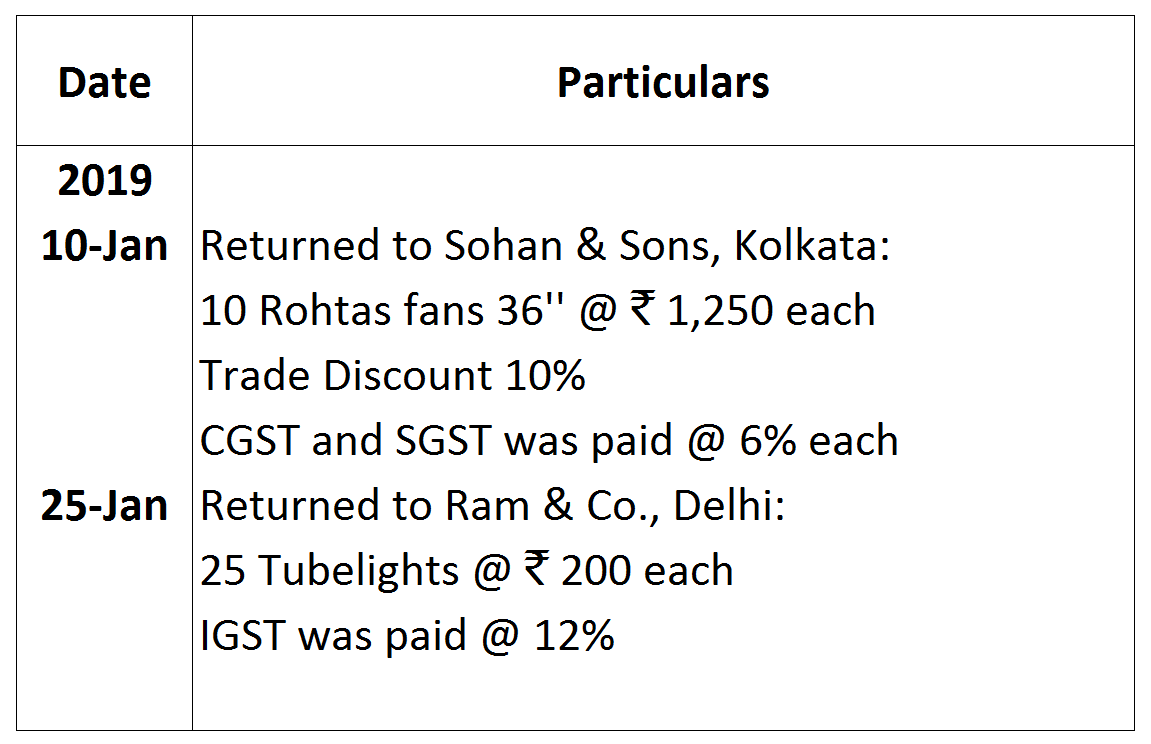
Prepare Purchases Return Book of Aruna Stores, Kolkata from the following transactions and post them into Ledger:
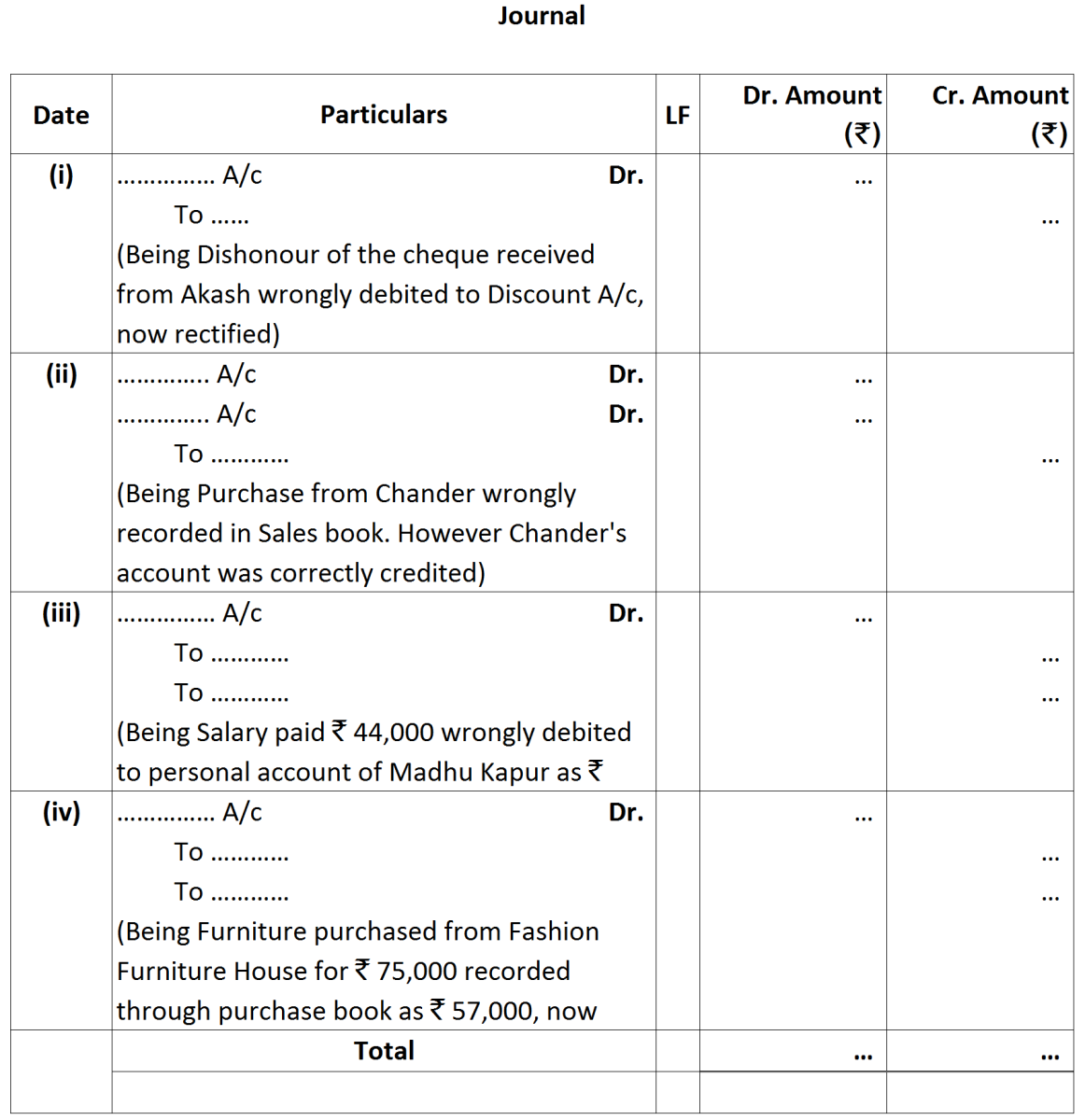
Fill up the missing information in the following rectifying entries:
Name the books of original entry where the following transactions will be recorded with reasons thereof:
  1. Goods purchased from Ram Lal for ₹ 5,000 on credit.
  2. Provision for doubtful debts created @ 5% on debtors with books value of ₹ 10,000.
  3. Defective goods sold to Babita on credit worth ₹ 4,000 were returned by her.
  4. Purchased furniture on credit from Mr. Ratan Singh for ₹ 15,000 for use in the business.
On 31st December, 2014, pass book shows debit balance of ₹ 7,500. From the following particulars, prepare a Bank Reconciliation Statement:
  1. Cheques paid in for collection amounted to ₹ 20,600 but cheques of ₹ 7,800 were credited on 3rd January, 2015.
  2. A cheque of ₹ 1,000 debited in cash book was omitted to be banked.
  3. Cheques of ₹ 7,800 were drawn on 27th December of which cheques of ₹ 2,400 were cashed upto 31st December.
  4. A cheque of ₹ 800 was banked and credited, but omitted to be recorded in cash book.
  5. Bank charged interest on Overdraft ₹ 650.
State three advantages of Sub-Division of Journal.
On 10th January, 2017, A sells goods to B for ₹ 12,000. On that date, B accepted a bill drawn upon him by A at two months for ₹ 12,000. A retains the bill till due date and on due date sends the bill to the Banker for collection. In due course, A receives the information from the Bank that the bill has been duly met.
Pass Journal Entries in the books of A and B.