Question
State three advantages of Sub-Division of Journal.

Answer

Advantages of Sub-Division of Journal:
  1. Division of Work: Since in place of one Journal, Subsidiary Books are maintained, accounting work can be divided among a number of persons.
  2. Specialisation and Efficiency: When the same work is handled by a particular person for a considerable time, he acquires knowledge and expertise in it. He becomes more efficient in handling it. Thus, accounting is done more efficiently.
  3. Saving of Time: Various accounting processes can be undertaken simultaneously because of the use of number of books. Thus, it leads to completing the work timely.
  4. Availability of Information: Since a separate book is maintained for each class of transactions, information relating to each class is available at one place.

Need a full question paper?

Generate a complete, print-ready paper with questions like this in minutes — across 16+ boards, with answer keys.

Start Generating Free

Similar questions

Enter the following transactions in a simple cash book for December 2017:
 
 
01
Cash in hand
7,750
06
Paid to Sonu
45
08
Purchased goods
600
15
Received cash from Parkash
960
20
Cash sales
500
25
Paid to S.Kumar
1,200
30
Paid rent
600
Give an example of a Voucher?
From the following particulars, prepare a Bank Reconciliation Statement of Sh. Yadav on 31st December 2014:- Balance as per Pass Book on 31st December, 2014 is ₹ 11,000. Cheques for ₹ 6,200 were issued during the month of December but of these cheques for ₹ 900 were presented in the month of January, 2015 and one cheque for ₹ 500 was not presented for payment. Cheque and cash amounting to ₹ 5,700 were deposited in bank during December but credit was given for ₹ 4,700 only. A customer had deposited ₹ 850 into the bank directly. The bank has credited the merchant for ₹ 150 as interest and has debited him for ₹ 30 as bank charges, for which there are no corresponding entries in Cash Book.
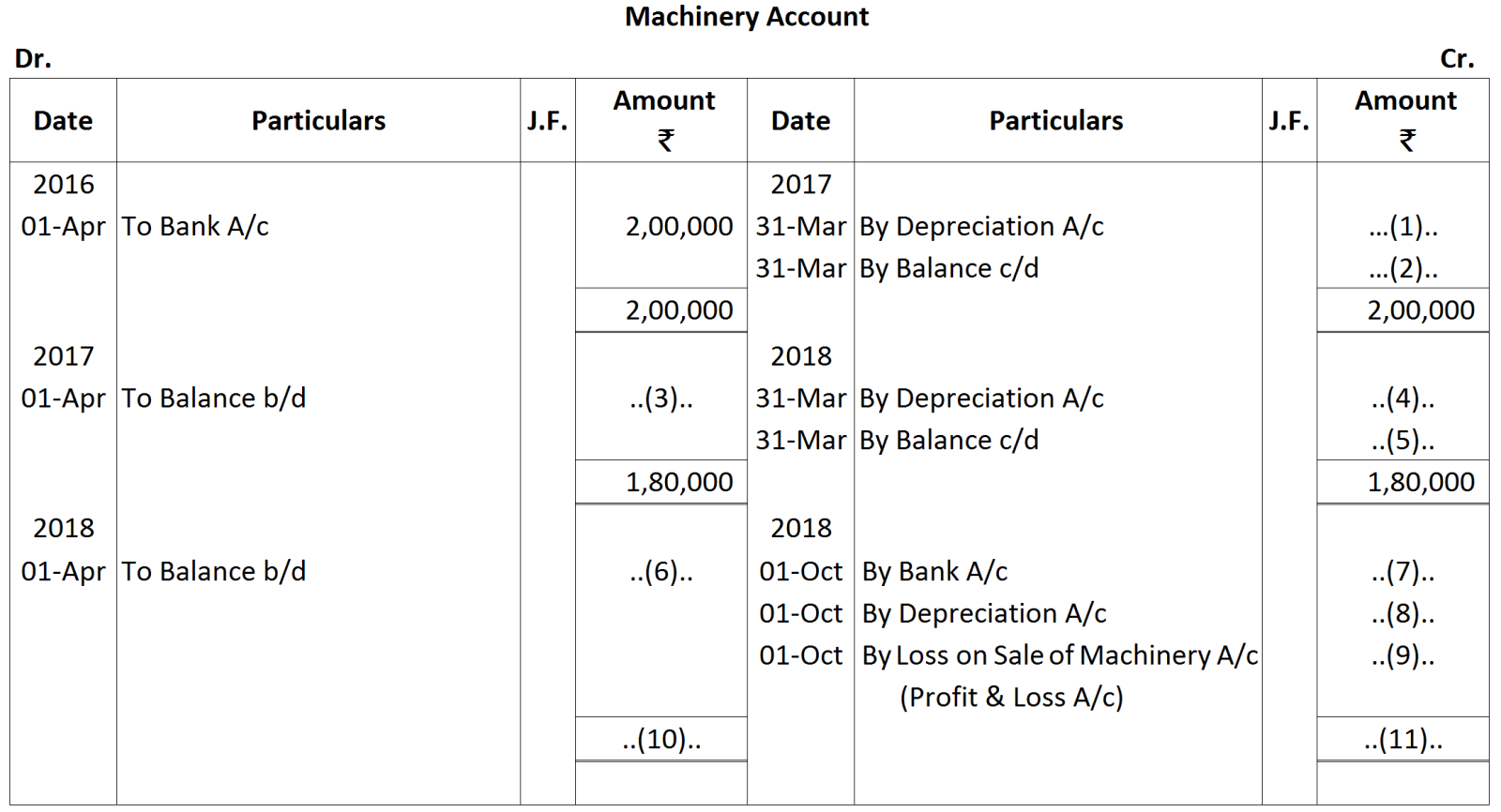
In the following Machinery Account, determine the missing values, if depreciation is to be charged @ 10% p.a. on the Original Cost. On 1st October, 2018, the machinery was sold for ₹ 1,20,000.
On 31st March, 2023, Bank Statement of Gopal shows credit balance of ₹ 33,570
whereas Cash Book showed debit balance of ₹ 53,000.
It was observed that the differences were because of the following:
i. Cheques and drafts sent to the bank but not collected and credited, amounted to ₹ 7,900 while cheque for ₹ 2,000 was received unpaid.
ii. Three cheques drawn for ₹ 3,000; ₹ 1,500 and ₹ 2,000 respectively were not presented for payment till 30th April, 2023.
iii. Bank has paid a cheque of ₹ 10,000 but it has not been entered in the Cash Book and a cheque of ₹ 5,000 which was discounted with the bank was dishonoured by the drawee on the due date.
iv. Bank has charged ₹ 130 as its commission for collecting outstation cheques and had credited an interest of ₹ 100 in the account.
v. A wrong debit of ₹ 5,000 was made by the bank, which was reversed on 4th April, 2023. Prepare Bank Reconciliation Statement as on 31st March, 2023.
On 15th February, 2019, X sold goods to Y for ₹ 60,000. On the same day, Y accepted a bill drawn upon him by X for three months for ₹ 60,000. X immediately discounted the bill at 15% p.a. at his bank and Y met the bill on maturity. Make Journal entries in the books of both the parties.
If in the above case, the proprietor had introduced fresh capital of ₹ $40,000 $and had withdrawn ₹ $10,000 $for personal purposes, calculate his profits.
Record the following transaction in simple cash book for November 2016:
 
 
01
Cash in hand
12,500
04
Cash paid to Hari
600
07
Purchased goods
800
12
Cash received from Amit
1,960
16
Sold goods for cash
800
20
Paid to Manish
590
25
Paid cartage
100
31
Paid salary
1,000
“Only financial transactions are recorded in Accountancy.” Explain the statement.
Explain the need for drawing up the special purpose books.