Question
What is adiabatic process? Establish the equation of state for this.

Answer

SELF

Need a full question paper?

Generate a complete, print-ready paper with questions like this in minutes — across 16+ boards, with answer keys.
Start Generating Free

Similar questions

$A$ and $B$ are two identical balls. $A$ moving with a speed of $6ms^{-1}$ along the positive $x-$ axis, undergoes a collision with $B,$ intially at rest. After collision each ball moves and the directions making of
Three identical charges, each having a value $1.0 \times 10^{-8}C$, are placed at the corners of an equilateral triangle of side $20cm$. Find the electric field and potential at the centre of the triangle.
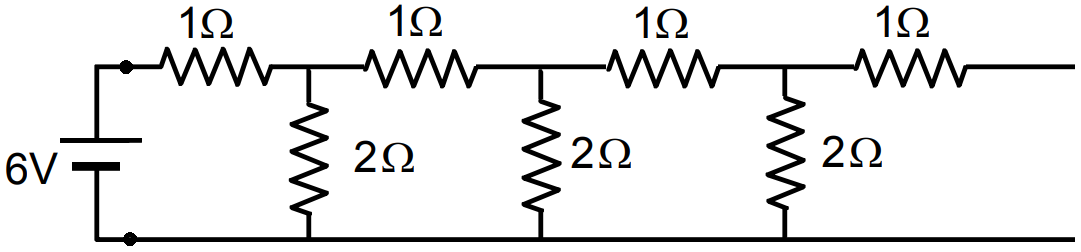
An infinite ladder is constructed with $1\Omega$ and $2\Omega$ resistors, as shown in the figure. (a) Find the effective resistance between the points A and B. (b) Find the current that passes through the $2\Omega$ resistor nearest to the battery.
Let us assume that our galaxy consists of $2.5 \times 10^{11}$ stars each of one solar mass. How long will a star at a distance of $50,000 \mathrm{ly}$ from the galactic centre take to complete one revolution? Take the diameter of the Milky Way to be $10^5 \mathrm{ly}$.
A uniform chain of mass M and length L is held vertically in such a way that its lower end just touches the horizontal floor. The chain is released from rest in this position. Any portion that strikes the floor comes to rest. Assuming that the chain does not form a heap on the floor, calculate the force exerted by it on the floor when a length x has reached the floor.
Suppose all the electrons of 100g water are lumped together to form a negatively charged particle and all the nuclei are lumped together to form a positively charged particle. If these two particles are placed 10.0cm away from each other, find the force of attraction between them. Compare it with your weight.
Two identical balls A and B undergo a perfectly elastic two dimensional collision. Initially A is moving with a speed of $10ms^{-1}$ and B is at rest. Due to collision A is scattered through angle of $30°$. What are the speed of A and B after the collision?
Separation of Motion of a system of particles into motion of the centre of mass and motion about the centre of mass: Show $\text{L}=\text{L}'+\text{R}\times\text{MV}$ where $\text{L}'=\sum\text{r}'_\text{i}\times\text{p}'_\text{i}$ is the angular momentum of the system about the centre of mass with velocities taken relative to the centre of mass. Remember $\text{r}'_\text{i}=\text{r}_\text{i}-\text{R},$ rest of the notation is the standard notation used in the chapter. Note: $\text{L}'$ and $\text{MR}\times\text{V}$ can be said to be angular momenta, respectively, about and of the centre of mass of the system of particles.
Reynold's number $N_R$ (a dimensionless quantity) determines the condition of laminar flow of a viscous liquid through a pipe. $N_R$​​​​​​​ is a function of the density of the liquid r, its average speed is v and the coefficient of viscosity of the liquid is h. If $N_R​​​​​​​$ is given directly proportional to d (the diameter of the pipe), show from dimensional consideration that $\text{N}_\text{R}\propto\frac{\text{d}\rho\upsilon}{\eta}$ the unit of $\eta$ in S.I. system is $kg m^{-1} s^{-1}$.
What do you understand by a driven simple harmonic oscillator? Derive the differential equation of its motion and explain it.