Question
What is alcoholism? What are its effects?

Answer

  • Alcoholism is the addiction to have alcohol in the form of different types of liquor. Liquor is produced from alcohol. Alcohol is in turn obtained by fermentation of different substances.
  • Consuming liquor becomes an addiction for a long-term. Due to alcohol, the efficiency of nervous system and especially the brain is affected.
  • Other vital organs such as kidneys and liver are adversely affected.
  • Lifespan of an alcoholic decreases due to constant drinking and malnourishment.
  • Especially in adolescent age if alcohol is consumed the brain functioning does not take place properly. The mental ability of memorization and learning becomes slow. There is lack of concentration in studies.
  • The alcoholic person lacks the rational thinking and hence faces with social, mental and familial problems along with physical illness.

Need a full question paper?

Generate a complete, print-ready paper with questions like this in minutes — across 16+ boards, with answer keys.

Start Generating Free

Similar questions

Draw a labelled diagram of the human respiratory system.
The image in a plane mirror is virtual and laterally inverted. What does this statement mean?
Give one word for “The forest conserved in the name of God.” (Board’s Model Activity Sheet)
Sketch, labell and classify: Wall Lizard
Balance the following equation stepwise.
Take into account the time required for following processes. Classify them into two groups and give titles to the groups.
(i) Cooking gas starts burning on ignition.
(ii) Iron article undergoes rusting.
(iii) Erosion of rocks takes place to form soil.
(iv) Alcohol is formed on mixing yeast in glucose solution under proper condition.
(v) Effervescence is formed on adding baking soda into a test tube containing dilute acid.
(vi) A white precipitate is formed on adding dilute sulphuric acid to barium chloride solution.
The organ A which is located inside the skull of our body is protected by a bony shell B. It is surrounded by three layers membranes C. The spaces between these layers are filled with a liquid D which protects organ A from mechanical shocks. Organ A in combination with another organ E makes up the central nervous system.
  1. What is organ A?
  2. What are B, C and D?
  3. Name the organ E.
  4. While walking barefoot, if we happen to step on a sharp piece of stone, we immediately lift our foot up. Which of the two organs: A or E, is directly involved in this action?
  5. If we step out from a darkened room into bright sunlight, we close our eyes for a moment. Which of the two organs: A or E, is directly involved in this action?
When a spherical mirror is held towards the sun and its sharp image is formed on a piece of a carbon paper for some time, a hole is burnt in the carbon paper.
  1. What is the nature of spherical mirror?
  2. Why is a hole burnt in the carbon paper?
  3. At which point of the spherical mirror the carbon paper is placed?
  4. What name is given to the distance between spherical mirror and carbon paper?
  5. What is the advantage of using a carbon paper rather than a white paper?
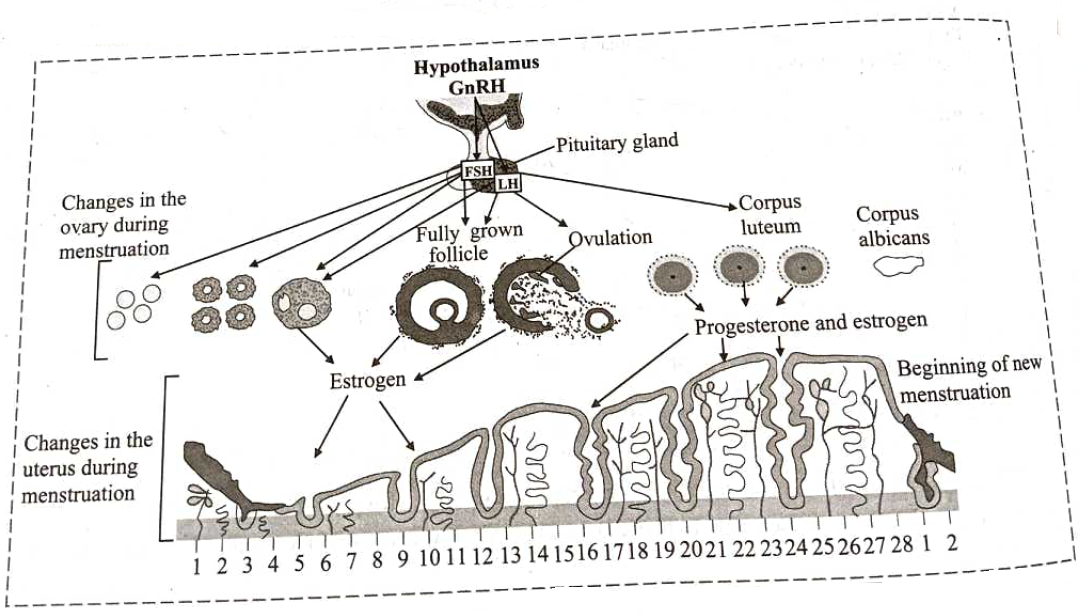
Answer the following questions by observing the diagram of menstrual cycle:
Image
i. What is the period of menstruation?
ii. On which day does ovulation occur during menstrual cycle?
iii. In menstrual cycle which reproductive organs undergo changes?
iv. Which period is said to be period of regeneration of endometrium?
v. Which period is said to be period of secretions of glands in endometrium?
Write a short note on Electrical energy generation and environment.
What is meant by an artificial satellite? How are the satellites classified based on their functions?