Question
What is an alternating current (AC)?
Answer

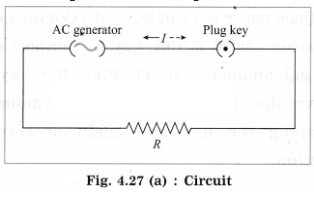
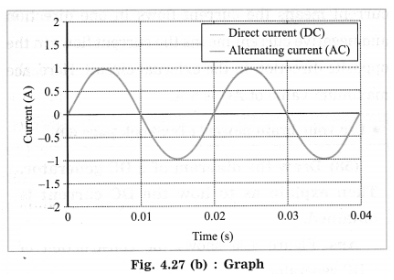
A current that changes in magnitude and direction after equal intervals of time is called an alternating current (AC) (Fig. 4.27).
Image
Image

Electric current changes sinusoidally with time. Electric current and potential difference are shown by the symbol ~.
[Note: An alternating current is obtained with an AC generator.]

Need a full question paper?

Generate a complete, print-ready paper with questions like this in minutes — across 16+ boards, with answer keys.

Start Generating Free

Similar questions

An electric bulb is connected to a source of 250 volts. The current passing through it is 0.27 A. What is the power of the bulb?
What physical and chemical properties of elements did Mendeleev consider in compiling the periodic table?
How the biodiversity can be conserved?
Find the power of a convex lens of focal length 12.5 cm.
The absolute refractive index of a transparent medium is 5/3. Find the speed of light in the medium.
An element has its electron configuration as $2,8,1$. Now answer the following questions:
i. What is the atomic number of this element?
ii. What is the group of this element?
iii. To which period does the element belong?
Explain with suitable examples importance of anatomical evidences in evolution.
###
Explain the importance of Anatomical evidences with examples.
What are the disadvantages of burning fossil fuels?
The atomic masses of three elements X, Y and Z having similar chemical properties are 7, 23 and 39 respectively.
  1. Calculate the average atomic mass of elements X and Z.
  2. How does the average atomic mass of elements X and Z compare with the atomic mass of element Y?
  3. Which law of classification of elements is illustrated by this example?
  4. What could the elements X, Y and Z be?
  5. Give another example of a set of elements which can be classified according to this law.
A calorimeter has mass $100g$ and specific heat $0.1 \ kcal/kg^\circ C.$ It contains $250 \ gm$ of liquid at $30 ^\circ C$ having specific heat of $0.4 \ kcal/kg^\circ C.$ If we drop a piece of ice of mass $10g$ at $0^\circ C,$ What will be the temperature of the mixture?