Question
What is an ammeter? How can we convert any galvanometer into an ammeter of given range? Explain.###Describe briefly that how and when any galvanometer is converted into an ammeter?

Answer

SELF

Need a full question paper?

Generate a complete, print-ready paper with questions like this in minutes — across 16+ boards, with answer keys.
Start Generating Free

Similar questions

An adiabatic vessel of total volume V is divided into two equal parts by a conducting separator. The separator is fixed in this position. The part on the left contains one mole of an ideal gas (U = 1.5nRT) and the part on the right contains two moles of the same gas. Initially, the pressure on each side is p. The system is left for sufficient time so that a steady state is reached. Find,
  1. The work done by the gas in the left part during the process.
  2. The temperature on the two sides in the beginning.
  3. The final common temperature reached by the gases.
  4. The heat given to the gas in the right part.
  5. The increase in the internal energy of the gas in the left part.
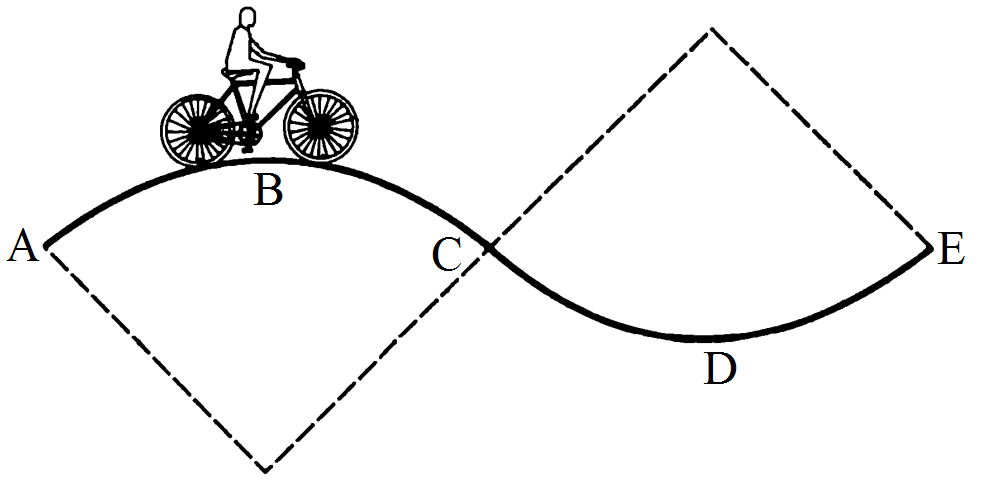
A track consists of two circular parts ABC and CDE of equal radius 100m and joined smoothly as shown in figure. Each part subtends a right angle at its centre. A cycle weighing 100 kg together with the rider travels at a constant speed of 18km/h on the track.
  1. Find the normal contact force by the road on the cycle when it is at B and at D.
  2. Find the force of friction exerted by the track on the tyres when the cycle is at B, C and D.
  3. Find the normal force between the road and the cycle just before and just after the cycle crosses C.
  4. What should be the minimum friction coefficient between the road and the tyre, which will ensure that the cyclist can move with constant speed? Take g= 10m/s2.

A small bulb is placed at the bottom of a tank containing water to a depth of 80cm. What is the area of the surface of water through which light from the bulb can emerge out? Refractive index of water is 1.33. (Consider the bulb to be a point source).
When a Coolidge tube is operated for some time it becomes hot. Where does the heat come from?
The resistance of an iron wire and a copper wire at 20°C are $3.9\Omega$ and $4.1\Omega,$ respectively. At what temperature will the resistance be equal? Temperature coefficient of resistivity for iron is $5.0\times10^{-3}\text{K}^{-1}$ and for copper, it is $4.0\times10^{-3}\text{K}^{-1}.$ Neglect any thermal expansion.
When a light ray passes from the atmosphere (a) through the combination of two mediums water (b) and glass (c), then find the relationship between the refractive indices of the three mediums.
A plane EM wave travelling along z direction is described by $\text{E}=\text{E}_0\sin(\text{kz}-\omega\text{t})\hat{\text{i}}\text{ and }\text{B}=\text{B}_0\sin(\text{kz}-\omega\text{t})\hat{\text{j}}$. Show that,

  1. The average energy density of the wave is given $\text{u}_\text{av}=\frac{1}{4}\in_0\text{E}_0^2+\frac{1}{4}\frac{\text{B}_0^2}{\mu_0}$.

  2. The time averaged intensity of the wave is given $\text{I}_\text{av}=\frac{1}{2}\text{c}\in_0\text{E}_0^2$.
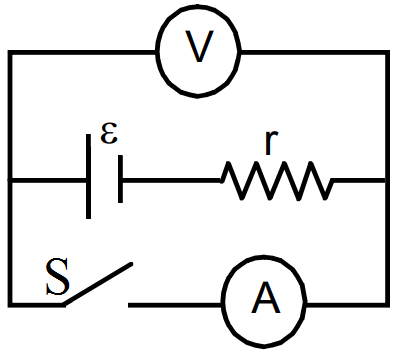
Figure. shows an arrangement to measure the emf $\in$ and internal resistance r of a battery. The voltmeter has a very high resistance and the ammeter also has some resistance. The voltmeter reads 1.52V when the switch S is open. When the switch is closed, the voltmeter reading drops to 1.45V and the ammeter reads 1.0A. Find the emf and the internal resistance of the battery.

Two long, straight wires, each carrying a current of 5A, are placed along the X and Y-axes respectively. The currents point along the positive directions of the axes. Find the magnetic fields at the points (a) (1m, 1m), (b) (-1m, 1m), (c) (-1m,-1m) and (d) (1m, -1m),
Describe the potential energy of an electric dipole in an external field in different positions also draw the diagram.