Question
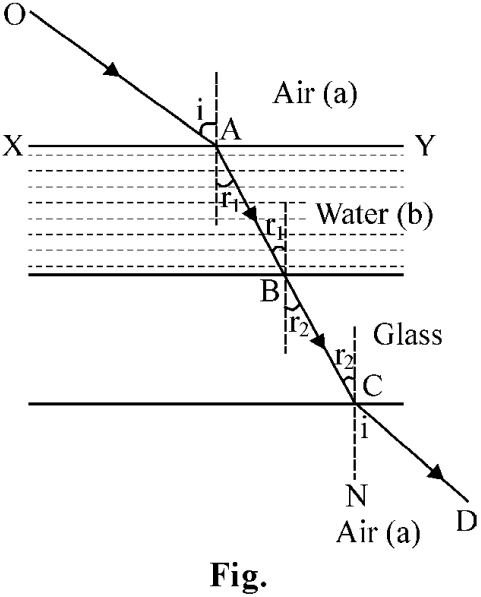
When a light ray passes from the atmosphere (a) through the combination of two mediums water (b) and glass (c), then find the relationship between the refractive indices of the three mediums.

Need a full question paper?

Generate a complete, print-ready paper with questions like this in minutes — across 16+ boards, with answer keys.
Start Generating Free

Similar questions

Consider the fission of $^{238}_{92}\text{U}$ by fast neutrons. In one fission event, no neutrons are emitted and the final end products, after the beta decay of the primary fragments, are $^{140}_{58}\text{Ce}$ and $^{99}_{44}\text{Ru}.$ Calculate Q for this fission process.
The relevant atomic and particle masses are:
$\text{m}(^{238}_{92}\text{U})=238.05079\text{ u}$
$\text{m}(^{140}_{58}\text{Ce})=139.90543\text{ u}$
$\text{m}(^{99}_{44}\text{Ru})=98.90594\text{ u}$
An optical instrument used for angular magnification has a 25D objective and a 20D eyepiece. The tube length is 25cm when the eye is least strained.
  1. Whether it is a microscope or a telescope?
  2. What is the angular magnification produced?
An air bubble of radius 2.0mm is formed at the bottom of a 3.3m deep river. Calculate the radius of the bubble as it comes to the surface. Atmospheric pressure = 1.0 × 10⁵ Pa and density of water = 1000kg/m-3.
Derive an expression for the gravitational field due to a uniform rod of length L and mass M at a point on its perpendicular bisector at a distance d from the centre.
Find the maximum magnifying power of a compound Microscope having a 25 diopter lens as the objective, a 5 diopter lens as the eyepiece and the separation 30cm between the two lenses. The least distance for clear vision is 25cm.
  1. An electron moves along a circle of radius 1m in a perpendicular magnetic field of strength 0.50T. What would be its speed? Is it reasonable?
  2. If a proton moves along a circle of the same radius in the same magnetic field, what would be its speed?
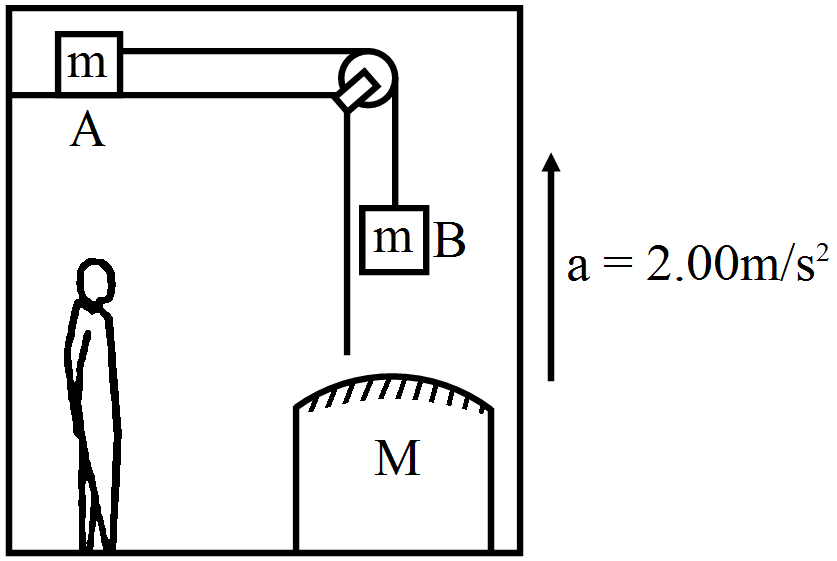
Consider the situation shown in figure. The elevator is going up with an acceleration of 2.00m/s2 and the focal length of the mirror is 12.0cm. All the surfaces are smooth and the pulley is light. The mass-pulley system is released from rest (with respect to the elevator) at t = 0 when the distance of B from the mirror is 42.0cm. Find the distance between the image of the block B and the mirror at t = 0.200s. Take g = 10m/s2.

What is meant by rectification? Draw a diagram of a half wave rectifier electric circuit. Write a brief description of its working. Draw the waveforms of input voltage and output voltage for this rectifier circuit.
An electron makes 3 × 10⁵ revolutions per second in a circle of radius 0.5 angstrom. Find the magnetic field B at the centre of the circle.
Write the properties of charge. What is meant by charge conservation? Explain with example. What do you understand by charge quantization?