Question
What is an ecosystem service? List any four important ecosystem services provided by the natural ecosystems. Are you in favour or against levying a charge on the service provided by the ecosystem?

Answer

The product of ecosystem processes is called ecosystem service.
Following is the list of four important ecosystem services:
  1. Purification of air and water
  2. Rainfall
  3. Pollination of crops
  4. Assimilation of excess carbon
There should be no charge for ecosystem services because nature provides everything for free. However, there should be proper attempts to estimate the cost of these services. Data about costs of these services should be made available to the general public. Every person should be educated about the real value of ecosystem services. This will help us in appreciating the real value of services which we get from the ecosystem.

Need a full question paper?

Generate a complete, print-ready paper with questions like this in minutes — across 16+ boards, with answer keys.
Start Generating Free

Similar questions

What is gene therapy? Illustrate using the example of adenosine deaminase (ADA) deficiency.
Answer the following questions:
Draw a schematic labelled diagram of a fertilised embryo sac of an angiosperm.
What is DNA fingerprinting? Mention its application.
In your view what motivates youngsters to take to alcohol or drugs and how can this be avoided?
Why is thermoregulation more effectively achieved in larger animals than in smaller ones?
Read the following and answer any four questions from (i) to (v) given below:
Apomixis is a mode of reproduction which does not involve formation of zygote through gametic fusion. In plants, apomixis commonly mimics sexual reproduction but produces seeds without fertilization. There are several methods of atomistic development in seeds. Thee two common ones are recurrent agamospermy and advective embryony.
  1. Apomixis is a type of reproduction in plants, in which?
  1. Fertilization does not take place.
  2. Male nucleus takes part in fertilization.
  3. Pollen fusion takes place.
  4. Generative nucleus takes part in fertilization.
  1. Which of the following statements is incorrect regarding recurrent agamospermy?
  1. It is the formation of seed that has an embryo formed without meiosis and syngamy.
  2. All the cells of embryo sac are diploid.
  3. An embryo develops directly from a diploid cell other than egg like that of nucleus and integument.
  4. None of these.
  1. Adventive embryony is found in:
  1. Citrus.
  2. Opuntia.
  3. Apple.
  4. Both (a) and (b).
  1. Formation of embryo directly from diploid egg without fertilization is called:
  1. Apospory.
  2. Diplospory.
  3. Polyembryony.
  4. Diploid parthenogenesis.
  1. If any somatic cell of sporophyte produces gametophyte without reduction division, it is called:
  1. Parthenogenesis.
  2. Apogamy.
  3. Apospory.
  4. Amphimixis.
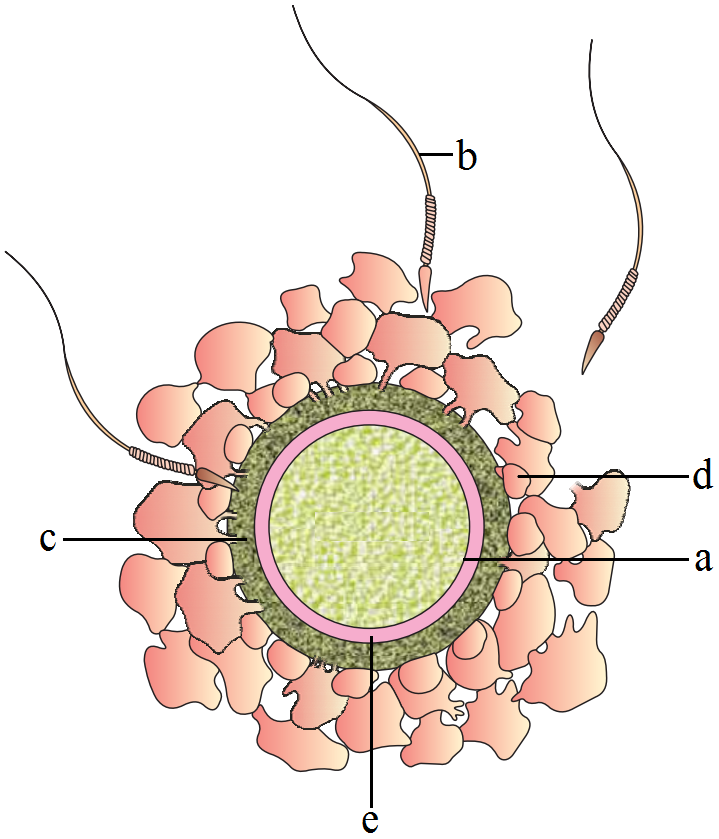
Study the illustration given and answer the questions that follow:

Name and state the function of ‘c’.

B.
(i) Name the two types of desirable approaches to conserve biodiversity? Explain with examples bringing out the difference between the two types.
(ii) State the features of a stable biological community?
Explain briefly the ‘rivet popper hypothesis’ of Paul Ehrlich.
Draw a diagram and describe the immune system found in humans.