Question
What is an electric generator?

Answer


A electric generator is a machine that converts mechanical energy into electrical energy. The working principle of generator is the law of electromagnetic induction and the law of electromagnetic force. The generator is mainly made up of stator and rotor.
It works on the Faraday’s law of the Electromagnetic Induction which says that whenever a conductor is placed in a varying magnetic field, EMF is induced and this induced EMF is equal to the rate of change of flux.
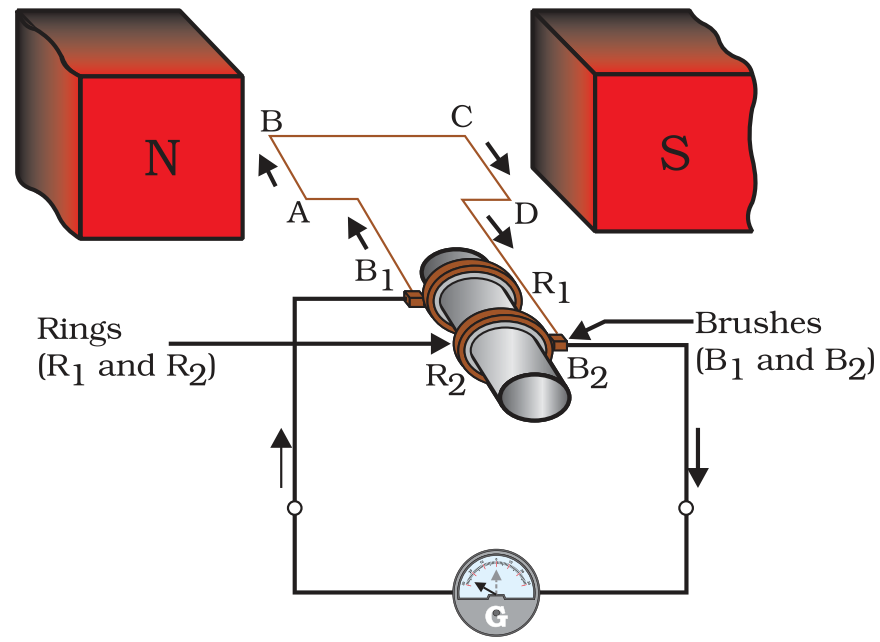
Electric generators are of two types A.C generator and D.C generator. Figure below shows the A.C generator.

Need a full question paper?

Generate a complete, print-ready paper with questions like this in minutes — across 16+ boards, with answer keys.
Start Generating Free

Similar questions

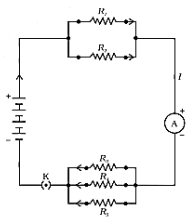
If in figure,$R _1=10 \Omega, R _2=40 \Omega, R _3=30 \Omega, R _4=20 \Omega, R _5=60 \Omega$, and a 12 V battery is connected to the arrangement. Calculate
Image

a. the total resistance in the circuit, and
b. the total current flowing in the circuit.
How is Earth kept warm by nature? Describe in detail.
What is periodicity in properties of elements with reference to the Modern Periodic Table? Why do all the elements of the same group have similar properties? How does the tendency of elements to gain electrons change as we move from left to right in a period? State the reason of this change.
The non - metal A is an important constituent of our food and most of the fuels around us. A forms two oxides B and C. The oxide B is poisonous whereas oxide C causes global warming.
  1. Identify A, B and C.
  2. To which group of periodic table does A belong?
  3. Name another element which is placed in the same group as A.
How is zinc extracted from its carbonate ore (calamine)? Explain with equations.
State the energy conversion taking place in the solar cell panel. For what purpose, solar cell panel is used? State its two main advantages.
How do tropisms differ from nasties (or nastic movements)?
  1. Name a metal for each case:
  1. It does not react with cold as well as hot water but reacts with steam.
  2. It does not react with any physical state of water?
  1. When calcium metal is added to water, the gas evolved does not catch fire but the same gas evolved on adding sodium metal to water catches fire. Why is it so?
State any three differences between the physical properties of metals and non-metals.
A pea plant with blue colour flower denoted by BB is cross-bred with a pea plant with white flower denoted by ww.
a. What is the expected colour of the flowers in their $F _1$ progeny?
b. What will be the percentage of plants bearing white flower in $F_2$ generation, when the flowers of $F_1$ plants were selfed?
c. State the expected ratio of the genotype BB and Bw in the $F _2$ progeny.