Question
What is Bt? How does it create resistance to the insect?

Answer

Bt is a type of toxin. It is made from a bacteria called Bacillus thurigiensis (in brief Bt).
Bt toxin gets cloned from gene bacteria and get expressed in plants and creates resistance against insects (pests). As a result, there is no need to use pesticides. This is how biopesticides are manufactured, e.g. : Bt cotton, Bt corn, rice, tomato and potato etc.
Bt Cotton : Some breeds of Bacillus thuringiensis produce such proteins that are helpful in killing specific insects like lapidopterans (tobacco bud worm, soldier worm), coleopterans (beetles) and dipterans (flies and mosquitoes). Bt produces some toxic insecticidal proteins. Why does this toxin not kill the Bacillus? In fact, the Bt toxin protein, protoxin is in an active form, as soon as the insect eats this inactive toxin, alkaline pH changes it in its intestine. Due to this, they become soluble and get converted into active form. Active toxin bind to the surface of epithelial cells of the middle intestine and form holes in them due to which the cell swell and burst and as a result the insect dies.
The specific Bt toxin has been isolated from Bt and has been incorporated into many crops like cotton. The choice of genes depends on the crop and the specific pest. Whereas most Bt toxins depend on insect group specificity.
Need a full question paper?

Generate a complete, print-ready paper with questions like this in minutes — across 16+ boards, with answer keys.

Start Generating Free

Similar questions

Rearrange the following in the correct sequence to accomplish an important biotechnological reaction:
  1. In vitro synthesis of copies of DNA of interest.
  2. Chemically synthesised oligonucleotides.
  3. Enzyme DNA-polymerase.
  4. Complementary region of DNA.
  5. Genomic DNA template.
  6. Nucleotides provided.
  7. Primers.
  8. Thermostable DNA-polymerase (from Thermus aquatics).
  9. Denaturation of ds-DNA.
How do mycorrhizal fungi help the plants harbouring them?
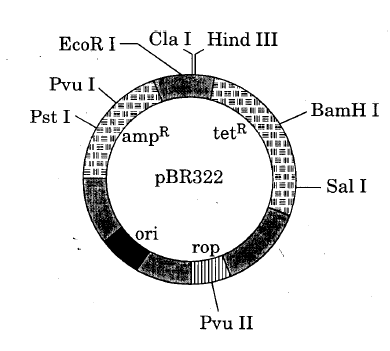
  1. Name the organism in which the vector shown is inserted to get the copies of the desired gene.
  2. Mention the area labelled in the vector responsible for controlling the copy number of the inserted gene.
  3. Name and explain the role of a selectable marker in the vector shown.
Explain the changes that milk undergoes when suitable starter/ inoculum is added to it. How does the end product formed prove to be beneficial for human health?
How does the study of different parts of a flower help in identifying in wind as its pollinating agent?
A large number of married couples the world over are childless. It is shocking to know that in India the female partner is often blamed for the couple being childless.
Why in your opinion the female partner is often blamed for such situations in India?
Write the formula for the change in population density.
Expand the following:
  1. ART
  2. GIFT
  3. ICSI
  4. RTI
  5. IUI
(i) Which is that specific geographical area where these organism are found?
(ii) Name and explain the phenomenon that resulted in the development of so many dive species in this region.
(iii) Explain by writing the reasons how it was possible for the placental Wolf and Tasmanian wolf to live together in the same environment?
Describe the various types of age pyramids.