Question
What is carbyl amine reaction?

Answer

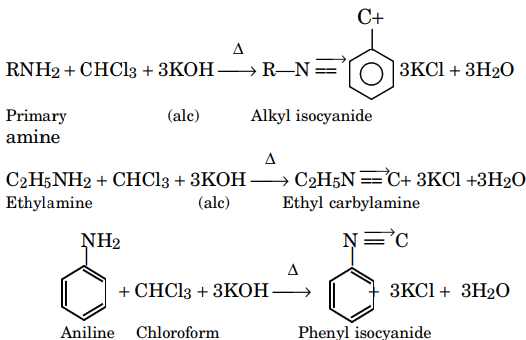
Carbylamine reaction or isocyanide test : Aliphatic and aromatic primary amines when heated with chloroform and alcoholic KOH solution produce isocyanides or carbylamines which are foul smelling substances. Secondary and tertiary amines do not undergo this reaction.
Image

Need a full question paper?

Generate a complete, print-ready paper with questions like this in minutes — across 16+ boards, with answer keys.
Start Generating Free

Similar questions

Give examples and suggest reasons for the following features of the transition metal chemistry :
(i) The lowest oxide of transition metal is basic, the highest is amphoteric/acidic.
(ii) A transition metal exhibits highest oxidation state in oxides and fluorides.
(iii) The highest oxidation state is exhibited in oxoanions of a metal.
Draw the shape of the following molecules :
(1) $XeOF _4$
(2) $B r F _3$
(3) $HClO _4$
(4) $XeF _2$
What is ligand? Explain classification of ligand.
Discuss the nature of bonding in $\left.[CoF _6\right]^{3-}$ coordination entities on the basis of valence bond theory.
Account for the following statements:
(i) Co(II) is stable in aqueous solution but in the presence of strong ligands and air it can get oxidised to Co(III).
(ii) $[Ni(CN)_{4}]^{2-}$ is square planar and diamagnetic whereas $[NiCl_{4}]^{2-}$ is tetrahedral and paramagnetic.
Write one chemical equation to illustrate the following reactions :
(i) Aldol condensation,
(ii) Cannizzaro's reaction.
What is rate of a chemical reaction? Explain average and instantaneous rate of reaction with help of graph and also give unit of rate of reaction.
Write the cell reaction and calculate the emf of the following cell at 298 K
$S n _{( s )}\left| S n ^{2+}( 0 . 0 0 4 ~ M ) \| H ^{+}( 0 . 0 2 0 ~ M )\right| H _2( g ) \overline{( 1 )} \mid P t s$ (Given : $ES _{ n }{ }^{2+} / Sn =- 0 . 1 4 V$ )
What happens when D-glucose is treated with the following reagents?
(i) HI , (ii) Bromine water, (iii) $HNO _3$.
Compare the general characteristics of the first series of the transition metals with those of the second and third series metals in the respective vertical coloumns. Give special emphasis on the following points :
(i) Electronic configurations
(ii) Oxidation states
(iii) Ionisation enthalpies and
(iv) Atomic sizes.