Question
What is ‘chlor-alkali’ process and what products are formed during this process?

Answer

When electricity is passed through an aqueous solution of sodium chloride it decomposes to form sodium hydroxide. The process is called the chlor-alkali alkali process because of the products formed: chlor for chlorine and alkali for Sodium Hydroxide. Chlorine gas is given off at the anode and hydrogen gas at the cathode. An aqueous solution of sodium chloride is called brine.$2\text{NaCl(aq)}+2\text{H}_2\text{O(l)}\xrightarrow{\text{(electrolysis)}}2\text{NaOH(aq)}+\text{Cl}_2+\text{H}_2\text{(g)}$

Need a full question paper?

Generate a complete, print-ready paper with questions like this in minutes — across 16+ boards, with answer keys.
Start Generating Free

Similar questions

Why is the leakage of LPG detected easily although it is odourless? State the steps to be taken in case its leakage is detected in the kitchen.
Explain why, an aqueous solution of sodium chloride is not used for the electrolytic extraction of sodium metal.
Bacteria have a simpler body plan when compared with human beings. Does it mean that human beings are more evolved than bacteria? Provide a suitable explanation.
Why ions move freely and conduct electricity in the molten form?
Describe the grafting method for the artificial propagation of plants with the help of labelled diagrams.
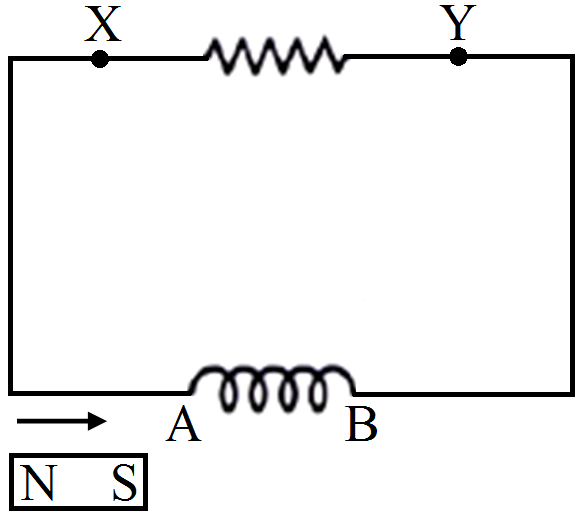
A small valued resistance XY is connected across the ends of a coil. Predict the direction of induced current in the resistance XY when.
  1. South pole of a magnet moves towards end A of the coil.
  2. South pole of a magnet moves away from end A of the coil.
Based on the group valency of elements write the molecular formula of the following compounds giving justification for each:
  1. Oxide of first group elements.
  2. Halide of the elements of group thirteen.
  3. Compound formed when an element, A of group 2 combines with an element, B of group seventeen.
At what distance from a concave mirror of focal length 10cm should an object 2cm long be placed in order to get an erect image 6cm tall?
There are five animals A, B, C, D and E. The animal A uses its modified forelimbs for flying. The animal B uses its forelimbs for running whereas the animal C uses its forelimbs for grasping. The animal D can live on land as well as in water and uses its forelimbs to prop up the front end of its body when at rest. The animal E which respires by using spiracles and tracheae uses wings for flying but its wings are analogous to the modified forelimbs of animal A.
  1. What could the animals A, B, C, D and E be?
  2. Why are the forelimbs of animals A, B, C, D called homologous organs?
  3. What does the existence of homologous organs in animals A, B, C and D tell us about their ancestors?
  4. Why are the modified forelimbs of animal A and the wings of animal E called analogous organs?
  5. State whether animals A and E have a common ancestor or not.
Name the 3 Rs' that will help us to conserve natural resources for long-term use.