Question
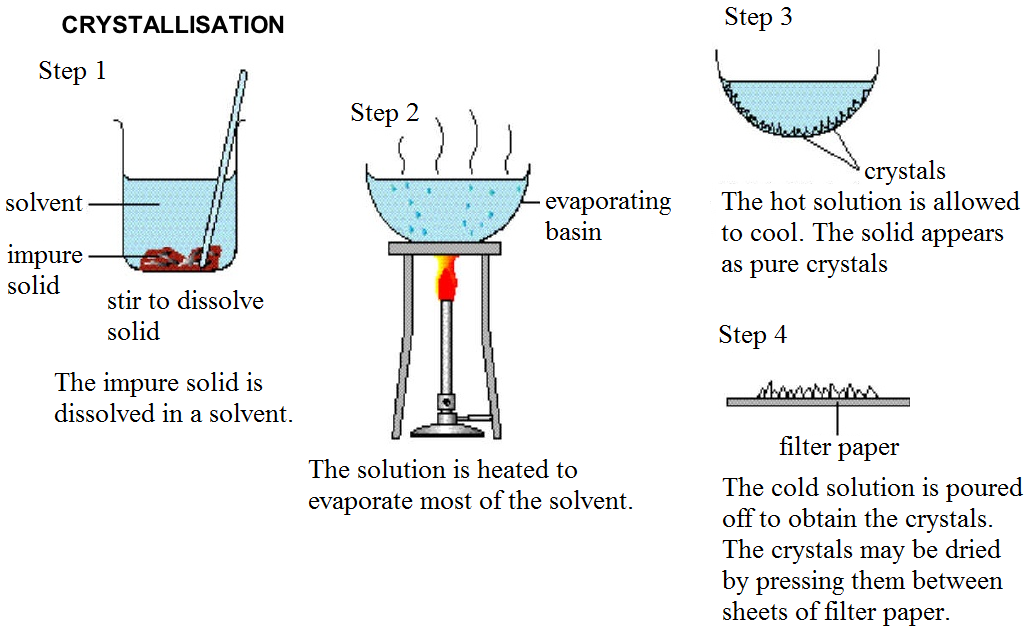
What is crystallisation? How can this technique be used to purify impure copper sulphate?
Answer


Crystallization: Crystallization is the solidification of atoms or molecules into a highly structured form called a crystal. Usually, this refers to the slow precipitation of crystals from a solution of a substance. However, crystals can form from a pure melt or directly from deposition from the gas phase. Crystallization can also refer to the solid-liquid separation and purification technique in which mass transfer occurs from the liquid solution to a pure solid crystalline phase.
The impure copper sulfate can be purified by crystallization. In this process, a suitable solvent is used for dissolving the impure sample and is heated in a water bath. This mixture is allowed to stand. After a while we obtain the pure crystals.
The crystals which obtained are extremely pure and are obtained from the procedure of crystallization. The solution is made from the combination of impure copper sulfate and a suitable solute.

Need a full question paper?

Generate a complete, print-ready paper with questions like this in minutes — across 16+ boards, with answer keys.

Start Generating Free

Similar questions


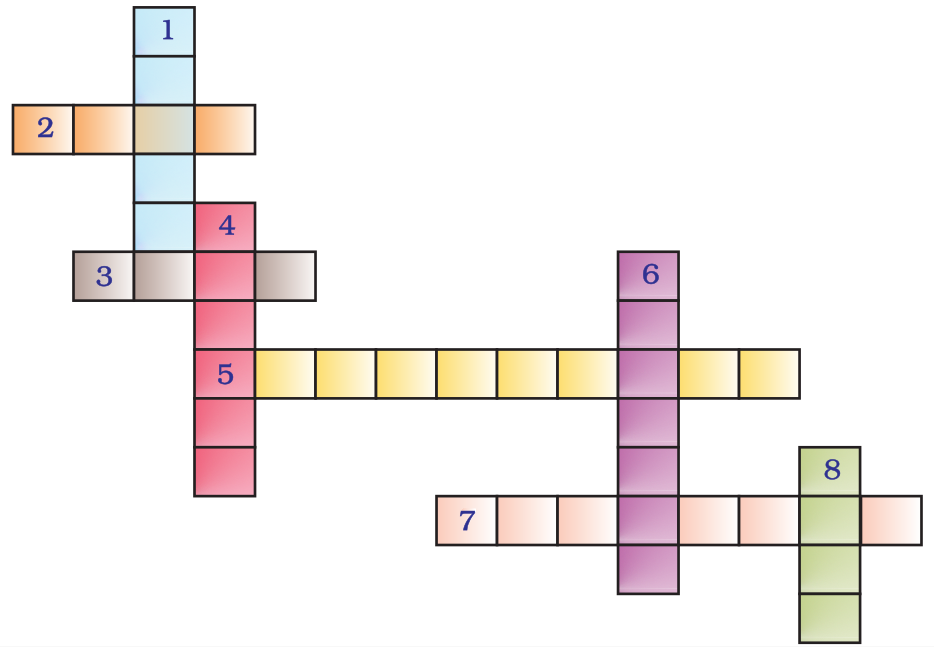
Complete the following crossword puzzle (Figure) by using the name of the chemical elements. Use the data given in the table following.
Across
Down
$2.$
The element used by Rutherford during his $\alpha$–scattering experiment.
$1.$
A white lustrous metal used for making ornaments and which tends to get tarnished black in the presence of moist air.
$3.$
An element which forms rust on exposure to moist air.
$4.$
Both brass and bronze are alloys of the element.
$5.$
A very reactive non–metal stored under water.
$6.$
The metal which exists in the liquid state at room temperature.
$7.$
Zinc metal when treated with dilute hydrochloric acid produces a gas of this element which when tested with burning splinter produces a pop sound.
$8.$
An element with symbol Pb.
State the law of conservation of mass. Give one example to illustrate this law.
Compare among Pisces, Amphibia and Reptilia.
An element $X$ forms the following compounds with hydrogen, carbon and oxygen:
$H_2X, CX_2, XO_2, XO_3$
Obtain a relation for the distance travelled by an object moving with a uniform acceleration in the interval between 4th and 5th second.
Which system of our body is activated in response to infection and how it responds?
When compared to an acute disease patient, a chronic disease patient recovers after a longtime. Is it true? Give one reason.
Using second law of motion, derive the relation between force and acceleration. A bullet of 10g strikes a sand-bag at a speed of $103m s^{-1}$ and gets embedded after travelling $5\ cm.$ Calculate
  1. The resistive force exerted by the sand on the bullet.
  2. The time taken by the bullet to come to rest.
Derive the unit of force using the second law of motion. A force of $5\ N$ produces an acceleration of $8 m\mathrm{s}^{-2}$ on a mass $\mathrm{m}_1$ and an acceleration of $24 \mathrm{~m} \mathrm{~s}^{-2}$ on a mass $\mathrm{m}_2$. What acceleration would the same force provide if both the masses are tied together$?$
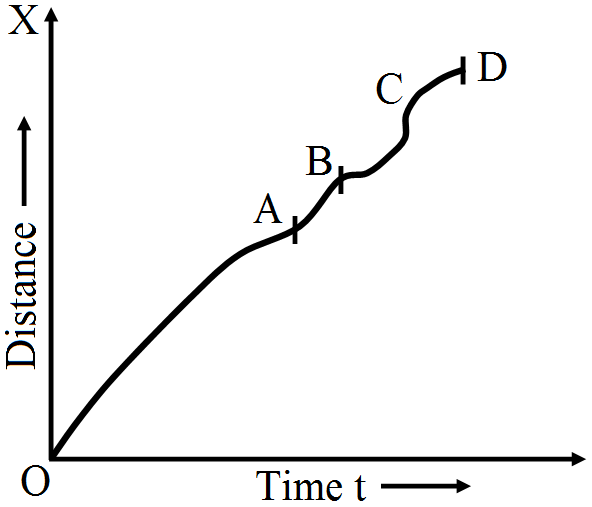
The figure shows an $x-t$ graph of a particle moving along a straight line. What is the sign of the acceleration during the intervals $OA, AB, BC,$ and $CD?$