Question
What is cyclotron ? State its two limitations.

Answer

Principle of Cyclotron : The working of the cyclotron is based on the fact that a positively charged particle can be accelerated to a sufficiently high energy with the help of smaller values of oscillating electric field by making it to cross the same electric field again and again with the use of strong magnetic field.
Two limitations of cyclotron are:
(i) It can't accelerate electrons : Because electrons have a very small mass, they can't be accelerated by a cyclotron.
(ii) It can't accelerate neutral particles : Cyclotrons can't accelerate particles that have no charge, like neutrons, because they don't interact with electric or magnetic fields.
Need a full question paper?

Generate a complete, print-ready paper with questions like this in minutes — across 16+ boards, with answer keys.

Start Generating Free

Similar questions

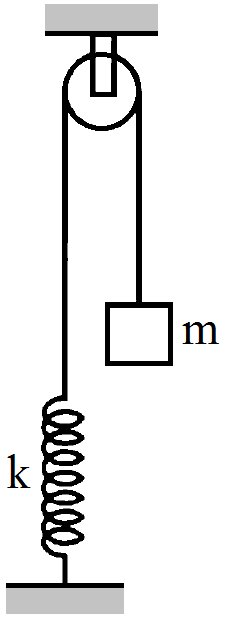
Consider the situation shown in figure. Initially the spring is unstretched when the system is released from rest. Assuming no friction in the pulley, find the maximum elongation of the spring.
When a nucleus at rest emits a beta particle, it is found that the velocities of the recoiling nucleus and the beta particle are not along the same straight line. How can this be possible in view of the principle of conservation of momentum?
State Kirchhoff's rules. Explain briefly how these rules are justified.
A $1.0m$ long metallic rod is rotated with an angular frequency of $400\ rad s^{–1}$ about an axis normal to the rod passing through its one end. The other end of the rod is in contact with a circular metallic ring. A constant and uniform magnetic field of $0.5T$ parallel to the axis exists everywhere. Calculate the emf developed between the centre and the ring.
The internal resistance of an accumulator battery of emf 6V is $10\Omega$ when it is fully discharged. As the battery gets charged up, its internal resistance decreases to $1\Omega.$
The battery in its completely discharged state is connected to a charger that maintains a constant potential difference of 9V. Find the current through the battery (a) just after the connections are made and (b) after a long time when it is completely charged.
How will an air bubble behave like a lens in water?
Explain network, junction point (branch point) and loop.
If Bohr’s quantisation postulate (angular momentum $=\text{nh}/\pi$) is a basic law of nature, it should be equally valid for the case of planetary motion also. Why then do we never speak of quantisation of orbits of planets around the sun?
You are facing a circular wire carrying an electric current. The current is clockwise as seen by you. Is the field at the centre coming towards you or going away from you?
How does the power of a convex lens vary, if the incident red light is replaced by violet light?