Question
What is de-Broglie wave? Write an expression for its wavelength.

Answer

de-Broglie Wavelength : The wave associated with the particle in motion with high speed is called deBroglie wave. The wavelength of this wave is called deBroglie wavelength.
Expression for de-Broglie wavelength :
$ \lambda=\frac{h}{p}; $ or $ \lambda=\frac{h}{mv} $ or $ \lambda=\frac{h}{\sqrt{2mK}} $ or $ \lambda=\frac{h}{\sqrt{2mqV}} $
where = $h$ Planck's constant and $p$ linear momentum of the particle in motion.
$m$ = mass of the particle,
$v$ = speed of the particle,
K = kinetic energy of the particle.
If the particle is charged having charge $q$, and the kinetic energy K is obtained by it when it is accelerated through potential difference V, then K = qV.

Need a full question paper?

Generate a complete, print-ready paper with questions like this in minutes — across 16+ boards, with answer keys.
Start Generating Free

Similar questions

A horizontal straight wire 10 m long extending from east to west is falling with a speed of $5.0 ms^{-1}$, at right angles to component of the earth's magnetic field $0.30 \times 10^{-4} Wbm ^{-2}$.
(a) What is the instantaneous value of the emf induced in the wire?
(b) What is the direction of the emf?
(c) Which end of the wire is at the higher electrical potential?
A human body excretes $($removes by waste discharge, sweating, etc.$)$ certain materials by a law similar to radioactivity. If technetium is injected in some form in a human body, the body excretes half the amount in $24$ hours. A patient is given an injection containing $^{99}Tc.$ This isotope is radioactive with a half-life of $6$ hours. The activity from the body just after the injection is $6\mu\text{Ci}.$ How much time will elapse before the activity falls to $3\mu\text{Ci}?$
A block hangs from a string wrapped on a disc of radius 20cm free to rotate about its axis which is fixed in a horizontal position. If the angular speed of the disc is 10rad/s at some instant, with what speed is the block going down at that instant?
A proton and an $\alpha$-particle move perpendicular to a magnetic field. Find the ratio of radii of the circular paths described by them when both (i) have equal momenta, and (ii) were accelerated through the same potential difference.
Use Biot-Savart law to derive the expression for the magnetic field on the axis of a current carrying circular loop of radius R. Draw the magnetic field lines due to a circular wire carrying current I.
  1. Draw the circuit diagram for studying the characteristics of a transistor in common emitter configuration. Explain briefly and show how input and output characteristics are drawn.
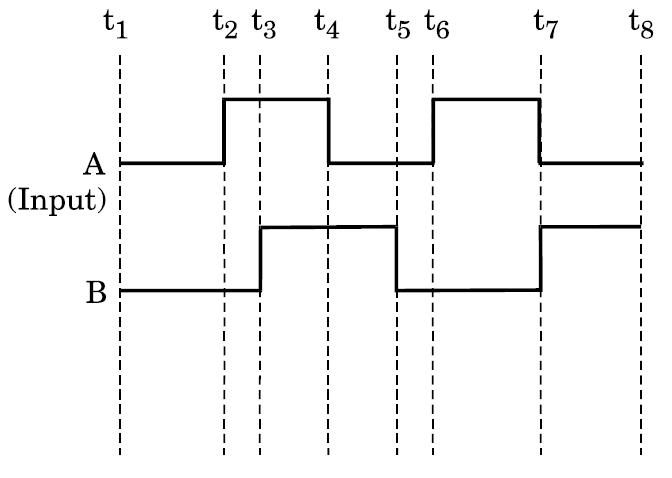
  2. The figure shows input waveforms A and B to a logic gate. Draw the output waveform for an OR gate. Write the truth table for this logic gate and draw its logic symbol.
Draw a labelled diagram of Hertz’s experimental set-up to produce electromagnetics waves. Explain the generation of electromagnetic waves using this set-up.
If one of the two electrons of a $H_2$ molecule is removed, we get a hydrogen molecular ion $\text{H}^+_2​.$ In the ground state of an $\text{H}^+_2​,$ the two protons are separated by roughly $1.5 \mathring A ,$ and the electron is roughly $1 \mathring A$ from each proton. Determine the potential energy of the system. Specify your choice of the zero of potential energy.
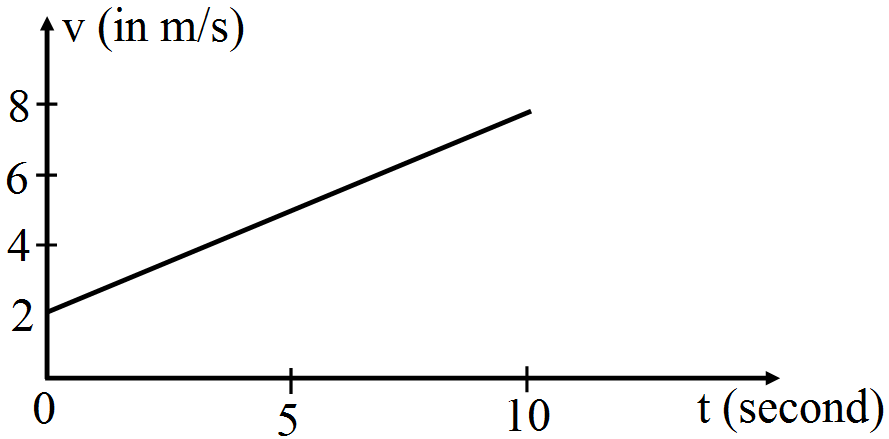
Figure shows the graph of velocity versus time for a particle going along the $X-$axis. Find:
  1. The acceleration.
  2. The distance travelled in $0$ to $10s.$
  3. The displacement in $0$ to $10s.$
A square loop of side $10 \ cm$ and resistance $0.5 \Omega$ is placed vertically in the east $-$ west plane. $A$ uniform magnetic field of $0.10 T$ is set up across the plane in the north-east direction. The magnetic field is decreased to zero in $0.70 s$ at a steady rate. Determine the magnitudes of induced emf and current during this time $-$ interval.