Question
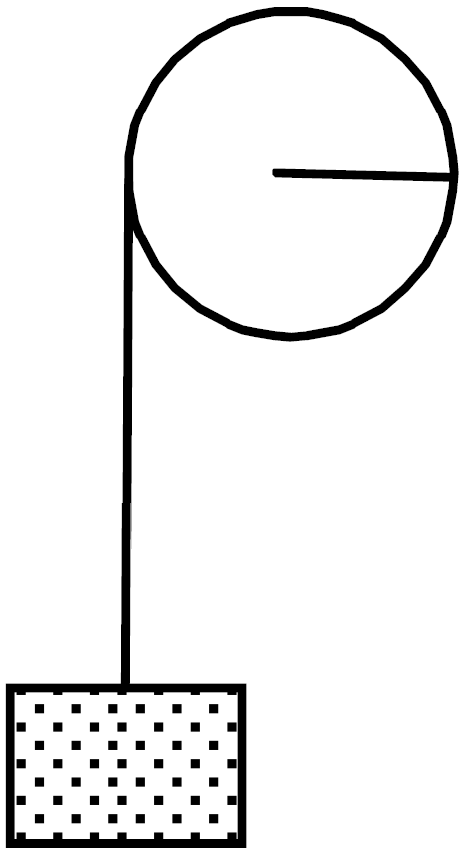
A block hangs from a string wrapped on a disc of radius 20cm free to rotate about its axis which is fixed in a horizontal position. If the angular speed of the disc is 10rad/s at some instant, with what speed is the block going down at that instant?
Answer

The Block is moving the rim of the pulley The pulley is moving at a $\omega=10\text{rad/s}$ Therefore the radius of the pulley = 20cm Therefore linear velocity on the rim = tangential velocity $=\text{r}_{\omega}=20\times20=200\text{cm/s}=2\text{m/s}.$

Need a full question paper?

Generate a complete, print-ready paper with questions like this in minutes — across 16+ boards, with answer keys.

Start Generating Free

Similar questions

With the help of an example, explain how the neutron to proton ratio changes during $\alpha-$decay of a nucleus.
A molecule. of hydrogen contains two protons and two electrons. The nuclear force between these two protons is always neglected while discussing the behaviour of a hydrogen molecule. Why?
There are energy bands in a solid. Do we have really continuous energy variation in a band or do we have very closely spaced but still discrete energy levels?
What is interference of light? Give one example of interference in our daily life.
A circular ring of radius r made of a nonconducting material is placed with its axis parallel to a uniform electric field. The ring is rotated about a diameter through $180^\circ$ . Does the flux of electric field change? If yes, does it decrease or increase?
A block is kept on the floor of an elevator at rest. The elevator starts descending with an acceleration of $12m/s^2.$ Find the displacement of the block during the first $0.2s$ after the start. Take $g = 10m/s^2.$
In Fizeau method of measuring the speed of light, the toothed wheel is placed in the focal plane of a converging lens. How would the experiment be affected if the wheel is slightly away from the focal plane?
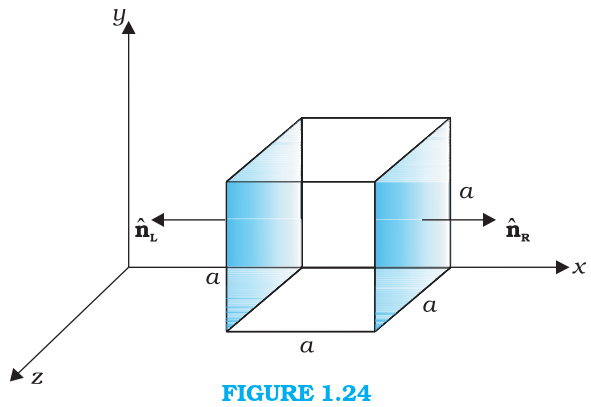
The electric field components in Fig. $1.24$ are $E_x=\alpha x^{1 / 2}, E_y=E_z=0$, in which $\alpha=800 N / C m ^{1 / 2}$. Calculate $(a)$ the flux through the cube, and $(b)$ the charge within the cube. Assume that $a=0.1 m$.
Image
A convex lens, of focal length $20\ cm,$ has a point object placed on its principle axis at distance of $40\ cm$ from it. A plane mirror is placed $30\ cm$ behind the convex lens. Locate the position of image formed by this combination.
The length of a rod is exactly $1m$ when measured at rest. What will be its length when it moves at a speed of:
  1. $3 \times 10^5\ m/s.$
  2. $3 \times 10^6\ m/s.$
  3. $3 \times 10^7\ m/s.$