Question
What is detritus food chain?

Answer

→ The detritus food chain (DFC) begins with dead organic matter.
→ It is made up of decomposers which are heterotrophic organisms, mainly fungi and bacteria.
→ They meet their energy and nutrient requirements by degrading dead organic matter or detritus.
These are also known as saprotrophs (sapro: to decompose).
→ Decomposers secrete digestive enzymes that breakdown dead and waste materials into simple, inorganic materials, which are subsequently absorbed by them.
→ In an aquatic ecosystem, GFC is the major conduit for energy flow.
→ As against this, in a terrestrial ecosystem, a much larger fraction of energy flows through the detritus food chain than through the GFC.
→ Detritus food chain may be connected with the grazing food chain at some levels: some of the organisms of DFC are prey to the GFC animals, and in a natural ecosystem, some animals like cockroaches, crows, etc., are omnivores.
→ These natural interconnection of food chains make it a food web.
Need a full question paper?

Generate a complete, print-ready paper with questions like this in minutes — across 16+ boards, with answer keys.

Start Generating Free

Similar questions

Why did T.H. Morgan select Drosophila melanogaster to study sex linked genes for his lab experiments?
Many plant and animal species are on the verge of their extinction because of loss of forest land by indiscriminate use by the humans. As a biology student what method would you suggest along with its advantages that can protect such threatened species from getting extinct?
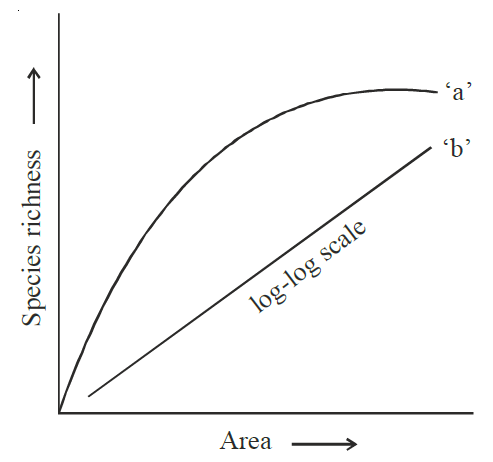
The following graph shows the species-area relationship. Answer the following question as directed.

  1. Name the naturalist who studied the kind of relationship shown in the graph. Write the observation made by him.
  2. Write the situations as discovered by the ecologists when the value of 'Z' (slope of the line) lies.
  1. 0.1 and 0.2
  2. 0.6 and 1.2

What does 'Z' stand for?

  1. When would the slope of the line 'b' become steeper?
Write a short note on
Behavioural adaptations in animals
Identify A, B, C, D, E and F in the table given below:
S. No.
Component-I
Component-II
Chemical linkage bonding the two components
Product
(i)
A
B
C
Nucleotide
(ii)
Nucleotide
D
E
Nucleotide
(iii)
Nucleotide
Nucleotide
F
Dinucleotide
Given below is an equation describing the Species-Area relationship between species richness and area for a wide variety of taxa as angiosperm plants, birds, bats etc.
S = CAZ
a. Give a graphical representation of the given equation showing Species-Area relationship.
b. What does S represent in the given equation?
c. What is the value of Z (regression coefficient) for frugivorous birds and mammals in the tropical forests of different continents?
What is the use of aeration tank in the treatment of sewage?
  1. A DNA segment has a total of 1000 nucleotides, out of which 240 of them are adenine containing nucleotides. How many pyrimidine bases this DNA segment possesses?
  2. Draw a diagrammatic sketch of a portion of DNA segment to support your answer.
List the salient features of genetic code###Give important feature of genetic code###Write any six main teatares of genetic code
When someone buys packets of cigarettes, cannot miss the statutory warning that is present on the packing which warns against smoking and says how it is injurious to health. Yet, smoking is very prevalent in our society, both among young and old. Advise the adolescents about the importance of avoiding smoking. (Mention any six points.)