Questions

3 Marks Question

Take a timed test

7 questions · self-marked practice — reveal the answer and mark yourself.

Question 13 Marks
Explain the primary productivity of ecosystem.
Answer
Primary productivity :
→ Primary production is defined as the amount of biomass or organic matter produced per unit area over a time period by plants. during photosynthesis.
→ Primary productivity depends on the plant species inhabiting a particular area.
→ It also depends on a variety of environmental factors, availability of nutrients and photosynthetic capacity of plants,
→ Therefore, it varies in different types of ecosystems. The annual net primary productivity of the whole biosphere is approximately 170 billion tons (dry weight) of organic matter.
→ Of this, despite occupying about 70 percent of the surface, the productivity of the oceans are only 55 billion tons.
View full question & answer
Question 23 Marks
Explain productivity about sustainable ecosystem.###Describe productivity as a unit of ecosystem.
Answer
The production of biomass is called productivity.
Primary productivity :
→ A constant input of solar energy is the basic requirement for any ecosystem to function and sustain.
→ Primary production is defined as the amount of biomass or organic matter produced per unit area over a time period by plants during photosynthesis.
→ It is expressed in terms of weight $\left( gm ^{-2}\right)$ or energy (K cal m-2).
→ It is expressed in terms of $gm ^{-2} yr ^{-1}$ or (K cal m-2) to compare the productivity of different ecosystems.
→ It can be divided into gross primary productivity (GPP) and net primary productivity (NPP).
(a) Gross primary productivity : of an ecosystem is the rate of production of organic matter during photosynthesis.
(b) Net primary productivity
→  A considerable amount of GPP is utilised by plants in respiration. Gross primary productivity minus respiration losses (R), is the net primary productivity (NPP). $GPP - R = NPP$
Secondary productivity :
→ Net primary productivity is the available biomass for the consumption to heterotrophs (herbivores and decomposers).
→ Secondary productivity is defined as the rate of formation of new organic matter by consumers.
View full question & answer
Question 33 Marks
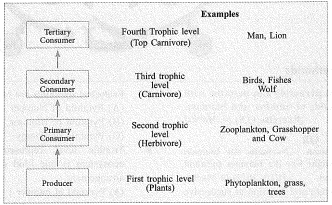
What is Trophic level? Draw diagrammatic representation of trophic levels in ecosystem.
Answer
→ Organisms occupy a place in the natural surroundings or in a community according to their feeding relationship with other organisms.
→ Based on the source of their nutrition or food, organisms occupy a specific place in the food chain that is known as their trophic level.
→ In other words, 'the successive level of food chain and food web is called trophic levels'.
→ Producers belong to the first trophic level, herbivores (primary consumer) to the second and carnivores (secondary consumer) to the third.
Image
View full question & answer
Question 43 Marks
What is detritus food chain?
Answer
→ The detritus food chain (DFC) begins with dead organic matter.
→ It is made up of decomposers which are heterotrophic organisms, mainly fungi and bacteria.
→ They meet their energy and nutrient requirements by degrading dead organic matter or detritus.
These are also known as saprotrophs (sapro: to decompose).
→ Decomposers secrete digestive enzymes that breakdown dead and waste materials into simple, inorganic materials, which are subsequently absorbed by them.
→ In an aquatic ecosystem, GFC is the major conduit for energy flow.
→ As against this, in a terrestrial ecosystem, a much larger fraction of energy flows through the detritus food chain than through the GFC.
→ Detritus food chain may be connected with the grazing food chain at some levels: some of the organisms of DFC are prey to the GFC animals, and in a natural ecosystem, some animals like cockroaches, crows, etc., are omnivores.
→ These natural interconnection of food chains make it a food web.
View full question & answer
Question 53 Marks
Ecosystem can be visualised as a functional unit of nature. Explain how?
Answer
→ An ecosystem can be visualised as a functional unit of nature, where living organisms interact among themselves and also with the surrounding physical environment.
→ Ecosystem varies greatly in size from a small pond to a large forest or a sea. Many ecologists regard the entire biosphere as a global ecosystem, as a composite of all local ecosystems on Earth.
→ Since this system is too much big and complex to be studied at one time, it is convenient to
divide it into two basic categories. (A) terrestrial and (B) the aquatic.
(A) Terrestrial ecosystem : Forest, grassland and desert
(B) Aquatic ecosystems : pond, lake, wetland, river and estuary.
→ Crop fields and an aquarium may also be considered as man-made ecosystems.
View full question & answer
Question 63 Marks
Explain aquatic ecosystem by taking example of small pond.
Answer
→ To understand the ethos of an aquatic ecosystem let us take a small pond as an example.
→ This is fairly a self-sustainable unit and rather simple example that explain even the complex interactions that exist in an aquatic ecosystem.
→ A pond is a shallow water body in which all the above mentioned four basic components of an ecosystem are well exhibited.
→ The abiotic component is the water with all the dissolved inorganic and organic substances and the rich soil deposit at the bottom of the pond.
→ The solar input, the cycle of temperature, day- length and other climatic conditions regulate the rate of function of the entire pond.
→ The autotrophic components include the phytoplankton, some algae and the floating, submerged and marginal plants found at the edges.
→ The consumers are represented by the zooplankton, the free swimming and bottom dwelling forms.
→ The decomposers are the fungi, bacteria and flagellates especially abundant in the bottom of the pond.
→ This system performs all the functions of any ecosystem and of the biosphere as a whole.
(1) Conversion of inorganic into organic material with the help of the radiant energy of the sun by the autotrophs..
(2) Consumption of the autotrophs by heterotrophs.
(3) Decomposition and mineralisation of the dead matter to release them back for reuse by the autotrophs, these event are repeated over and over again.
(4) There is unidirectional movement of energy towards the higher trophic levels and its dissipation and loss as heat to the environment.
View full question & answer
Question 73 Marks
Describe consumers
Answer
→ All animals depend on plants (directly or indirectly) for their food needs.
→ They are hence called consumers and also heterotrophs.
→ If they feed on the producers, the plants, they are called primary consumers.
→ Obviously the primary consumers will be herbivores.
→ If the animals eat other animals which in turn eat the plants (or their product) they are called secondary consumers.
→ Likewise, you could have tertiary consumers too.
→ The consumers that feed on these herbivores are carnivores, or more correctly primary carnivores (though secondary consumers).
View full question & answer