Question
What is doping ? - Explain.

Answer

"The deliberate addition of a desired impurity is called doping. And the impurity atoms are called dopants. Such a material is also called a doped semiconductor (or extrinsic semiconductors or impurity semiconductors.)".
The dopant atom (impurity atom) has to be such that it does not distort the original pure semiconductor lattice.
It occupies only a very few of the original semiconductor sites in the crystal. A necessary condition to attain this is that the sizes of the dopant and the semiconductor atoms should be nearly same.
Generally a small amount, say, a few parts per million (ppm), of a suitable impurity is added to the pure semi-conductor. Due to the added impurity atoms, the conductivity of the semiconductor is increased manifold.
There are two types of dopants used in doping the tetravalent $S i$ or Ge:
(i) Pentavalent (Valency 5) : like Arsenic (As), Antimony (S $b$ ), Phosphorous ( P ), etc.
(ii) Trivalent (Valency 3) : like Indium (I $n$ ) Boron (B), Aluminium $( A l$ ) etc.

Need a full question paper?

Generate a complete, print-ready paper with questions like this in minutes — across 16+ boards, with answer keys.
Start Generating Free

Similar questions

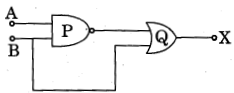
  1. Identify the logic gates marked P and Q in the given logic circuit.
  1. Write down the output at X for the inputs A = 0, B = 0 and A = 1, B = 1.
X and Y are two parallel plate capacitors, whose plates have the same area and the same distance between them. There is air between the plates of $X$ and a dielectric material of dielectric constant $k=5$ between the plates of $Y$ (in the figure). (a) Calculate the potential diffe-rence between the plates X and Y . (b) What is the ratio of electrical potential energies stored in X and Y ?
Calculate the dimensions of:
  1. $\int\vec{\text{E}}.\vec{\text{dl}}.$
  2. $\text{vBl}$
  3. $\frac{\text{d}\psi_{\text{B}}}{\text{dt}}$
The symbols have their usual meanings.
In Ampere's $\oint\overrightarrow{\text{B}}.\text{d}\overrightarrow{\text{l}}=\mu_0\text{i},$ the current outside the curve is not included on the right hand side. Does it mean that the magnetic field B calculated by using Ampere's law, gives the contribution of only the currents crossing the area bounded by the curve?
Sketch the magnetic field lines for a current-carrying circular loop near its centre. Replace the loop by an equivalent magnetic dipole and sketch the magnetic field lines near the centre of the dipole. Identify the difference.
In 1959 Lyttleton and Bondi suggested that the expansion of the Universe could be explained if matter carried a net charge. Suppose that the Universe is made up of hydrogen atoms with a number density N, which is maintained a constant. Let the charge on the proton be: $e_p= -(1 + y)e$ where e is the electronic charge.
Show that the velocity of expansion is proportional to the distance from the centre.
A point charge is taken from a point A to a point B in an electric field. Does the work done by the electric field depend on the path of the charge?
Draw the figures of field lines of (a) a bar magnet, (b) a current carrying finite solenoid and (c) an electric dipole.
Consider an amplifier circuit using a transistdf. The output power is several times greater than the input power. Where does the extra power come from?
The circuit arrangement given below shows that when an a.c. passes through the coil A, the current starts flowing in the coil B.
  1. State the underlying principle involved.
  2. Mention two factors on which the current produced in the coil B depends.