Question
What is ecological pyramid? Describe the different types of pyramid.

Answer

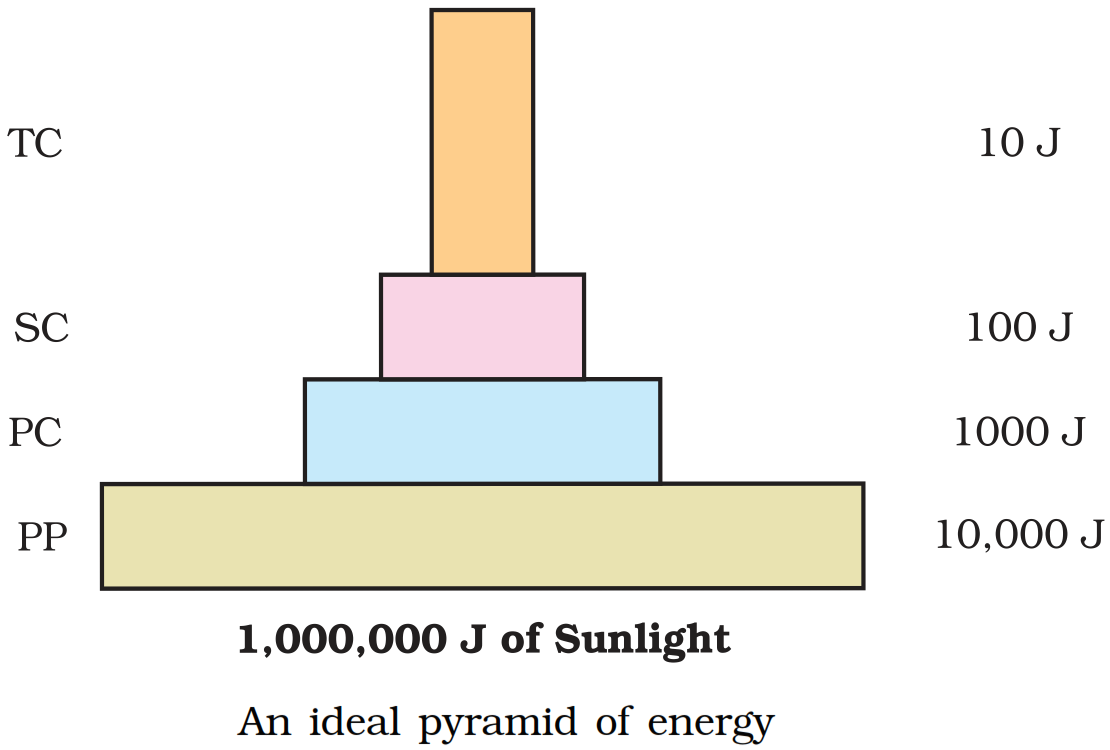
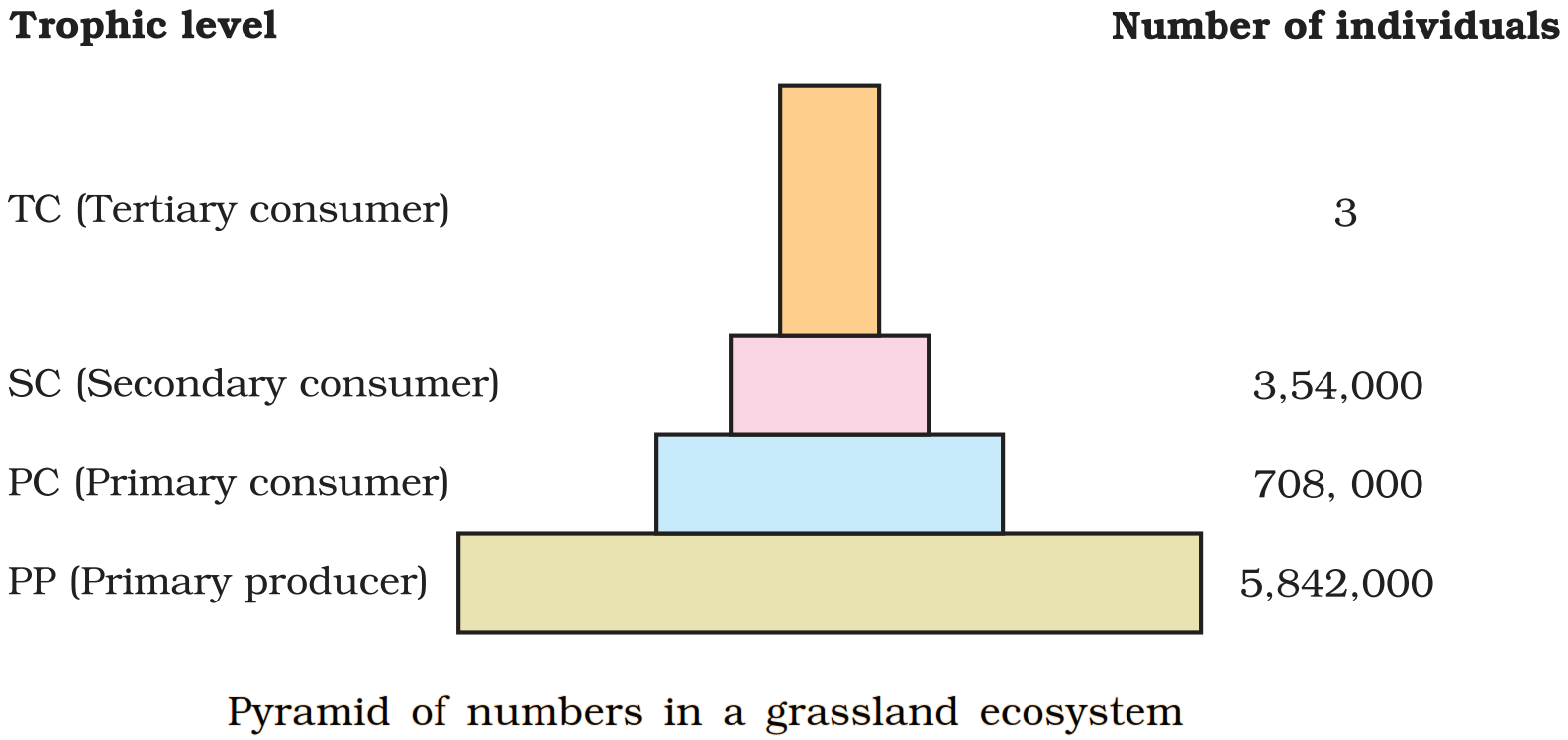
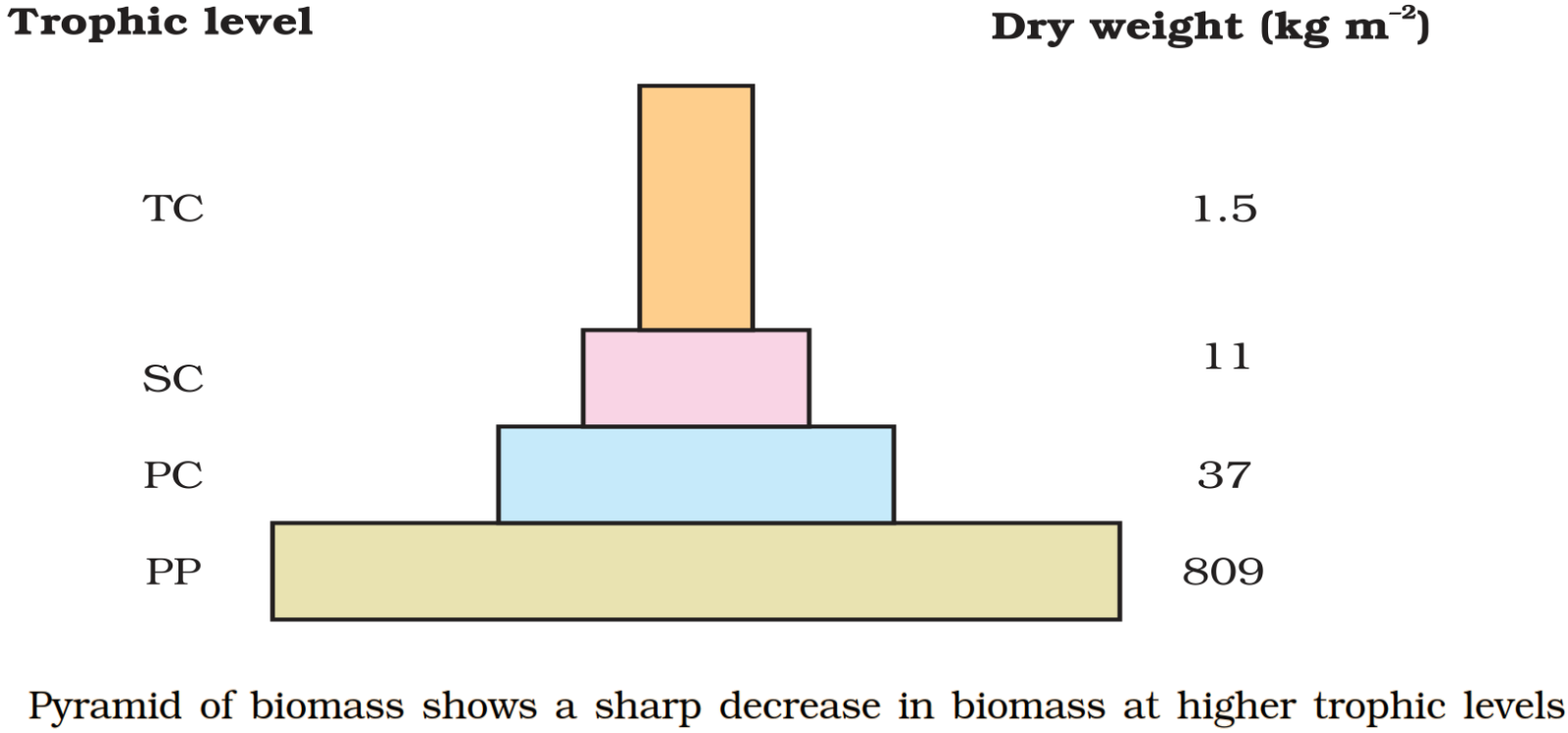
The relation between producers and consumers in an ecosystem can be graphically represented in the form of a pyramid called ecological pyramid.
  • Structure: The base always represents the producers or the first trophic level and the apex represents top level consumer or the last trophic level.
  • Ecological pyramids are of three types:
  1. Pyramid of number: The relationship between producers and consumers in an ecosystem can be represented in the form of a pyramid in terms of number called pyramid of number.
  1. Pyramid of biomass: The relationship between producers and consumers in an ecosystem can be represented in the form of a pyramid in terms of biomass called pyramid of biomass.
It can be:
  1. Upright, e.g., in case of grassland ecosystem;
  2. Inverted, e.g., in case of pond ecosystem.
  1. Pyramid of energy: The relationship between producers and consumers in an ecosystem can be represented in the form of a pyramid, in terms of flow of energy called pyramid of energy. It is always upright because energy is always lost as heat at each step.

Need a full question paper?

Generate a complete, print-ready paper with questions like this in minutes — across 16+ boards, with answer keys.
Start Generating Free

Similar questions

How are the morphological and biochemical/ physiological characteristics of plants associated with resistance to insect pests? Give any five examples of plants with their features and the name of the pest to which each is resistant.
Can you think of a scientific explanation, besides analogy used by Paul Ehrlich, for the direct relationship between diversity and stability of an ecosystem?
Do you think microbes can also be used as source of energy? If yes, how?
  1. Distinguish between parasitism and predation, with an example of each.
  2. Name two groups of animals, that are regulaters.
  3. When does the growth curve assume of J shape?
Sunny was rushed to a nearby hospital after an accident, which had caused too much blood loss. The hospital failed to supply 'O' negative blood for transfusion. Ahmed, who was attending a patient there, heard about the situation and agreed to donate blood as he had the same blood group. Sunny's mother initially refused but was later convinced by her daughter's view.
  1. Why cannot 'O' positive blood be transfused into Sunny's body?
  2. What is the genetic basis of blood group inheritance?
  3. Human blood grouping is an example of?
  4. What values do you find in Sunny's sister and Ahmed?
Answer the following questions:
When and where does spermatogenesis occur in a human male?
Explain the difference between apes and human.
Thalassemia and haemophilia are both Mendelian disorders related to blood. Write the symptoms of the diseases. Explain with the help of crosses the difference in the inheritance pattern of the two diseases.
OR
Why are thalassemia and hemophilia categorised as Mendelian disorders? Write the symptoms of these diseases. Explain their pattern of inheritance in humans. Write the genotypes of the normal parents producing a haemophilic son.
Compare and contrast the advantages and disadvantages of production of genetically modified crops.
Define a cistron. Giving examples differentiate between monocistronic and polyeistronic transcription unit.