Question
What is electric current ? Explain about it.

Answer

$\rightarrow$ To understand electric current, imagine a small area held normal $($Perpendicular$)$ to the direction of flow of charges.
$\rightarrow$ Both the positive and the negative charges may flow forward and backward across the area.
$\rightarrow$ Let $q_{+}$ be the net amount of positive charge that flows in the forward direction across the area Similarly, let $q_{-}$ be the net amount of negative charge flowing across the area in the forward direction.
$\rightarrow$ The net amount of charge flowing across the area in the forward direction in the time interval $t ,$ is
$q=q_{+}-q_{-}$
$\rightarrow$ For steady current, electric charge is proportional to time. so,
$\therefore q \propto t$
$\therefore I =\frac{q}{t}$
$\rightarrow$ Electric current : "The amount of electric charge passing perpendicularly through the cross-section of a conductor per unit time is called electric current."
$\rightarrow$ An electric current which does not change with time is called steady current.
$\rightarrow$ Currents are not always steady. In that case, average value or instantaneous value of current has to be considered.
$\rightarrow$​​​​​​​ Let $\Delta Q$ be the net charge flowing across $a ^{\prime}$ cross $-$ section of a conductor during the time interval $\Delta t$, then the average current flowing through the conductor is
$< I >=\frac{\Delta Q }{\Delta t}$
$\rightarrow $ The current at time $t$ across the cross $-$ section of the conductor is defined as the value of the ratio of $\Delta Q$ to $\Delta t$ in the limit of $\Delta t$ tending to zero.
So, instantaneous current
$I =\lim _{\Delta t \rightarrow 0} \frac{\Delta Q }{\Delta t}$
$\therefore I =\frac{d Q }{d t}$
$\rightarrow$ The unit of electric current is ampere $(A)$ and current is a scalar quantity.
$\rightarrow$ An ampere is typically the order of magnitude of currents in domestic appliances.
$\rightarrow$ An average lighting carries currents of the order of tens of thousands of amperes $\left(\sim 10^4 A\right. ).$
$\rightarrow$​​​​​​​ Currents in nerves of our body are in the order of microamperes. $\left(\sim 10^{-6} A\right)$

Need a full question paper?

Generate a complete, print-ready paper with questions like this in minutes — across 16+ boards, with answer keys.

Start Generating Free

Similar questions

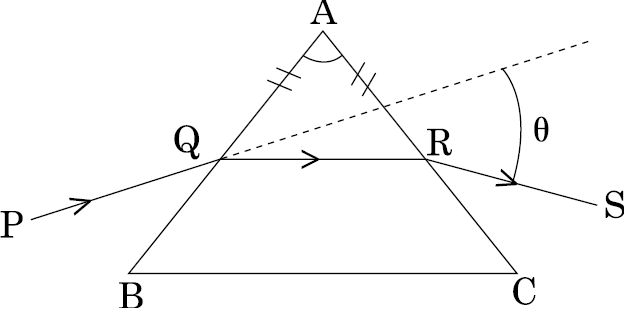
A ray PQ incident on the refracting face BA is refracted in the prism BAC as shown in the figure and emerges from the other refracting face AC as RS such that AQ = AR. If the angle of prism $A = 60^\circ$ and refractive index of material of prism is$\sqrt{3}$, calculate angle $\theta.$
Draw and explain the phasor diagram and the graph of $v$ and $i$ versus $\omega$t, for an AC circuit having pure inductor.
Explain that in day to day life we can't get coherent sources using two sodium lamps.
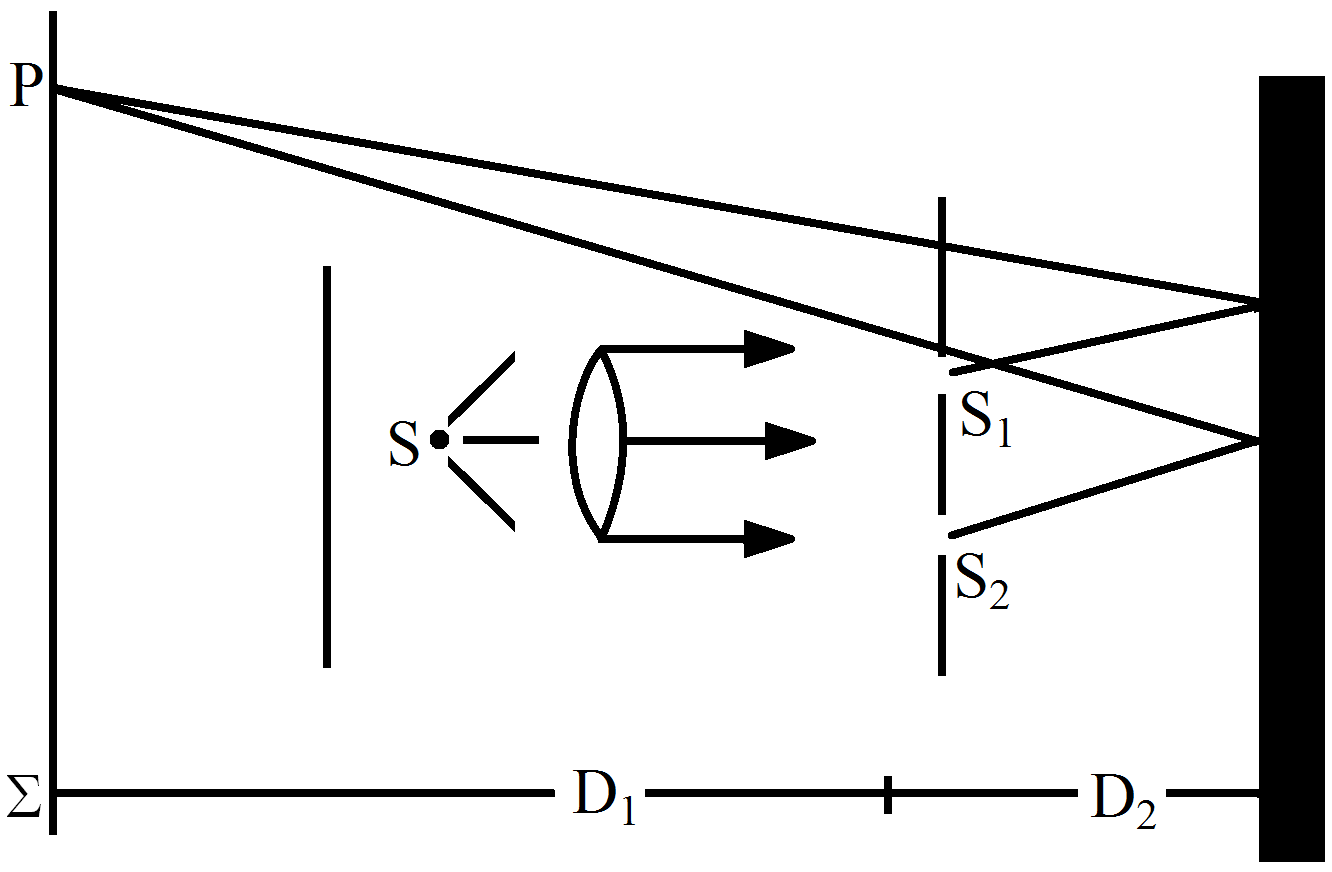
A double slit $S_1-S_2$ is illuminated by a coherent light of wavelength $\lambda$. The slits are separated by a distance $d$. A plane mirror is placed in front of the double slit at a distance $D_1$ from it and a screen $\sum$ is placed behind the double slit at a distance $D_2$ from it (figure $17-E_2$ ). The screen E receives only the light reflected by the mirror. Find the fringe-width of the interference pattern on the screen.
Define refractive index of a transparent medium.
A ray of light passes through a triangular prism. Plot a graph showing the variation of the angle of deviation with the angle of incidence.
Spring fitted doors close by themselves when released. You want to keep the door open for a long time, say for an hour. If you put a half kg stone in front of the open door, it does not help. The stone slides with the door and the door gets closed. However, if you sandwitch a 20g piece of wood in the small gap between the door and the floor, the door stays open. Explain why a much lighter piece of wood is able to keep the door open while the heavy stone fails.
A plate of thickness t made of a material of refractive index $\mu$ is placed in front of one of the slits in a double slit experiment.
  1. Find the change in the optical path due to introduction of the plate.
  2. What should be the minimum thickness t which will make the intensity at the centre of the fringe pattern zero? Wavelength of the light used is $\lambda$. Neglect any absorption of light in the plate.
Consider the situation of the previous problem. Take "the table plus the ball" as the system. Friction between the table and the ball is then an internal force. As the ball slows down, the momentum of the system decreases. Which external force is responsible for this change in the momentum?
A steady current $\left(I_1\right)$ flows through a long straight wire. Another wire carrying steady current $\left(I_2\right)$ in the same direction is kept close and parallel to the first wire. Show with the help of a diagram how the magnetic field due to the current $\mathrm{I}_1$ exerts a magnetic force on the second wire. Write the expression for this force.
Two conductors $X$ and $Y$ of same diameters but different substances are joined in series with a battery. If electron density in X is double than that of Y , then find the ratio of drift velocities of electrons in these two wires.