Maharashtra BoardEnglish MediumSTD 12 SciencePhysicsElectromagnetic Induction4 Marks
Question
What is electromagnetic induction? Prove theoretically \(e=-\frac{ d \phi}{ d t}\).
✓
Answer
The phenomenon of producing an induced e.m.f in a conductor or conducting coil due to changing magnetic flux is called electromagnetic induction.
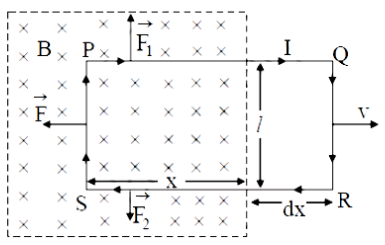
1) Consider a rectangular loop of conducting wire ‘PQRS’ partly placed in uniform magnetic field of induction ‘B’ as shown in figure.
2) Let 'l' be the length of the side PS and 'x' be the length of the loop within the field.
∴ A = lx = area of the loop, which lies inside the field.
3) The magnetic flux (Φ) through the area A at certain time ‘t’ is Φ = BA = Blx
4) The loop is pulled out of the magnetic field of induction ‘B’ to the right with a uniform
velocity ‘v’.
5) The rate of change of magnetic flux is given by, \(\frac{d \phi}{d t}=\frac{d}{d t}\left(\frac{B}{x}\right)\)
\(\therefore \frac{d \phi}{d t}=B l\left(\frac{d x}{d t}\right)\)
But, \(\left(\frac{d x}{d t}\right)=v\)
\(\therefore \frac{d \phi}{d t}= Blv\) ....(1)
6) Due to change in magnetic flux, induced current is set up in the coil. The direction of this current is clockwise according to Lenz’s law. Due to this, the sides of the coil experiences the forces, $F_1, F_2$ and $F$ as shown in figure. The directions of these forces is given by Flemings left hand rule.
7) The magnitude of force $‘F’$ acting on the side PS is given by, $F = BIl.$
8)The force \(\vec{F}_1\) and \(\vec{F}_2\) are equal in magnitude and opposite in direction, therefore they cancel out. The only unbalanced force which opposes the motion of the coil is \(\vec{F}\) Hence, work must be done against this force in order to pull the coil.
9) The work done in time ‘dt’ during the small displacement $‘dx’$ is given by, $dW = - Fdx - ve$ sign shows that $F$ and $‘dx’$ are opposite to each other.
$\therefore dW = - (BIl) dx ….(2)$
10) This external work provides the energy needed to maintain the induced current I
through the loop (coil).
11) If ‘e’ is the e.m.f induced then, electric power = \(\frac{d W}{d t}=e I\)
$\therefore dW = eIdt ....3$
12) From equations (2) and (3),
eIdt = - BIl dx
\(\therefore e=-B l\left(\frac{d x}{d t}\right)\)
\(\therefore e =- Blv . . . .(4)\)
13) From equation (1) and (4), \(e=-\frac{d \phi}{d t}\)
Need a full question paper?
Generate a complete, print-ready paper with questions like this in minutes — across 16+ boards, with answer keys.