Question
What is fundamental difference between electric dipole and magnetic dipole.

Answer

Self

Need a full question paper?

Generate a complete, print-ready paper with questions like this in minutes — across 16+ boards, with answer keys.
Start Generating Free

Similar questions

What can be said about the centre of mass of a uniform hemisphere without making any calculation? Will its distance from the centre be more than $\frac{\text{r}}{2}$ or less than $\frac{\text{r}}{2}?$
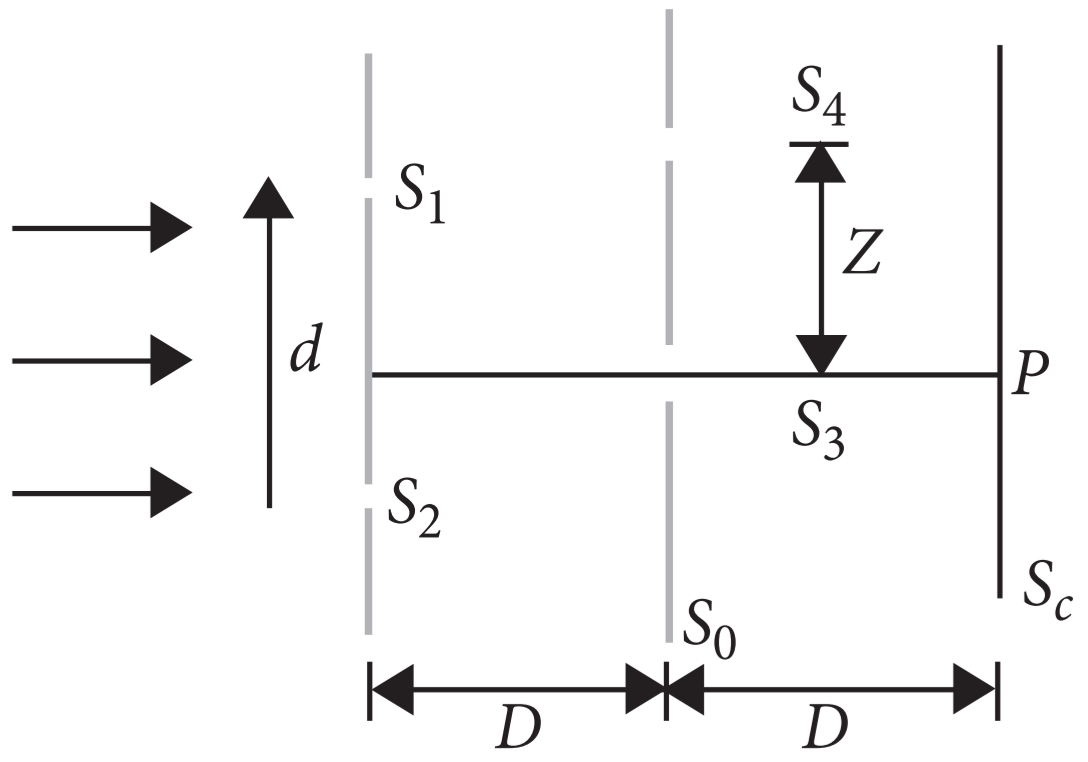
Consider the situation shown in figure. The two slits S1 and S1 placed symmetrically around the central line are illuminated by monochromatic light of wavelength $\lambda$. The separation between the slits is d. The light transmitted by the slits falls on a screen S0 place at a distance D from the slits. The slits S3 is at the central line and the slit S4 is at a distance from S3. Another screen Sc is placed a further distance D away from Sc.

  1. Find the path difference if $\text{z}=\frac{\lambda\text{D}}{2\text{d}}$.

  1. $\lambda$

  2. $\frac{\lambda}{2}$

  3. $\frac{3}{2\lambda}$

  4. $2\lambda$

  1. Find the ratio of the maximum to minimum intensity observed on Sc if $\text{z}=\frac{\lambda\text{D}}{\text{d}}$

  1. 4
  2. 2
  3. $\infty$

  4. 1
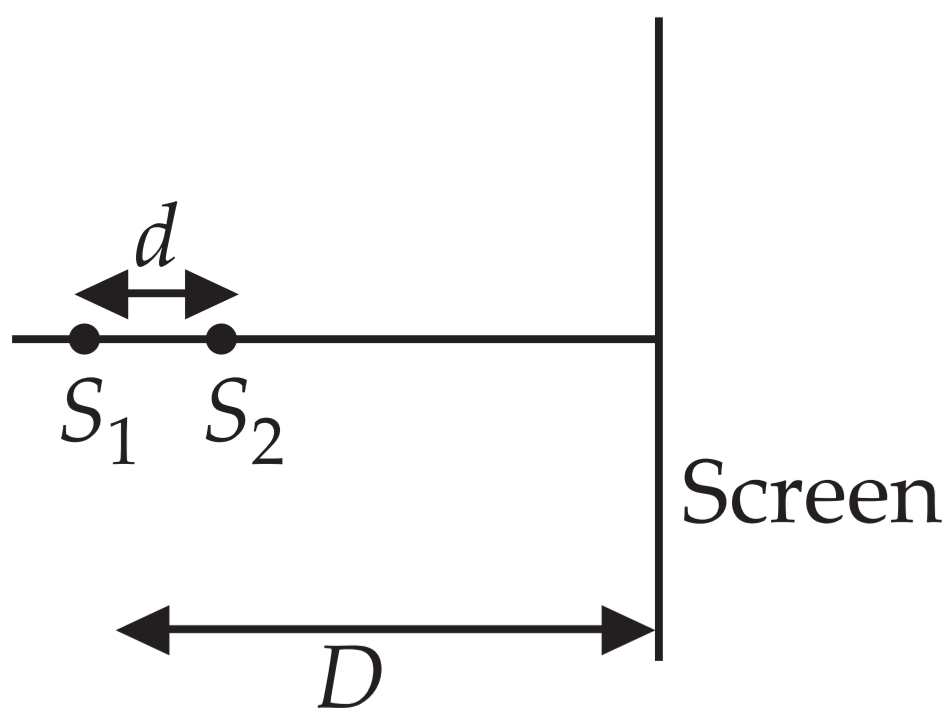
  1. Two coherent point sources S1 and S2 are separated by a small distanced as shown in figure. The fringes obtained on the screen will be:

  1. Concentric circles.
  2. Points.
  3. Straight lines.
  4. Semi-circles.
  1. ln the case of light waves from two coherent sources S1 and S2, there will be constructive interference at an arbitrary point P, if the path difference S1P - S2P is:
  1. $\Big(\text{n}+\frac{1}{2}\Big)\lambda$

  2. $\text{n}\lambda$

  3. $\Big(\text{n}-\frac{1}{2}\Big)\lambda$

  4. $\frac{\lambda}{2}$

  1. Two monochromatic light waves of amplitudes 3A and 2A interfering at a point have a phase difference of 60º. The intensity at that point will be proportional to:
  1. 5A2
  2. 13A2
  3. 7A2
  4. 19A2
TV signals broadcast by Delhi studio cannot be directly received at Patna which is about 1000km away. But the same signal goes some 36000km away to a satellite, gets reflected and is then received at Patna. Explain.
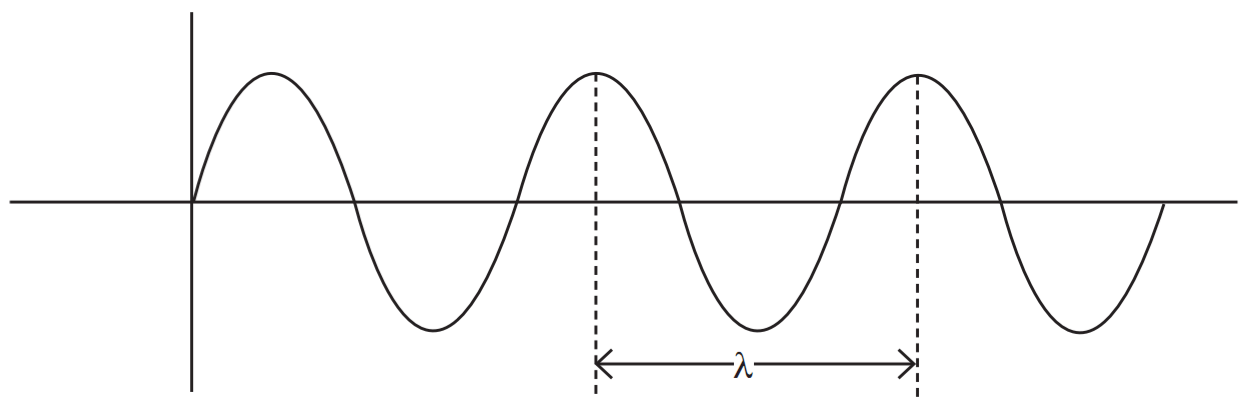
According to de-Broglie, a moving material particle sometimes acts as a wave and sometimes as a particle or a wave associated with moving material particle which controls the particle in every respect. The wave associated with moving particle is called matter wave or de-Broglie wave where wavelength called de-Broglie wavelength, rs given by $\lambda=\frac{\text{h}}{\text{mv}}$.

  1. If a proton and an electron have the same de Broglie wavelength, then:
  1. Kinetic energy of electron < kinetic energy of proton.
  2. Kinetic energy of electron = kinetic energy of proton.
  3. Momentum of electron = momentum of proton.
  4. momentum of electron < momentum of proton.
  1. Which of these particles having the same kinetic energy has the largest de Broglie wavelength?
  1. Electron
  2. Alpha particle
  3. Proton
  4. Neutron
  1. Two particles A1 and A2 of masses m1, m2 (m1 > m2) have the same de Broglie wavelength. Then:
  1. Their momenta are the same.
  2. Their energies are the same.
  3. Momentum of A1 is less than the momentum of A1.
  4. Energy of A1 is more than the energy of A2.
  1. When the velocity of an electron increases, its de Broglie wavelength:
  1. Increases.
  2. Decreases.
  3. Remains same.
  4. May increase or decrease.
  1. Proton and $\alpha$ - particle have the same de-Broglie wavelength. What is same for both of them?
  1. Time period
  2. Energy
  3. Frequency
  4. Momentum
   The lens maker's formula is a relation that connects focal length of a lens to radii of curvature of two surfaces of the lens and refractive index of the material of the lens. It is $\frac{1}{\text{f}}=(\mu-1)(\frac{1}{\text{R}_1}-\frac{1}{\text{R}_2}),$ where $\mu$ is refractive index of lens material w.r.t. the medium in which lens is held. As $\mu_\text{v}>\mu_\text{r}$ therefore $\text{f}_\text{r}>\text{f}_\text{v}.$ Mean focal length of lens for yellow colour is $\text{F}=\sqrt{\text{f}_\text{r}\times\text{f}_\text{v}}.$

  1. Focal length of a equiconvex lens of glass $\mu=\frac{3}{2}$ in air is 20cm. The radius of curvature of each surface is:
  1. 10cm
  2. -10cm
  3. 20cm
  4. -20cm
  1. A substance is behaving as convex lens in air and concave in water, then its refractive index is:
  1. Greater than air but less than water.
  2. Greater than both air and water.
  3. Smaller than air.
  4. Almost equal to water.
  1. For a thin lens with radii of curvatures R1 and R2, refractive index n and focal length f, the factor $(\frac{1}{\text{R}_1}-\frac{1}{\text{R}_2})$ is equal to:
  1. $\frac{1}{\text{f}(\text{n}-1)}$

  2. $\text{f}(\text{n}-1)$

  3. $\frac{(\text{n}-1)}{\text{f}}$

  4. $\frac{\text{n}}{\text{f}(\text{n}-1)}$

  1. A given convex lens of glass $(\mu=\frac{3}{2})$ can behave as concave when it is held in a medium of $\mu$ equal to:
  1. $1$
  2. $\frac{3}{2}$

  3. $\frac{2}{3}$

  4. $\frac{7}{4}$

  1. The radii of curvature of the surfaces of a double convex lens are 20cm and 40cm respectively, and its focal length is 20cm. What is the refractive index of the material of the lens?
  1. $\frac{5}{2}$

  2. $\frac{4}{3}$

  3. $\frac{5}{3}$

  4. $\frac{4}{5}$   

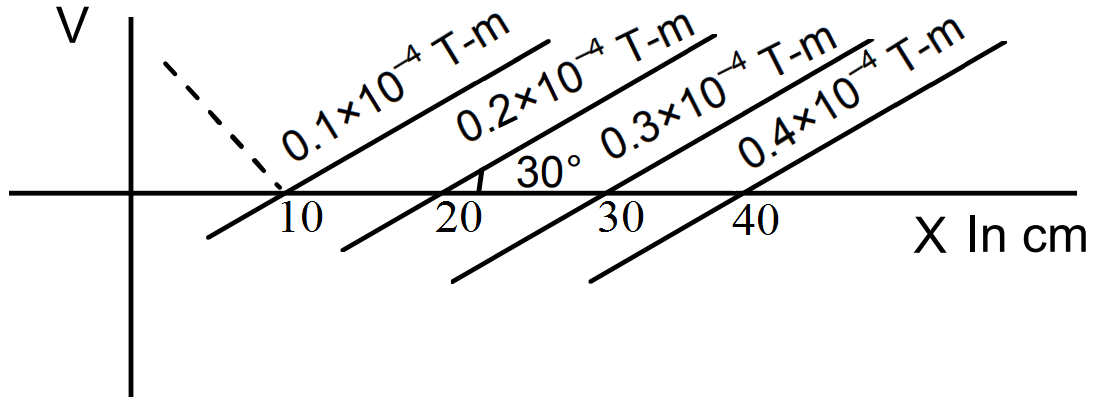
Figure shows some of the quipotential surfaces of the magnetic scalar potential. Fmd the magnetic field B at a point in the region.

The half-life of 226Ra is 1602y. Calculate the activity of 0.1g of RaCl2 in which all the radium is in the form of 226Ra. Taken atomic weight of Ra to be 226g/mol-1 and that of Cl to be 35.5g/mol-1.
Ram is a  student of class X in a village school. His uncle gifted him a bicycle with a dynamo fitted in it. He was very excited to get it. While cycling during night, he could light the bulb and see the objects on the road. He however, did not know this device works. He asked this question to his teacher. the teacher considered it an opportunity to explain the working to the whole class.
Answer the following question:
  1. State the principle and working of a dynamo.
  2. Write two values each displayed by Ram and his school teacher.
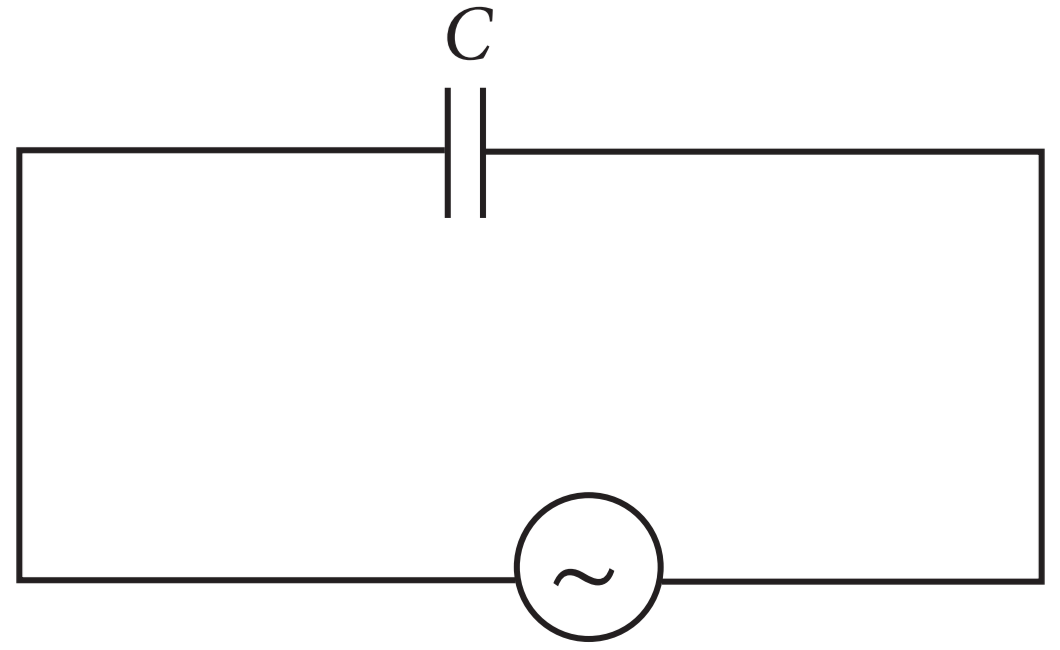
Let a source of alternating e.m.f. $\text{E} = \text{E}_\circ\sin\omega\text{t}$ be connected to a capacitor of capacitance C. If 'I' is the instantaneous value of current in the circuit at instant t, then $\text{I}=\frac{\text{E}_0}{\frac{1}{\omega\text{C}}}\sin\Big(\omega\text{t}+\frac{\pi}{2}\Big).$ The capacitive reactance limits the amplitude of current in a purely capacitive circuit and it is given by $\text{X}_\text{C}=\frac{1}{\omega\text{C}}.$

  1. What is the unit of capacitive reactance?
  1. Farad
  2. Ampere
  3. Ohm
  4. Ohm-1
  1. The capacitive reactance of a $5\mu\text{F}$ capacitor for a frequency of 106Hz is:
  1. $0.032\Omega$
  2. $2.52\Omega$
  3. $1.25\Omega$
  4. $4.51\Omega$
  1. In a capacitive circuit, resistance to the flow of current is offered by:
  1. Resistor
  2. Capacitor
  3. Inducto
  4. Frequency
  1. In a capacitive circuit, by what value of phase angle does alternating current leads the e.m.f?
  1. 45º
  2. 90º
  3. 75º
  4. 60º
  1. One microfarad capacitor is joined to a 200V, 50Hz alternator. The rrns current through capacitor is:
  1. 6.28 × 10⁻²A
  2. 7.5 × 10⁻⁴A
  3. 10.52 × 10⁻²A
  4. 15.25 × 10⁻²A
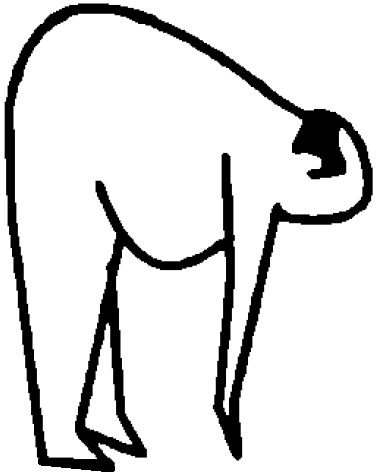
When a fat person tries to touch his toes, keeping the legs straight, he generally falls. Explain with reference to figure.