Rajasthan BoardEnglish MediumSTD 12 ScienceBIOLOGYEnvironmental Issues4 Marks
Question
What is global warming? Describe main causes of global warming.
✓
Answer
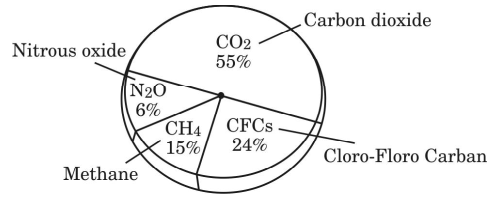
Global Warming : Global warming is the long-term warming of the planet's overall temperature. Though this warming trend has been going on for a long time, its pace has significantly increased in the last hundred years due to the burning of fossil fuels. As the human population has increased, so has the volume of fossil fuels burnt? Fossil fuels include coal, oil, and natural gas, and burning them causes what is known as the ‘‘greenhouse effect’’ in Earth's atmosphere. The greenhouse effect is when the Sun's rays penetrate the atmosphere, but when that heat is reflected off the surface cannot escape back into space. Gases produced by the burning of fossil fuels prevent the heat from leaving the atmosphere. These greenhouse gasses are carbon dioxide, chlorofluorocarbons, water vapour, methane, and nitrous oxide. The excess heat in the atmosphere has caused the average global temperature to rise overtime, otherwise known as global warming. Global warming has presented another issue called climate change. Sometimes these phrases are used interchangeably, however, they are different. Climate change refers to changes in weather patterns and growing seasons around the world. It also refers to sea level rise caused by the expansion of warmer seas and melting ice sheets and glaciers. Global warming causes climate change, which poses a serious threat to life on earth in the forms of widespread flooding and extreme weather. Scientists continue to study global warming and its impact on Earth. Causes of Global Warming : Humans are increasingly influencing the climate and the earth's temperature by burning fossil fuels, cutting down forests and farming livestock. This adds enormous amounts of greenhouse gases to those naturally occurring in the atmosphere, increasing the greenhouse effect and global warming. The main driver of climate change is the greenhouse effect. Some gases in the Earth's atmosphere act a bit like the glass in a greenhouse, trapping the sun's heat and stopping it from leaking back into space and causing global warming. Many of these greenhouse gases occur naturally, but human activity is increasing the concentrations of some of them in the atmosphere, in particular : carbon dioxide $\left(\mathrm{CO}_2\right)$, methane nitrous oxide fluorinated gases $\mathrm{CO}_2$, produced by human activities is the largest contributor to global warming. Other greenhouse gases are emitted by human activity in smaller quantities. Methane is a more powerful greenhouse gas than $\mathrm{CO}_2$ but has a shorter atmospheric lifetime. Nitrous oxide, like $\mathrm{CO}_2$ is a long-lived greenhouse gas that accumulates in the atmosphere over decades to centuries. Causes for rising emissions :
Burning coal, oil and gas produces carbon dioxide and nitrous oxide.
Cutting down forests (deforestation). Trees help to regulate the climate by absorbing $\mathrm{CO}_2$ from the atmosphere. When they are cut down, that beneficial effect is lost and the carbon stored in the trees is released into the atmosphere, adding to the greenhouse effect.
Increasing livestock farming, cows and sheep produce large amounts of methane when they digest their food.
Fertilizers containing nitrogen produce nitrous oxide emissions.
Fluorinated gases are emitted from equip-ment and products that use these gases. Such emissions have a very strong warming effect, up to 23000 times greater than $\mathrm{CO}_2$.
Need a full question paper?
Generate a complete, print-ready paper with questions like this in minutes — across 16+ boards, with answer keys.