Question
Explain the steps involved in a polypeptide synthesis. How are the amino acids activated during polypeptide synthesis?

Answer

  1. Initiation:
  • In prokaryotes, initiation requires the large and small ribosome subunits, the mRNA, initiation tRNA and three initiation factors (IFs).

  • Activation of amino acid: Amino acids become activated by binding with aminoacyl tRNA synthetase enzyme in the presence of ATP.

  • Aminoacid(AA) + ATP → synthetases Aminoacy lt RNA AA - AMP - Enzymecomplex + Pi

  • Transfer of amino acid to tRNA: The AA - AMP - Enzyme complex formed reacts with specific tRNA to form aminoacyl-tRNA complex. AA - AMP - Enzyme complex + tRNA → AA - tRNA + AMP + Enzyme.

  • The cap region of mRNA binds to the smaller subunit of ribosome.
  • The ribosome has two sites, A-site and P-site.
  • The smaller subunit first binds to the initiator mRNA and then binds to the larger subunit so that initiation codon (AUG) lies on the P-site.
  • The initiation tRNA, i.e., methionyl tRNA then binds to the P-site.
  1. Elongation of polypeptide chain:
  • Another charged aminoacyl tRNA complex binds to the A-site of the ribosome at the second codon.
  • A peptide bond is formed between carboxyl group (-COOH) of amino acid at P-site and amino group (-NH) of amino acid at A-site by the enzyme peptidyl transferase.
  • The ribosome slides over mRNA from codon to codon in the 5′ → 3′ direction.
  • According to the sequence of codons, amino acids are attached to one another by peptide bonds and a polypeptide chain is formed.

Need a full question paper?

Generate a complete, print-ready paper with questions like this in minutes — across 16+ boards, with answer keys.
Start Generating Free

Similar questions

Give the term/ reason:
Role of oxytocin during expulsion of the baby out of uterus.
Describe briefly about embryonic stages in human being.
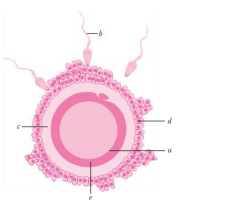
Study the illustration given and answer the questions that follow:

Draw a diagram of ‘b’ separately and label the parts:
  • That help its entry into ‘a’;
  • That carry genetic material;
  • That help in its movement.
(A) Give short note on cell mediate immunity.###(b) What are the basic principles of immunology and their Applications.
Match the items in Column I with those in Column II.
S.No Column I S.No Column II
A. ABO blood group in humans 1. Polygenic inheritance
B. Flower colour in snapdragon 2. Mendelian genetic disorder
C. Human skin colour 3. Sex-linked Mendelian disorder
D. Phenylketonuria 4. Incomplete dominance
    5. Multiple allelism
What is the Human Genome Project? Write the features of the Human Genome Project. Give a diagram representing the Human Genome Project.
Explain polygenic inheritance with the help of an example.
Give a genetic explanation for the following cross. When a tall pea plant with round seeds was crossed with a dwarf pea plant with wrinkled seeds then all the individual of F1-population were tall with round seeds. However selfing among F1-population led to a 9:3:3:1 phenotypic ratio.
(i) What is called immunity?
(ii) Write the difference between active immunity and passive immunity. (Sr. Sec. Board Exam., 2023)
(iii) Explain passive immunization. (iv) Make a labeled diagram of the stages of life cycle of Plasmodium in mosquito host.
Explain with an example, where a gene, which carries a major disadvantage in homozygous state, confers an advantage in heterozygous condition.