Question
What is ideal Solution? Explain with examples.

Answer

→ "The solutions which follows Raoult's law over the entire range of concentration are known as ideal solutions."
→ The enthalpy of mixing of the pure components to form the solution is zero and the volume of mixing is also zero,
$\Delta_{\text {mix }} H =0 \quad \Delta_{\text {mix }} V =0$
→ It means that no heat is absorbed or evolved when the components are mixed.
→ The volume of solution would be equal to the sum of volumes of the two components.
→ At molecular level, ideal behaviour of the solutions can be explained by considering two components A and B. In pure components, the intermolecular attractive interactions will be of types A-A and B-B, where as in the binary solutions in addition to these two interactions, A-B type of interactions will also be present.
→ If the intermolecular attractive forces between the A-A and B-B are nearly equal to those between A-B, this leads to the formation of ideal solution.
→ Example of ideal solution:
→ n-hexane and n-heptane, bromoethane and chloroethane, benzene and toluene, etc.

Need a full question paper?

Generate a complete, print-ready paper with questions like this in minutes — across 16+ boards, with answer keys.
Start Generating Free

Similar questions

Draw a diagram of galvanie cell and explain the following reaction
$Zn ( s )+2 Ag ^{+}( aq ) \longrightarrow Zn ^{2+}( aq )+2 Ag ( s )$ which electrode is electronegative in this reaction? what are the charge carriers in a cell? write the reactions occurring at each electrode.
State Kohlrausch's law of independent migration of ions. How can the degree of dissociation of acetic acid in a solution be calculated from its molar conductivity data?
$^{238}_{92}\text{U}$ Change to $^{206}_{92}\text{Pb}$ by successive radioactive decay. A sample of urenium ore was anlaysed and found to contain $1.0 g$ of $^{238}\text{U}$ and $0.1 g$ of $^{206}\text{Pb}$ had accumulated due to decay of $^{238}\text{U}$, find out the age of ore. $($Half$-$ life of $^{238}\text{U}$$= 4.5\times10^9$ years$).$
Answer the following question:$An$ organic compound A having molecular formula $\ce{C_6H_6O}$ gives a characteristic colour with aqueous $\ce{FeCl_3}$ solution. A on treatment with $\ce{CO_2}$ and $\ce{NaOH}$ at $400K$ under pressure gives $B$ which on acidification gives a compound $C.$ The compound $C$ reacts with acetyl chloride to give D which is a popular pain killer. Deduce the structure of $A, B, C$ and $D.$
Complete the following chemical reaction equations:
$\text{Cr}_2\text{O}^{2-}_7(\text{aq})+\text{Fe}^{2+}(\text{aq})+\text{H}^+(\text{aq})\xrightarrow{\ \ \ \ \ \ \ \ \ }$
Calculate the charge of one mole of electrons.
Image
Answer the following question:
Give chemical tests to distinguish between:
  1. Acetaldehyde and benzaldehyde.
  2. Propanone and propanol.
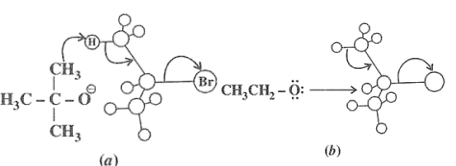
One of the two figures given below represents substitution and the other represents elimination. Indicate which is substitution and which is elimination.
Image
What products are formed when chloroform is :
(i) Boiled with aqueous KOH .
(ii) Heated with silver powder.
(iii) Aniline in presence of alcoholic KOH
(iv) Phenol in presence of alcoholic KOH at 340 K .