MCQ
What is immaterial for an electric fuse wire
  • A
    Its specific resistance
  • B
    Its radius
  • Its length
  • D
    Current flowing through it

Answer

Correct option: C.
Its length
c
(c) Length is immaterial for an electric fuse wire.

Need a full question paper?

Generate a complete, print-ready paper with questions like this in minutes — across 16+ boards, with answer keys.
Start Generating Free

Similar questions

In a hydrogen like atom electron make transition from an energy level with quantum number $n$ to another with quantum number $(n- 1)$. If $n > >  1$, the frequency ofradiation emitted is proportional to
The correct formula for fringe visibility is
Let $[{\varepsilon _0}]$ denotes the dimensional formula of the permittivity of the vacuum and $[{\mu _0}]$ that of the permeability of the vacuum. If $M = {\rm{mass}}$, $L = {\rm{length}}$, $T = {\rm{Time}}$ and $I = {\rm{electric current}}$, then
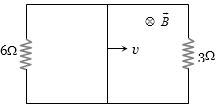
A rectangular loop with a sliding connector of length $l = 1.0 \,m$ is situated in a uniform magnetic field $B = 2\,T$ perpendicular to the plane of loop. Resistance of connector is $r = 2$ $\Omega$ Two resistance of $6$ $\Omega$ and $3$ $\Omega$ are connected as shown in figure. The external force required to keep the connector moving with a constant velocity $v = 2\,m/s$ is........$N$
The insulation property of air breaks down at $E = 3 \times {10^6}$ $volt\,/\,metre$. The maximum charge that can be given to a sphere of diameter $5\,m$ is approximately (in coulombs)
Two points $P$ and $Q$ are maintained at the potentials of $10\  V$ and $- 4\ V$, respectively. The work done in moving $100$ electrons from $P$ to $Q$ is
Lenz's law is consequence of the law of conservation of
A car of mass $m$ starts from rest and accelerates so that the instantaneous power delivered to the car has a constant magnitude $P_0$. The instantaneous velocity of this car is proportional to
An automobile engine develops $100\ kW$ when rotating at a speed of $1800\ rev/min$.  What torque does it deliver .......... $N-m$
The $\beta$-decay process, discovered around $1900$ , is basically the decay of a neutron ( $n$ ), In the laboratory, a proton ( $p$ ) and an electron ( $e ^{-}$) are observed as the decay products of the neutron. therefore, considering the decay of a neutron as a tro-body dcay process, it was predicted theoretically that thekinetic energy of the electron should be a constant. But experimentally, it was observed that the electron kinetic energy has a continuous spectrum. Considering a three-body decay process, i.e. $n \rightarrow p+ e ^{-}+\bar{v}_{ e }$, around $1930,$ Pauli explained the observed electron energy spectrum. Assuming the anti-neutrino $\left(\bar{v}_{ e }\right)$ to be massless and possessing negligible energy, and neutron to be at rest, momentum and energy conservation principles are applied. From this calculation, the maximum kinetic energy of the lectron is $0.8 \times 10^6 eV$. The kinetic energy carried by the proton is only the recoil energy.

$1.$ What is the maximum energy of the anti-neutrino?

$(A)$ Zero

$(B)$ Much less than $0.8 \times 10^6 \ eV$

$(C)$ Nearly $0.8 \times 10^6 \ eV$

$(D)$ Much larger than $0.8 \times 10^6 \ eV$

$2.$ If the anti-neutrino had a mass of $3 eV / c ^2$ (where $c$ is the speed of light) instead of zero mass, what should be the range of the kinetic energy, $K$, of the electron?

$(A)$ $0 \leq K \leq 0.8 \times 10^6 \ eV$

$(B)$ $3.0 eV \leq K \leq 0.8 \times 10^6 \ eV$

$(C)$ $3.0 eV \leq K < 0.8 \times 10^6 \ eV$

$(D)$ $0 \leq K < 0.8 \times 10^6 \ eV$

Give the answer question $1$ and $2.$