MCQ
The correct formula for fringe visibility is
  • $V\, = \,\frac{{{I_{\max }} - {I_{\min }}}}{{{I_{\max }} + {I_{\min }}}}$
  • B
    $V\, = \,\frac{{{I_{\max }} + {I_{\min }}}}{{{I_{\max }} - {I_{\min }}}}$
  • C
    $V\, = \,\frac{{{I_{\max }}}}{{{I_{\min }}}}$
  • D
    $V\, = \,\frac{{{I_{\min }}}}{{{I_{\max }}}}$
Answer

Correct option: A.
$V\, = \,\frac{{{I_{\max }} - {I_{\min }}}}{{{I_{\max }} + {I_{\min }}}}$
a
Fringe visibility $(V)$ is given by

$V\, = \,\frac{{{I_{\max }} - {I_{\min }}}}{{{I_{\max }} + {I_{\min }}}}$.

Need a full question paper?

Generate a complete, print-ready paper with questions like this in minutes — across 16+ boards, with answer keys.

Start Generating Free

Similar questions

Two oscillating systems; a simple pendulum and a vertical spring-mass-system have same time period of motion on the surface of the Earth. If both are taken to the moon, then-
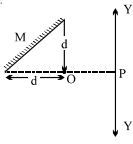
As shown in the figure a particle is placed at $O$ in front of a plane mirror $M$. $A$ man at $P$ can move along path $PY$ and $PY'$ then which of the following is true
Remote sensing satellites move in an orbit that is at an average height of about $500 \,km$ from the surface of the earth. The camera onboard one such satellite has a screen of area $A$ on which the images captured by it are formed. If the focal length of the camera lens is $50 \,cm$, then the terrestrial area that can be observed from the satellite is close to ............... $A$
$1\, m^3$ water is brought inside the lake upto $200$ metres depth from the surface of the lake. What will be change in the volume when the bulk modulus of elastically of water is $22000$ atmosphere? (density of water is $1\times10^3\, kg/m^3$ atmosphere pressure $= 10^5\, N/m^2$ and $g = 10\, m/s^2$)
In a double slit experiment, when a thin film of thickness $t$ having refractive index $\mu $ is introduced in front of one of the slits, the maximum at the centre of the fringe pattern shifts by one fringe width. The value of $t$ is ($\lambda $ is the wavelength of the light used)
A mixture of one mole of monoatomic gas and one mole of a diatomic gas (rigid) are kept at room temperature (27°C). The ratio of specific heat of gases at constant volume respectively is:
A passenger train of length $60\, m$ travels at a speed of $80\, km/hr$. Another freight train of length $120\, m$ travels at a speed of $30\, km/hr$. The ratio of times taken by the passenger train to completely cross the freight train when:

$(i)$ they are moving in the same direction, and

$(ii)$ in the opposite directions is

A nucleus with mass number $184$ initially at rest emits an $\alpha$-particle. If the $Q$ value of the reaction is $5.5\, {MeV}$, calculate the kinetic energy of the $\alpha-$ particle. (In ${MeV}$)
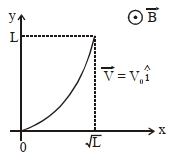
A conducting wire of parabolic shape, initially $y=x^2$, is moving with velocity $\overrightarrow{ V }= V _0 \hat{ i }$ in a nonuniform magnetic field $\vec{B}=B_0\left(1+\left(\frac{y}{L}\right)^\beta\right) \hat{k}$, as shown in figure. If $V_0, B_0, L$ and $\beta$ are positive constants and $\Delta \phi$ is the potential difference developed between the ends of the wire, then the correct statement(s) is/are:

$(1)$ $|\Delta \phi|$ remains the same if the parabolic wire is replaced by a straight wire, $y=x$ initially, of length $\sqrt{2} L$

$(2)$ $|\Delta \phi|$ is proportional to the length of the wire projected on the $y$-axis.

$(3)$ $|\Delta \phi|=\frac{1}{2} B _0 V _0 L$ for $\beta=0$

$(4)$ $|\Delta \phi|=\frac{4}{3} B_0 V_0 L$ for $\beta=2$

The pressure and density of a diatomic gas $(\gamma = 7/5)$ change adiabatically from $(P, d)$ to $(P', d')$. If $\frac{{d'}}{d} = 32$, then $\frac{{P'}}{P}$ should be