Question
What is interference of light? Write two essential conditions for sustained interference pattern to be produced on the screen.
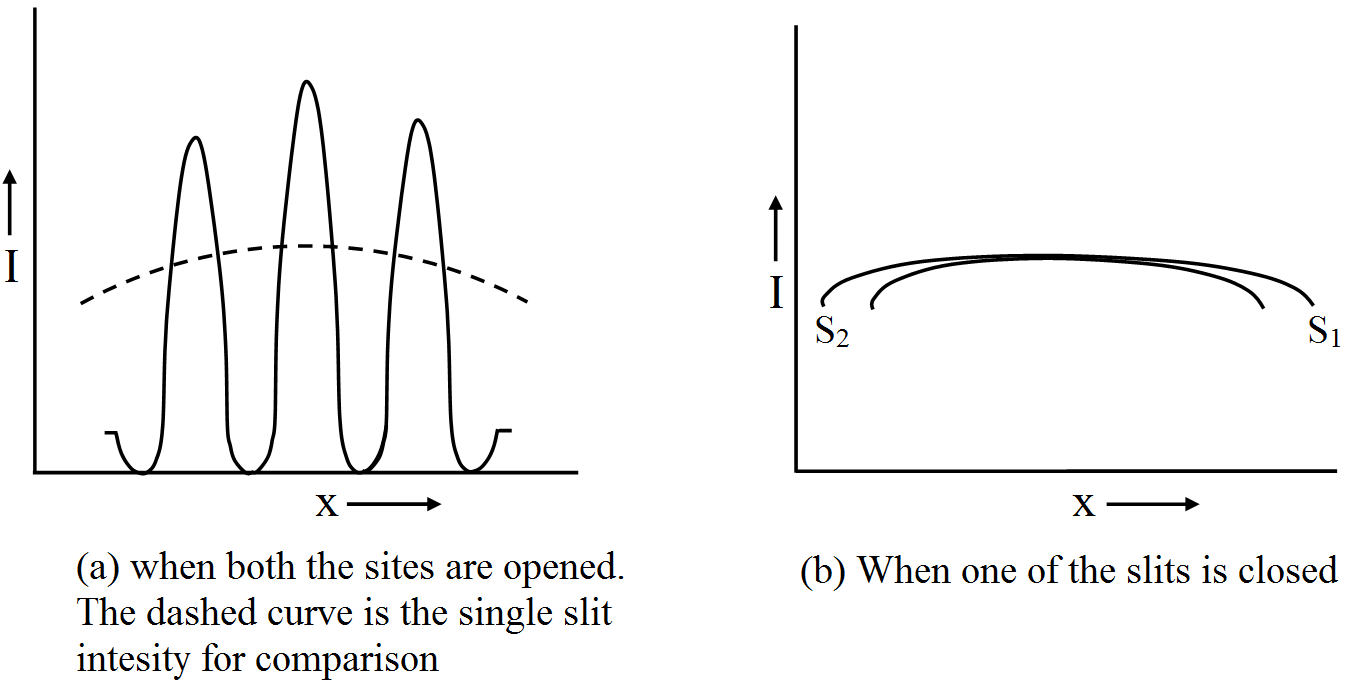
Draw a graph showing the variation of intensity versus the position on the screen in Young’s experiment when (a) both the slits are opened and (b) one of the slits is closed.
What is the effect on the interference pattern in Young’s double slit experiment when:
  1. Screen is moved closer to the plane of slits?
  2. Separation between two slits is increased?
Explain your answer in each case.

Answer


Interference of light: When two waves of same frequency and constant initial phase difference travel in the same direction along a straight line simultaneously, they superpose in such a way that the intensity of the resultant wave is maximum at certain points and minimum at certain other points. This phenomenon of redistribution of energy due to superposition of two waves of same frequency and constant initial phase difference is called interference
Conditions for Sustained Interference of Light Waves:
To obtain sustained (well-defined and observable) interference pattern, the intensity must be maximum and zero at points corresponding to constructive and destructive interference. For the purpose following conditions must be fulfilled:
  1. The two interfering sources must be coherent and of same frequency, i.e., the sources should emit light of the same wavelength or frequency and their initial phase should remain constant. If this condition is not satisfied the phase difference between the interfering waves will vary continuously. As a result the resultant intensity at any point will vary with time being alternately maximum and minimum, just like the phenomenon of beats in sound.
  2. The interfering waves must have equal amplitudes. Otherwise the minimum intensity will not be zero and there will be general illumination.

The variation of intensity I versus the position x on the screen in Young’s experiment. Fringe width, $\beta=\frac{\text{D}\lambda}{\text{d}}.$
  1. $\text{B}\alpha\text{D},$ therefore with the decrease of separation between the plane of slits and screen, the fringe width decreases.
  2. On increasing the separation between two slits (d), the fringe separation decreases as β is inversely proportional to d $(\text{i.e.,}\beta\alpha\frac{1}{\text{d}}.)$

Need a full question paper?

Generate a complete, print-ready paper with questions like this in minutes — across 16+ boards, with answer keys.

Start Generating Free

Similar questions

There are two current carrying planar coils made each from identical wires of length $L. C_1$ is circular $($radius $R )$ and $C_2$ is square $($side a$)$. They are so constructed that they have same frequency of oscillation when they are placed in the same uniform $B$ and carry the same current. Find a in terms of $R$.
Define the capacitance of a capacitor. Obtain an expression for the capacitance of a parallel plate capacitor. And explain on what factors the does capacitance depend?
Obtain the relation for equivalence in series combination of capacitors. Make a circuit diagram.
Calculate the work done in moving a test charge q0 from point A to point B against the repulsive force acting on it due to the other charge Q > 0 located at the origin.
A uniform magnetic field B exist in a region. An electron projected perpendicular to the field goes in a circle. Assuming Bohr's quantization rule for angular momentum, calculate (a) the smallest possible radius of the electron (b) the radius of the nth orbit and (c) the minimum possible speed of the electron.
A train running at 108km/h towards east whistles at a dominant frequency of 500Hz. Speed of sound in air is 340m/s.
  1. What frequency will a passenger sitting near the open window hear?
  2. What frequency will a person standing near the track hear whom the train has just passed?
  3. A wind starts blowing towards east at a speed f 36km/h. Calculate the frequencies heard by the passenger in the train and by the person standing near the track.
Monochromatic radiation of wavelength $640.2 nm (1nm = 10^{–9} m)$ from a neon lamp irradiates photosensitive material made of caesium on tungsten. The stopping voltage is measured to be $0.54 V.$ The source is replaced by an iron source and its $427.2\ nm$ line irradiates the same photo-cell. Predict the new stopping voltage.
A parallel $-$ plate capacitor having plate area $20\ cm^2$ and separation between the plates $1.00\ mm$ is connected to a battery of $12.0V$. The plates are pulled apart to increase the separation to $2.0\ mm$.
  1. Calculate the charge flown through the circuit during the process.
  2. How much energy is absorbed by the battery during the process?
  3. Calculate the stored energy in the electric field before and after the process.
  4. Using the expression for the force between the plates, find the work done by the person pulling the plates apart.
  5. Show and justify that no heat is produced during this transfer of charge as the separation is increased.
An electric kettle used to prepare tea, takes $2$ minutes to boil $4$ cups of water $(1$ cup contains $200cc$ of water$)$ if the room temperature is $25C$.
  1. If the cost of power consumption is $Rs. 1.00$ per unit $(1$ unit $- 1000$ watt $-$ hour$),$ calculate the cost of boiling $4$ cups of water.
  2. What will be the corresponding cost if the room temperature drops to $5^\circ \ C$?
A magnetic field of $(4.0\times10^{-3}\vec{\text{k}})$ T exerts a force of $(4.0\vec{\text{i}}+3.0\vec{\text{j}})\times10^{-10}$ N on a particle with a charge of $1.0\times10^{-9}\text{C}$ and going in the x−y plane. Find the velocity of the particle.