Question
What is interference of light? Write two essential conditions for sustained interference pattern to be produced on the screen. Draw a graph showing the variation of intensity versus the position on the screen in Young's experiment when (a) both the slits are opened and (b) one of the slit is closed. What is the effect on the interference pattern in Young's double-slit experiment when: 32. 33.
i. Screen is moved closer to the plane of slits?
ii. Separation between two slits is increased. Explain.
Answer

Interference of light: Phenomenon of redistribution of light energy in a medium on account of superposition of light waves from two coherent sources is called interference of light.
Conditions for sustained interference: The two essential conditions of sustained interference are as follows:
i. The two sources of light should emit light continuously.
ii. The light waves should be of same wavelength (Monochromatic).
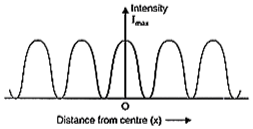
(a) When both the slits are open, we get an interference pattern on the screen. Then the following intensity distribution curve is obtained.
Image
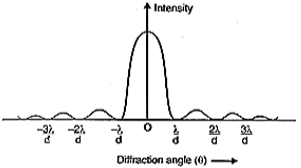
(b) When one of the slits is closed, diffraction pattern is obtained on the screen. The following intensity curve is obtained. 
Image

Also we know that, Fringe width, $\beta=\frac{D \lambda}{d}$, therefore i. The distance D decreases, the fringe width $\beta$ also decreases if screen is moved closer to the plane of the slits.
ii. Fringe width $\beta$ decreases if separation d between two slits is increased.

Need a full question paper?

Generate a complete, print-ready paper with questions like this in minutes — across 16+ boards, with answer keys.

Start Generating Free

Similar questions

Use (i) the Ampere's law for H and (ii) continuity of lines of B, to conclude that inside a bar magnet, (a) lines of H run from the N pole to S pole, while (b) lines of B must run from the S pole to N pole.
A particle having mass 10g oscillates according to the equation $\text{x}=(2.0\text{cm})\sin\big[(100\text{s}^{-1})\text{t}+\frac{\pi}{6}\big].$ Find (a) the amplitude, the time period and the spring constant (b) the position, the velocity and the acceleration at t = 0.
An eye can distinguish between two points of an object if they are separated by more than $0.22\ mm$ when the object is placed at $25\ cm$ from the eye. The object is now seen by a compound microscope having a $20D$ objective and $10D$ eyepiece separated by a distance of $20\ cm$. The final image is formed at $25\ cm$ from the eye. What is the minimum separation between two points of the object which can now be distinguished?
Three photo diodes $D1, D2$ and $D3$ are made of semiconductors having band gaps of $2.5eV, 2eV$ and $3eV,$ respectively. Which ones will be able to detect light of wavelength $6000\mathring{\text{A}}$?
Find the change in the internal energy of $2\ kg$ of water as it is heated from $0^\circ C$ to $4^\circ C$. The specific heat capacity of water is $4200Jkg^{-1} K^{-1}$ and its densities at $0^\circ C $and $4^\circ C$ are $999.9\ kgm^{-3}$ and $1000\ kgm^{-3}$ respectively. Atmospheric pressure $= 10^{-6}Pa.$
Prove that due to a charged layer of infinite expansion, the value of the electric field at any point near it does not depend on the area of the surface and the distance from the layer . i.e., the electric field remains uniform at points near the layer.###Write Gauss'law.By applying this rule,find the value of the electric field due to a uniformly charged infinite plane sheet at any point near the sheet.
A person standing on the floor of an elevator drops a coin. The coin reaches the floor of the elevator in a time $t_1$ if the elevator is stationary and in time $t_2$ if it is moving uniformly. Then$:$
A source emitting sound at frequency 4000Hz, is moving along the Y-axis with a speed of 22m/s. A listener is situated on the ground at the position (660m, 0). Find the frequency of the sound received by the listener at the instant the source the origin. Speed of sound in air = 330m/s.
An adiabatic vessel of total volume $V$ is divided into two equal parts by a conducting separator. The separator is fixed in this position. The part on the left contains one mole of an ideal gas $(U = 1.5\ nRT)$ and the part on the right contains two moles of the same gas. Initially, the pressure on each side is $p$. The system is left for sufficient time so that a steady state is reached. Find,
  1. The work done by the gas in the left part during the process.
  2. The temperature on the two sides in the beginning.
  3. The final common temperature reached by the gases.
  4. The heat given to the gas in the right part.
  5. The increase in the internal energy of the gas in the left part.
The difference in the frequencies of series limit of Lyman series and Balmer series is equal to the frequency of the first line of the Lyman series. Explain.