Questions

5 Marks Questions

Take a timed test

6 questions · self-marked practice — reveal the answer and mark yourself.

Question 15 Marks
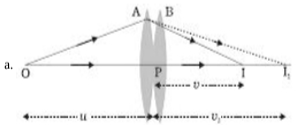
$a.$ Using the ray diagram for a system of two lenses of focal lengths $f_1$ and $f_2$ in contact with each other, show that the two lens system can be regarded as equivalent to a single lens of focal length $f$, where
$\frac{1}{ f }=\frac{1}{ f _1}+\frac{1}{ f _2}$
Also write the relation for the equivalent power of the lens combination.
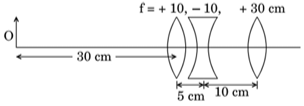
$b.$ Determine the position of the image formed by the lens combination given in the figure.
Image
Answer
Image
For less $A$
$\frac{1}{f_1}=\frac{1}{v_1}-\frac{1}{u}$ eg. $(I)$
For less $B$
$\frac{1}{f_2}=\frac{1}{v}-\frac{1}{v_1}$ eg.$(II)$
Adding eqn. $(i)$ eqn. $(ii)$
$\frac{1}{f_1}+\frac{1}{f_2}=\frac{1}{v_1}-\frac{1}{ u }+\frac{1}{ v }-\frac{1}{ v _1}$
$\frac{1}{f_1}+\frac{1}{f_2}=\frac{1}{ v }-\frac{1}{ u }$
$\frac{1}{f_1}+\frac{1}{f_2}=\frac{1}{F}$
$\therefore$ equivalent power
$P = P _2+ P _2$
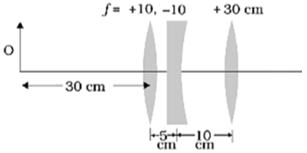
b. Image formed by lense of $f = +10 \ cm$
Image

$\frac{1}{v_1}-\frac{1}{u_1}=\frac{1}{f_1}$
$\frac{1}{v_1}-\frac{1}{30}=\frac{1}{10}$
$\therefore v_1=15 \ cm$
This image formed by the lens act as object from concave lens
$\therefore u _2=15-5=10 \ cm$
$\frac{1}{f_2}+\frac{1}{v_2}=\frac{1}{v_2}$
$\frac{1}{-10}=\frac{1}{v}-\frac{1}{10}$
$v=\infty$
Therefore virtual image forms at right of concave lens at $v=\infty$ and act as convex lens. ( $f=+30 \ cm$ )
$\therefore u _2=15-5=10 \ cm$
$\frac{1}{v_3}=\frac{1}{4}-\frac{1}{f_3}$
$\frac{1}{v_3}=\frac{1}{\infty}=\frac{1}{30}$
$v_3=30 \ cm$
View full question & answer
Question 25 Marks
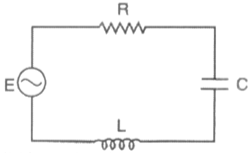
A resistor of $400 \Omega$, an inductor of $\frac{5}{\pi} H$ and a capacitor of $\frac{50}{\pi} \mu F$ are connected in series across a source of alternating voltage of $140 \sin 100 \pi t V$. Find the voltage $($rms$)$ across the resistor, the inductor and the capacitor. Is the algebraic sum of these voltages more than the source voltage? If yes, resolve the paradox. (Given, $\sqrt{2}=1.414 ).$
Answer
$C=\frac{50}{\pi} \mu F, L=\frac{5}{\pi} H, R=400 \Omega$
As applied voltage, $V=140 \sin 100 \pi t$
Comparing it with $V=V_0 \sin \omega t$,
Inductive reactance, $X_L=\omega L$
$X_L=100 \pi \times 5 / \pi=500 \Omega$
Capacitive reactance, $X_C=\frac{1}{\omega C}$
$X_c=\frac{1}{100 \pi \times \frac{80}{\nabla} \times 10^{-6}}=200 \Omega$
Impedance of the $AC$ circuit,
$Z=\sqrt{R^2+\left(X_L-X_C\right)^2}$
$=\sqrt{1409^2+(500-200)^2}$
$Z=\sqrt{1600+900=500 \Omega}$
Maximum current in the circuit,
$I_0=\frac{V_0}{Z}=\frac{140}{500}$
$I_{ rms }=\frac{I_0}{\sqrt{2}}=\frac{140}{500 \times \sqrt{2}}=0.2 A$
$ V _{\text {rms }}$ across resistor $R,  V_{r m s}=I_{r m s} R$
$V_{r m s}=0.2 \times 400=80 V$
$V _{\text {rms }}$ across inductor, $V_L=I_{ rms } X_L$
$V_L=0.2 \times 500=100 V$
$V _{\text {rms }}$ across capacitor, $V_C=I_{ rms } X_C$
$V_C=0.2 \times 200=40 V$
Now $, V$
Here, $V \neq V_R+V_L+V_C$
Because $V_C, V_L$ and $V_R$ are not in same phase,
$\therefore V=\sqrt{V_R^2+\left(V_L-V_C\right)^2}$
$V=\sqrt{80^2+(100-40)^2}$
$=100 V$
which is same as the applied rms voltage.
View full question & answer
Question 35 Marks
An ac voltage $V = V _{ m } \sin \omega t$ is applied to a series $\text{LCR}$ circuit. Obtain an expression for the current in the circuit and the phase angle between the current and voltage. What is resonance frequency?
Answer
$i.$ In a series $\text{LCR}$ circuit shown,
Image


Image
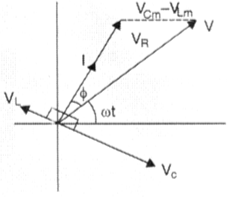
From the phasor relation, voltages $V_L+V_R+V_C=V$, as $V_C$ and $V_L$ are along the same line and in opposite directions, so they will combine in single phasor $\left( V _{ C }+ V _{ L }\right)$ having magnitude $\left| V _{ Cm }- VLm \right|$.
Since voltage $V$ is shown as the hypotenuse of a right $-$ angled triangle with sides as $V _{ R }$ and $\left( V _{ C }+ V _{ L }\right)$,
So the Pythagoras Theorem results as :
$V_m^2=V_R^2+\left(V_{C m}-V_{L m}\right)^2$
$V_m^2=\left( I _{ m } R \right)^2+\left( I _{ m } X _{ C }- I _{ m } X _{ L }\right)^2$
$V_m^2= I _{ m }{ }^2\left( R ^2+\left( X _{ C }- X _{ L }\right)^2\right)$
Now current in tire circuit :
$I_m=\frac{V_m}{\sqrt{\left(R^2+\left(X_C-X_L\right)^2\right.}}$
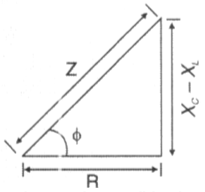
$I_m=\frac{V_m}{Z} \text { as } Z=\sqrt{\left[R^2+\left(X_C-X_L\right)^2\right]}$
Image

As phasor $1$ is always parallel to phasor $V_R$, the phase angle $\phi$ is the angle between $V_R$ and $V$ and can be determined from figure.
$\tan \phi=\frac{V_{C m}-V_{L m}}{V_{R \bar{m}}}$
$\tan \phi=\frac{X_C-X_L}{R}$
$ii.$ Resonance frequency is defined as the frequency at which the impedance of the $\text{LCR}$ circuit becomes minimum or current in the circuit becomes maximum. It is shown as: $V _{ Cm }= V _{ Lm }$ and $X _{ L }= X _{ C }$
$ f_0=\frac{1}{2 \pi \sqrt{L C}} $
View full question & answer
Question 45 Marks
$a$. Derive the expression for the electric potential due to an electric dipole at a point on its axial line.
$b$. Depict the equipotential surfaces due to an electric dipole.
Answer
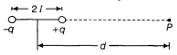
$a$. Let electric potential is to be determined at a point $P$ lying on the axis of an electric dipole of dipole length $2l$ at a distance $d$ from the centre of the dipole as shown in the figure.
Image

Potential at $P$ due to $+ q$ charge of the dipole $=\frac{1}{4 \pi \varepsilon_0} \cdot \frac{q}{(d-l)}$
Potential at $P$ due to $-q$ charge of the dipole 
$=\frac{1}{4 \pi \varepsilon_0} \frac{-q}{(d+l)}$
Total potential at $P$ due to both the charges of the dipole 
$=\frac{q}{4 \pi \varepsilon_0}\left[\frac{1}{(d-l)}-\frac{1}{(d+l)}\right] \\ =q \times \frac{2 \pi}{4 \pi \varepsilon_0} \times \frac{1}{\left(d^2-l^2\right)}$
$=\frac{p}{4 \pi \varepsilon_0} \times \frac{1}{\left(d^2-l^2\right)}$
where, the scalar value of dipole moment $(p)=q \times 2 l$
If $1 \ll d$, then neglecting $1^2$ we get, the final value of the electric potential to be, $V=\frac{1}{4 \pi \varepsilon_0} \frac{p}{d^2}$
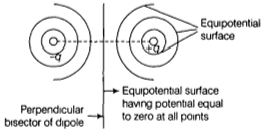
$b$. An electric dipole consists of two equal and opposite charges separated by some distance.
Equipotential lines and electric field are always perpendicular to each other.
Equipotential surfaces of a dipole are as shown below: 
Image

Potential of points lying on the perpendicular bisector surface will be zero.
View full question & answer
Question 55 Marks
a. Two $-$ point charges $q _1$ and $q _2$ are kept r distance apart in a uniform external electric field $\overrightarrow{ E }$. Find the amount of work done in assembling this system of charges.
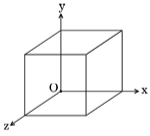
b. A cube of side $20 \ cm$ is kept in a region as shown in the figure. An electric field $\vec{E}$ exists in the region such that the potential at a point is given by $V =10 x +5$, where $V$ is in volt and $x$ is in m .
Image

Find the
$i$. electric field $\vec{E}$, and
$ii$. total electric flux through the cube.
Answer
$i$. Let the charge $q_1$ travels $r_1$ distance.
The work done in bringing the charge $q 1$ in the field is : $-$
$ w _1= F _1 \times r _1$
$= q _1 E \times r _1$
the work done in bringing the second charge
$ w _2= F _2 \times r _2$
$= q _2 E \times r _2$
and the work is also done to overcome the force of the charge on one-another.
$W_3=\frac{1}{4 \pi \epsilon_0} \cdot \frac{q_1 q_2}{r^2}$
So, total work $=q_1 E_1+q_2 E_2+\frac{1}{4 \pi \epsilon_0} \cdot \frac{q_1 q_2}{r^2}$
$ii$. a. Given that, $V=10 x+5$
We know
$E =-\frac{ dv }{ dx }$
$v=10 x+5$
$\frac{d v}{d x}=\frac{d}{d x}(10 x+5)$
$=10 \frac{d}{d x} x+0$
$=10$
electric field is given by $E = -10 N/C$
Since electric field is constant in negative $x-$ direction
as the flux enter in the cube will be same as flux come out through the cube so flux
$\phi_{\text {in }}=\phi_{\text {out }}$ hence,
Net flux from the cube $= 0, $ so total electric flux is given by:
$\phi_{\text {net }}=0$
View full question & answer
Question 65 Marks
What is interference of light? Write two essential conditions for sustained interference pattern to be produced on the screen. Draw a graph showing the variation of intensity versus the position on the screen in Young's experiment when (a) both the slits are opened and (b) one of the slit is closed. What is the effect on the interference pattern in Young's double-slit experiment when: 32. 33.
i. Screen is moved closer to the plane of slits?
ii. Separation between two slits is increased. Explain.
Answer
Interference of light: Phenomenon of redistribution of light energy in a medium on account of superposition of light waves from two coherent sources is called interference of light.
Conditions for sustained interference: The two essential conditions of sustained interference are as follows:
i. The two sources of light should emit light continuously.
ii. The light waves should be of same wavelength (Monochromatic).
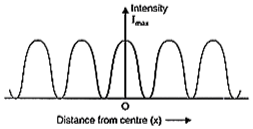
(a) When both the slits are open, we get an interference pattern on the screen. Then the following intensity distribution curve is obtained.
Image
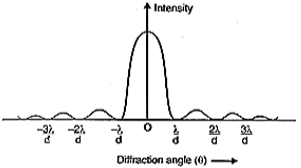
(b) When one of the slits is closed, diffraction pattern is obtained on the screen. The following intensity curve is obtained. 
Image

Also we know that, Fringe width, $\beta=\frac{D \lambda}{d}$, therefore i. The distance D decreases, the fringe width $\beta$ also decreases if screen is moved closer to the plane of the slits.
ii. Fringe width $\beta$ decreases if separation d between two slits is increased.
View full question & answer