What is it that forms the basis of $DNA$ fingerprinting ?
AIPMT 2012, Medium
Download our app for free and get started
d
(d) : $DNA$ fingerprinting is a technique of determining nucleotide sequences of certain areas of $DNA$ which are unique to each individual. The difference of about $0.1\%$ or $3 × 10^6$ base pairs (out of $3 × 10^9\ bp$) provides individuality to each human being. Human genome possesses numerous small noncoding but inheritable sequences of bases which are repeated many times. These sequences occur near telomere, centromeres, $Y$ chromosome and heterochromatic area. The area with same sequence of bases repeated several times is called repetitive $DNA$. It is separated as satellite from the bulk $DNA$ during density gradient centrifugation and hence called satellite $DNA$ where, repetition of bases is in tandem. Satellite $DNAs$ show polymorphism (the occurrence of mutations in a population at high frequency), which is the basis of genetic mapping of human genome as well as $DNA$ fingerprinting. While mutations in genes produce alleles with different expressions, mutations in noncoding repetitive $DNA$ have no immediate impact. These mutations which have piled up with time form the basis of polymorphism.
(d) : $DNA$ fingerprinting is a technique of determining nucleotide sequences of certain areas of $DNA$ which are unique to each individual. The difference of about $0.1\%$ or $3 × 10^6$ base pairs (out of $3 × 10^9\ bp$) provides individuality to each human being. Human genome possesses numerous small noncoding but inheritable sequences of bases which are repeated many times. These sequences occur near telomere, centromeres, $Y$ chromosome and heterochromatic area. The area with same sequence of bases repeated several times is called repetitive $DNA$. It is separated as satellite from the bulk $DNA$ during density gradient centrifugation and hence called satellite $DNA$ where, repetition of bases is in tandem. Satellite $DNAs$ show polymorphism (the occurrence of mutations in a population at high frequency), which is the basis of genetic mapping of human genome as well as $DNA$ fingerprinting. While mutations in genes produce alleles with different expressions, mutations in noncoding repetitive $DNA$ have no immediate impact. These mutations which have piled up with time form the basis of polymorphism.

Download our appand get started for free
Experience the future of education. Simply download our apps or reach out to us for more information. Let's shape the future of learning together!No signup needed.*
Similar Questions
- 1$A$ : Unknown $DNA$ after hybridization with $VNTR$ probe, the autoradiogram gives many bands of differing sizes in $DNA$ profiling.View Solution
$R$ : These bands represents $DNA$ fingerprint of organism - 2View SolutionThe drug streptomycin inhibits the process of
- 3$NHC$ structural proteins areView Solution
- 4View SolutionWhich is stop codon?
- 5Read the following statements:View Solution
$A.$ Variation at genetic level arises due to mutations.
$B.$ Technique of $DNA$ fingerprinting was initially developed by Alec Jeffreys - 6View SolutionWhat are the structures called that give an appearance as ‘beadsonstring’ in the chromosomes when viewed under electron microscope?
- 7If there are $999$ bases in an $RNA$ that code for a protein with $333$ amino acids, and the base at position $901$ is deleted such that the length of the $RNA$ becomes $998$ bases, how many codons will be altered?View Solution
- 8View SolutionWhich of the following is not region of transcription unit?
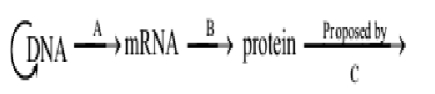
- 9The diagram shows an important concept in the genetic implication of $DNA$. Fill in the blanks $A$ to $C$.View Solution
- 10View SolutionA nucleoside differs from a nucleotide in not having