What is lateral inversion? Explain by giving a suitable example.
Download our app for free and get startedPlay store
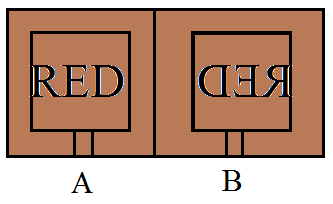
When an object is placed in front of a plane mirror, then the right side of the object appears to become the left side of the image; and the left side of the object appears to become right side of the image. This change of the sides of an object and its mirror image is called lateral inversion.
Example: When we hold a placard having the word RED written on it, as given in fig A, in the front of a plane mirror, the image of the word RED will be as given in fig B.
art

Download our app
and get started for free

Experience the future of education. Simply download our apps or reach out to us for more information. Let's shape the future of learning together!No signup needed.*

Similar Questions

  • 1
    When an object is placed 10cm in front of lens A, the image is real, inverted, magnified and formed at a great distance. When the same object is placed 10cm in front of lens B, the image formed is real, inverted and same size as the object:
    1. What is the focal length of lens A?
    2. What is the focal length of lens B?
    3. What is the nature of lens A?
    4. What is the nature of lens B?
    View Solution
  • 2
    A concave mirror produces three times enlarged virtual image of an object placed at 10cm in front of it. Calculate the radius of curvature of the mirror.
    View Solution
  • 3
    Determine how far an object must be placed in front of a converging lens of focal length 10cm in order to produce an erect (upright) image of linear magnification 4.
    View Solution
  • 4
    Sudha finds out that the sharp image of the window pane of her science laboratory is formed at a distance of 15cm from the lens. She now tries to focus the building visible to her outside the window instead of the window pane without disturbing the lens. In which direction will she move the screen to obtain a sharp image of the building? What is the approximate focal length of this lens?
    View Solution
  • 5
    When an object is placed at a distance of 50cm from a concave spherical mirror, the magnification produced is,$-\frac{1}{2}$ Where should the object be placed to get a magnification of, $-\frac{1}{5}?$
    View Solution
  • 6
    Two lenses have power of
    1. +2D
    2. –4D
    What is the nature and focal length of each lens?
    View Solution
  • 7
    Explain why, a stick half immersed in water appears to be bent at the surface. Draw a labelled diagram to illustrate your answer.
    View Solution
  • 8
    At what distance should an object be placed from a convex lens of focal length 18 cm to obtain an image at 24 cm from it on the other side. What will be the magnification produced in this case?
    View Solution
  • 9
    The optical prescription for a pair of spectacles is:
    Right eye: 3.50D, Left eye: 4.00D
    1. Are these lenses thinner at the middle or at the edges?
    2. Which lens has a greater focal length?
    3. Which is the weaker eye?
    View Solution
  • 10
    Make labelled ray diagrams to illustrate the formation of:
    1. A real image by a converging mirror.
    2. A virtual image by a converging mirror.
    Mark clearly the pole, focus, centre of curvature and position of object in each case.
    View Solution