Question
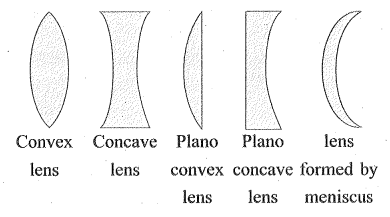
What is lens? State their types and draw their diagram.

Answer

→A structure formed by two refracting surfaces and capable of forming an image is called a lens.
→Types of lenses :
(1) Convex lens
(2) Concave lens
(3) Plano convex lens
(4) Plano concave lens
(5) lens formed by meniscus
Image

Need a full question paper?

Generate a complete, print-ready paper with questions like this in minutes — across 16+ boards, with answer keys.
Start Generating Free

Similar questions

Find the wavelength of the electron orbiting in the first excited state in hydrogen atom.
Write down the difference between a half wave rectifier and a full wave rectifier.
$a$. State Ampere's circuital law connecting the line integral of $B$ over a closed path to the net current crossing the area bounded by the path.
$b$. Use Ampere's law to derive the formula for the magnetic field due to an infinitely long straight current carrying wire.
$c$. Explain carefully why the derivation as in $(b)$ is not valid for magnetic field in a plane normal to a currentcarrying straight wire of finite length and passing through the midpoint of the axis.
Calculate the current drawn from the battery in the given network.
A simple microscope using a single lens often shows coloured image of a white source. Why?
Can you hear your own words if you are standing in a perfect vacuum? Can you hear your friend in the same conditions?
If current flowing in a circular coil is doubled and radius is halved, then what would be the change in the produced magnetic field at the center of the coil?
A parallel plate capacitor with air between the plates has a capacitance of 8 pF. The separation between the plates is now reduced by half and the space between them is filled with a medium of dielectric constant 5. Calculate the value
of capacitance of the capacitor in the second case.
A convex lens of refractive index 1.5 has a focal length of 18cm in air. Calculate the change in its focal length when it is immersed in water of refractive index $\frac{4}{3}$
Answer the following questions:
  1. Draw a graph showing variation of photocurrent with anode potential for a particular intensity of incident radiation. Mark saturation current and stopping potential.
  2. By how much would be stopping potential for a given photosensitive surface go up if the frequency of the incident radiations were to be increased from $4 \times 10^{15} \mathrm{~Hz}$ to $8 \times 10^{15} \mathrm{~Hz} ?$