Question
What is ligand? Explain classification of ligand.

Answer

$\rightarrow$ "Ligands are atom or ions which donates electron pairs to the central metal ion."
$(OR)$
$\rightarrow$ "The ions or molecules bound to the central atom/ion in the coordination entity are called ligands."
$\rightarrow$ These may be simple ions such as $Cl,$ small molecules such as $H_2O$ or $NH_3,$ larger molecules such as $H_2NCH_2CH_2NH_2 \ or \ N(CH_2CH_2NH_2)_3$ or even macromolecules, such as proteins.
Classification of Ligands:
$(1)$ Unidentate ligands:
$\rightarrow$ "When a ligand is bound to a metal ion through a single donor atom, the ligand is said to be unidentate."
Example :
$(a)$ Neutral: $H _2 \ddot{ O }$, : $NH _3,: CO ,: NO , CH _3 \ddot{N}H_2, C _5 H _5\ddot{N} \ (py)$
$(b)$ Negative ion: ${ }^{-} OH , F ^{-}, Cl ^{-}, Br ^{-}, I^{-} ,{ }^{-} CN , {}^{-}NH_2,$
$NO _3^{-}, NO _2^{-}, NCH _3 COO ^{-}\left( AcO ^{-}\right), O ^{2-}, S ^2, N^{3-}$
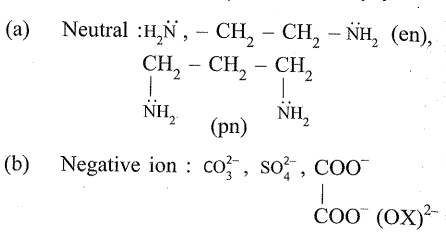
$(2)$ Didentate ligands:
$\rightarrow$ "When a ligand is bound to a metal ion through a two donor atom, the ligand is said to be didentate ".
Image
$(3)$ Tridentate ligands:
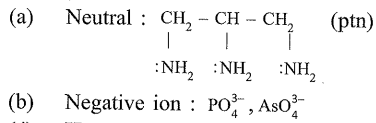
$\rightarrow$ "When a ligand is bound to a metal ion through a three donor atom, the ligand is said to be Tridentate,"
Example:
Image
$(4)$ Hexadentate ligands:
$\rightarrow$ When a ligand is bound to a metal ion through a six donor atom, the ligand is said to be hexadendate
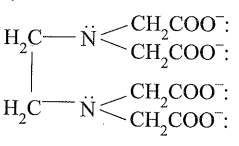
Example: Ethylenediaminetetraacetate ion $\left( EDTA ^{4-}\right)$
Image

Need a full question paper?

Generate a complete, print-ready paper with questions like this in minutes — across 16+ boards, with answer keys.
Start Generating Free

Similar questions

Write down reaction of halogens with metals. ### Give Fittig, Wurtz - Fittig and Grignard reaction of haloarene.
Discuss the nature of bonding in $[Co(NH_3)_6]^{3+}$ coordination entities on the basis of valence bond theory
Explain the addition of HX and halogens to alkenes.
Explain the following:
(i) Electrophilic chlorination (substitution) of toluene.
(ii) Free radical halogenation of alkanes.
$MnO$ is basic whereas $Mn_2O_7$ is acidic in nature. Give reason.
Write detailed note on the addition reaction of aldehydes and ketones with ammonia derivatives.
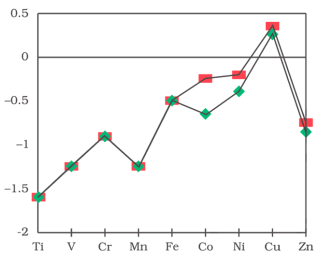
The unique behaviour of $Cu ,$ having a positive $E ^{\circ}$ accounts for its inability to liberate $H _2$ from acids. Only oxidising acids (nitric and hot concentrated sulphuric) react with $Cu ,$ the acids being reduced. The stability of the half$-$filled  sub$-$shell in $Mn ^{2+}$ and the completely filled $d ^{10}$ configuration in $Zn ^{2+}$ are related to their $E ^{\circ}$ values, whereas $E ^{\circ}$ for $Ni$ is related to the highest negative $\Delta_{h y d} H ^{\circ}$. An examination of the $E_{\left(M^{3+} / M^{2+}\right)}^o$ values the low value for $Sc$ reflects the stability of $Sc ^{3+}$ which has a noble gas configuration. The comparatively high value for $Mn$ shows that $Mn ^{2+}\left( d ^5\right)$ is particularly stable, whereas a comparatively low value for $Fe$ shows the extra stability of $Fe ^{3+}\left( d ^5\right)$. The comparatively low value for $V$ is related to the stability of $V ^{2+} ($half$-$filled $t _{2 g}$ level$).$
Image
$i.$ Why $Zn$ has high value for $M^{3+}/M^{2+}$ Standard Electrode Potentials?
$ii.$ Transition metals, despite high $E^\circ$ oxidation, are poor reducing agents. Justify.
$iii.$ Why is $Cr^{2+}$ reducing and $Mn^{3+}$ oxidising when both $Cr$ and $Mn$ have $d^4$ configuration?
$OR$
$iii.$ Why $Cu^{2+}$ is more stable than $Cu^+$ ?
Explain Daniell cell with diagram and explain different condition when external potential is applied in opposite direction.
Vapour pressure of a liquid or a solution is the pressure exerted by the vapour in equilibrium with the liquid or solution at a particular temperature. It depends upon the nature of the liquid and temperature. The non-volatile solute in solution reduces the escaping tendency of the solvent molecules in the vapour phase because some of the solute particles occupy the positions of the solvent molecules on the liquid surface. The relative lowering of the vapour pressure of a solution containing a non$-$volatile solute is equal to the mole fraction of the solute in the solution. This is also known as Raoult's law. However, for solutions of volatile solutes, the vapour pressure of a component in a solution at a given temperature is equal to the mole fraction of that component in the solution multiplied by the vapour pressure of that pure component. The solutions in which each component obeys Raoult's law is called an ideal solution. For ideal solutions $\Delta H_{\text {mixing }}$ and $\Delta V_{\text {mixing }}$ are also zero. Practically no solution is ideal. A non$-$ideal solution is that solution in which solute and solvent molecules interact with one another with a different force than the forces of interaction between the molecules of the pure components. There are two types of non-ideal solutions, showing positive deviations and negative deviations from ideal behaviour. If for the two components$ A$ and $B$ , the forces of interaction between $A$ and $B$ molecules are less than the $A-A$ and $B-B$ interactions, the non-ideal solutions have positive deviations. On the other hand, if the forces of interaction between $A$ and $B$ molecules are more than the $A-A$ and $B-B$ interactions, the non-ideal solutions have negative deviations.
$i.$ What is the mole fraction of A in solution obeying result's low if the vapour pressure of a pure liquid A is $40 \ mm$ of $Hg$ at $300 \ K$ . The vapour pressure of this liquid in solution with liquid $B$ is $32$ mm of $Hg ?$
$ii.$ Vapour pressure of a solution of heptane $\&$ octane is given by the equation: $(1) P ( sol ).( mm Hg )=35+65 x$, where x is the mole fraction of heptane. Calculate the vapour pressure of pure octane.
$iii.$ What is the value of $\Delta V _{\text {mixing }}$ and $\Delta H _{\text {mixing }}$ for non$-$ideal solution showing negative deviation?
OR
$iii.$ Acetic acid $+$ pyridine, the mixture is an example of which type of solution?
Give reason :
$(i)$ The boiling point of ethanol is higher than that of hydroxymethane.
$(ii)$ Phenol is a stronger acid than alcohol.
$(iii)$ Ethanol easily dissolve in water.